AfriSIG 2026
The 14th annual African School on Internet Governance (AfriSIG2026) will take place in Accra, immediately prior to the 15th edition of the Africa Internet Governance Forum (AfIGF). As it has been in previous years, AfriSIG 2026 will consist of an in-person five-day multistakeholder learning and leadership development event.
AfriSIG uses interactive peer-learning methodologies that assume that all participants have valuable experience and knowledge to share. Core faculty are invited to join all five days of the event, giving participants the opportunity to continue discussions even after the conclusion of sessions, facilitating debate and learning. The substantive sessions will be accompanied by a practicum which runs throughout the course of the School.
AfriSIG aims to create a space of trust and respect, allowing participants, faculty and resource persons to engage in debate on sensitive issues and explore differences in views, without fear of judgment. It provides participants with the opportunity to share their views, improve their public speaking skills, do hands-on policy analysis, and participate in multistakeholder negotiation and consensus building.
- Welcome to AfriSIG'26
- ⏳ UTC Time Converter
- 🛫 Logistics Advisory
- 📖 Reading List
- An Analysis of National AI Strategies in Africa
- Another World Is Possible | Naomi Klein & Arundhati Roy w/ Karen Hao
- Building the Architecture for Global Digital Governance
- Can Africa supply its own digital infrastructure?
- How the internet really works
- Rewriting the rules of an era of JUST AI
- The Implementation Gap: Why Africa’s Digital Strategies Rarely Become Digital Reality
- Keep the Future Human
- The Missing Link / Maitland Report
- Preliminary Report of the Independent International Scientific Panel on AI
- Nigeria AfCFTA Implementation Report
- The Road Not Taken?
- Understanding the AI Governance Dialogue and what it means for Africans
- UNESCO Digital Platform Governance Toolkit
- What’s the Whole Fuss About AI?
- Why we need women’s scepticism about AI
- ROAM-X National Assessment Reports
- State of Internet Freedom In Africa 2026
- 10 African AI Startups You Should Know About
- Thirty years of Original Sin of Digital and AI Governance
- 🔦 School Agenda at a glance
- 🎁 Detailed Agenda & Key Readings
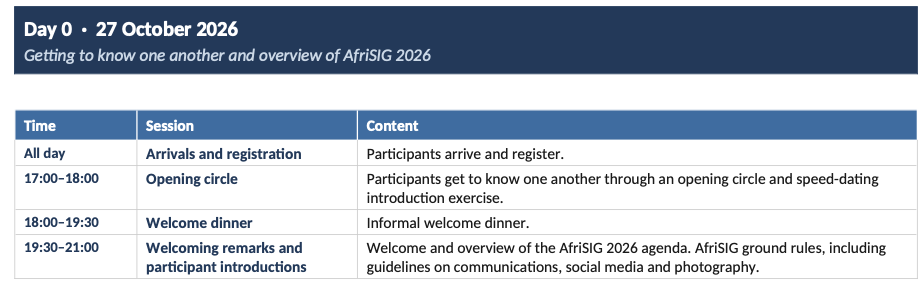
- Day 0 | 27 Oct — 17:00 - 21:00
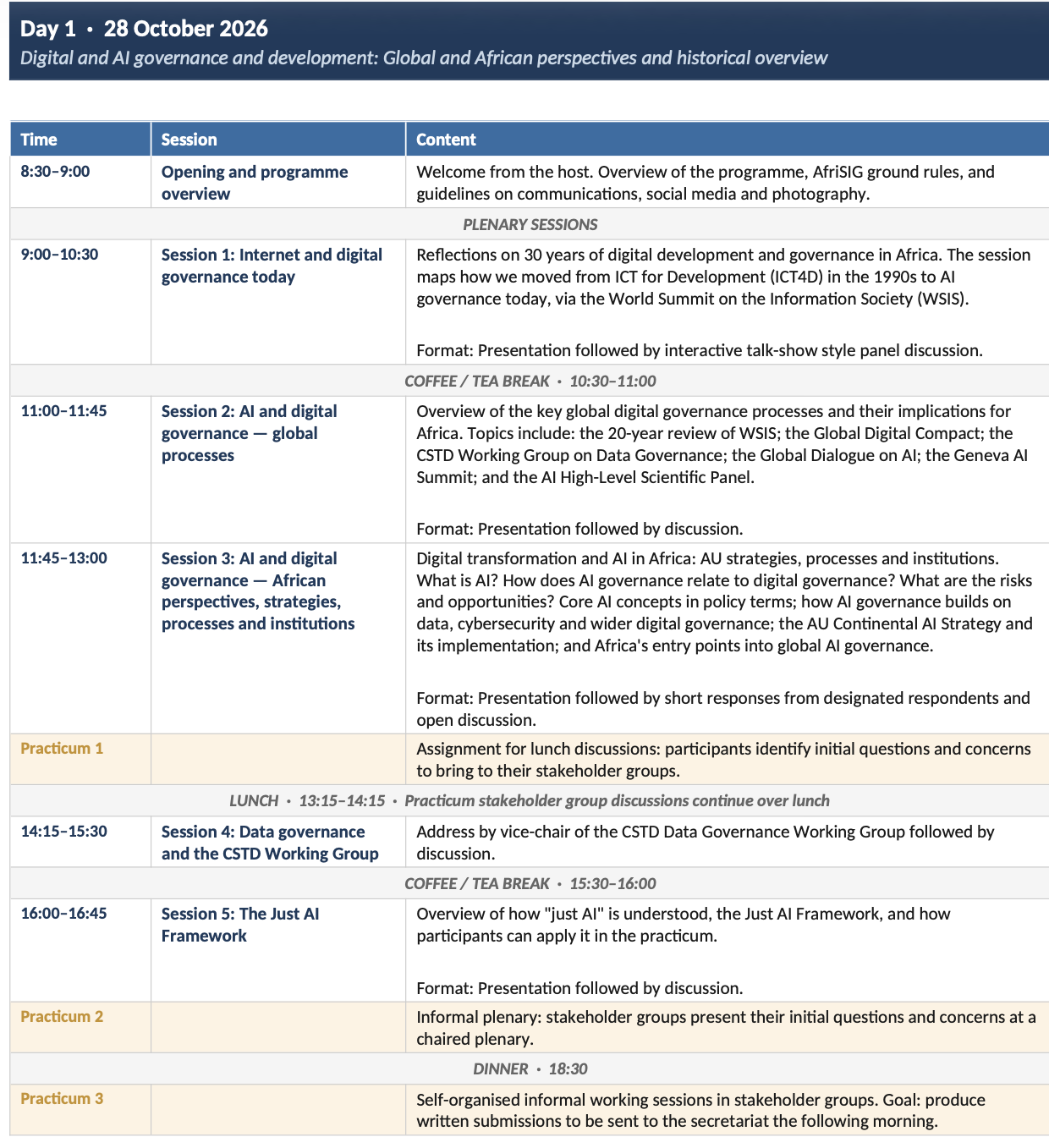
- Day 1 | 28 Oct — 08:30 - 20:30
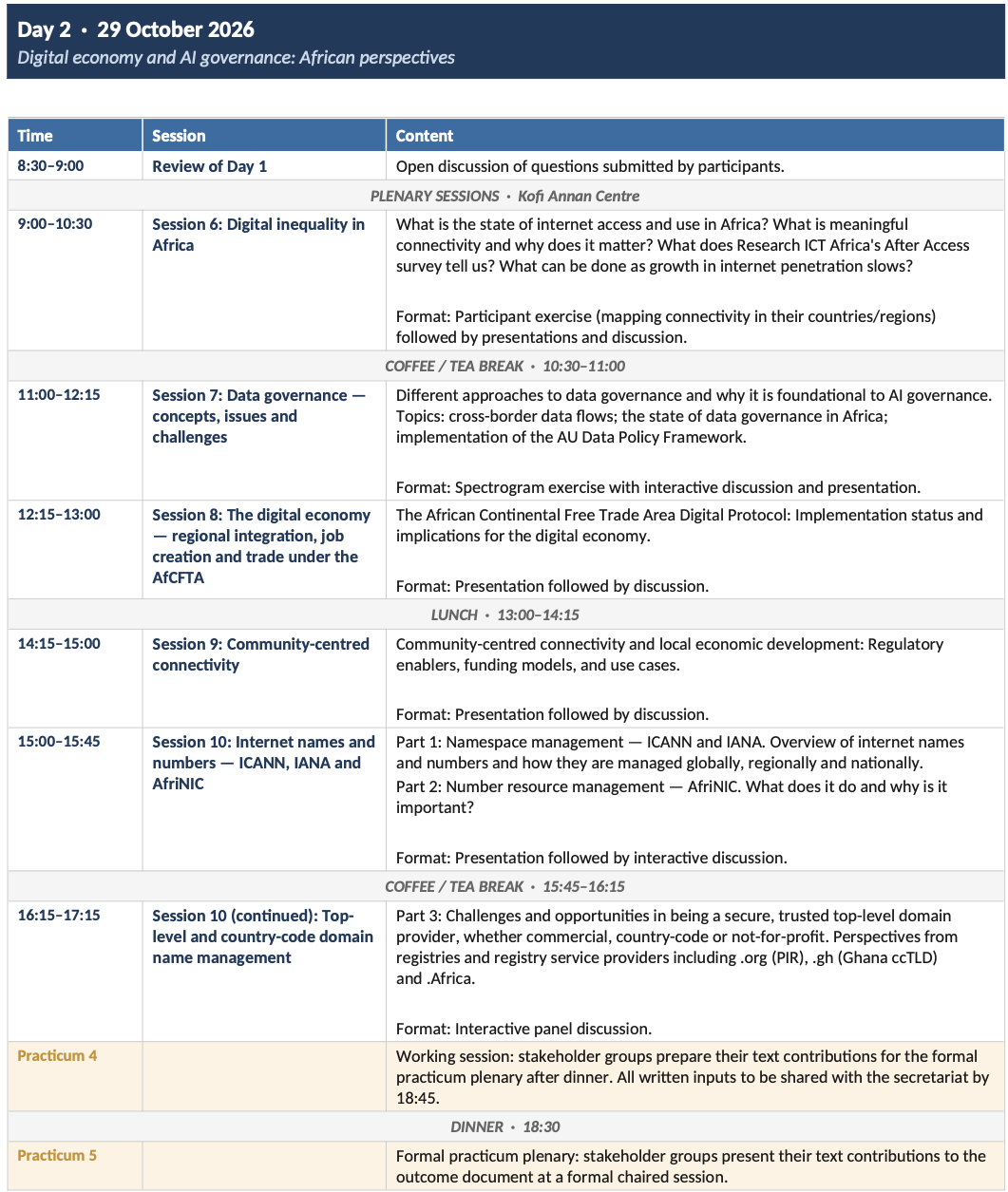
- Day 2 | 29 Oct — 8:30 - 20:30
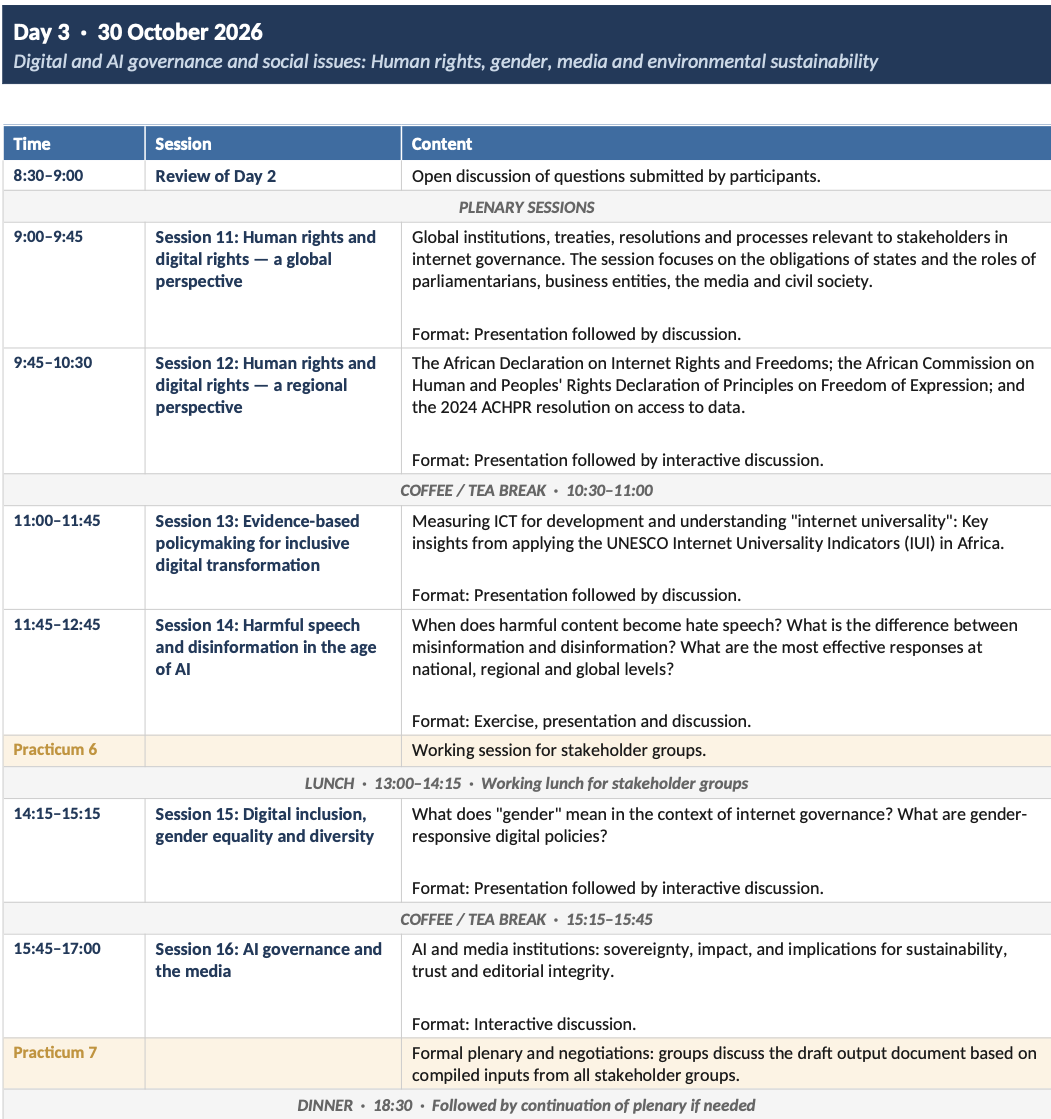
- Day 3 | 30 Oct -- 8:30 - 18:00
- Day 4 | 31 Oct -- 8:30 till late
- Day 5 | 1 Nov
- 📑 Essential Links
- 🔖 Essential Practicum Documents
- ✔️ Fellows' Profiles
- Abdulrahman Adebayo
- Adeboro Pelumi Odunlami
- Afua Akyaa Mensah Amirikah
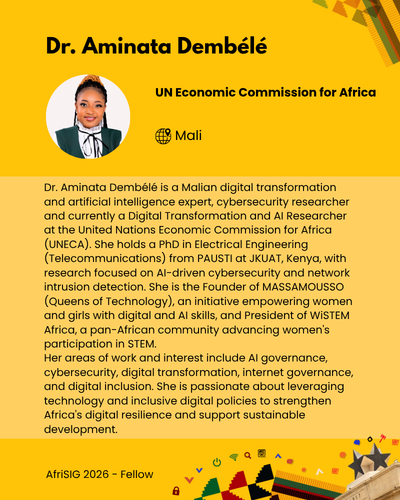
- Dr. Aminata Dembélé
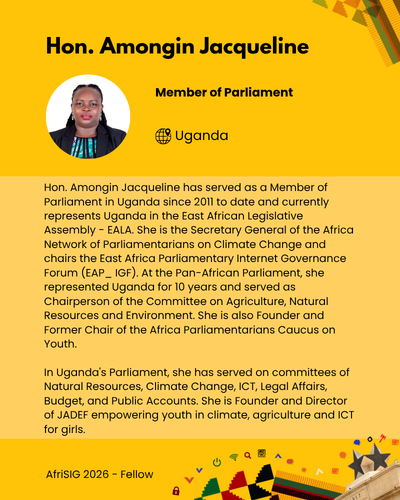
- Hon. Amongin Jacqueline
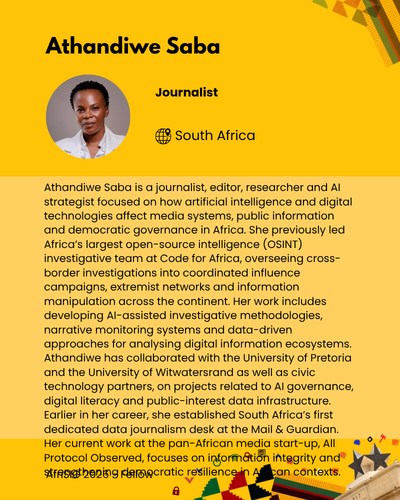
- Athandiwe Saba
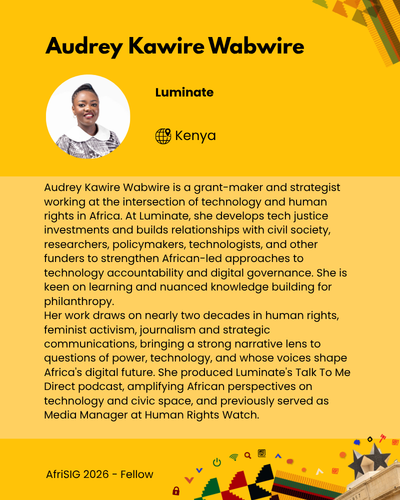
- Audrey Kawire Wabwire
- Barbara Phyllis Barnes
- Bintou Mariam Traoré
- Bonaventure Saturday
- Catherine Kyalo
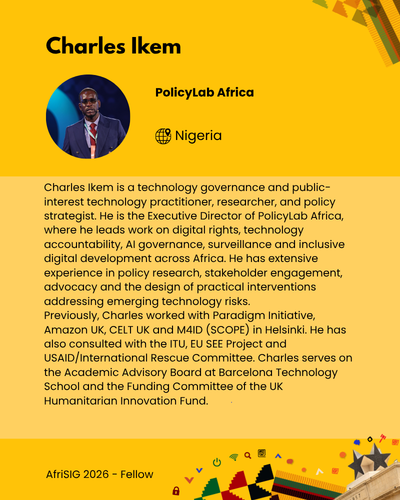
- Charles Ikem
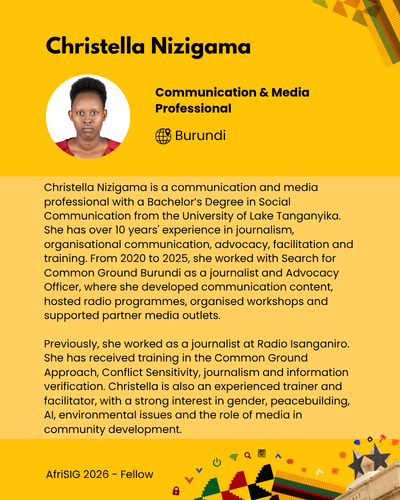
- Christella Nizigama
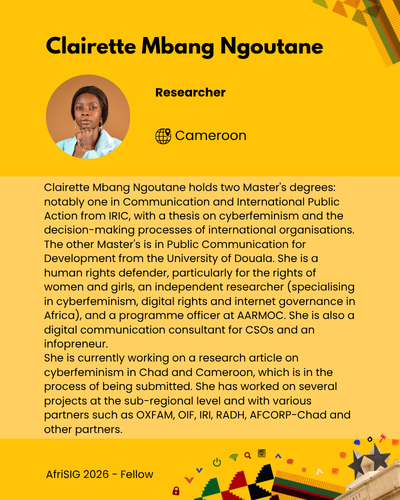
- Clairette M. Ngoutane
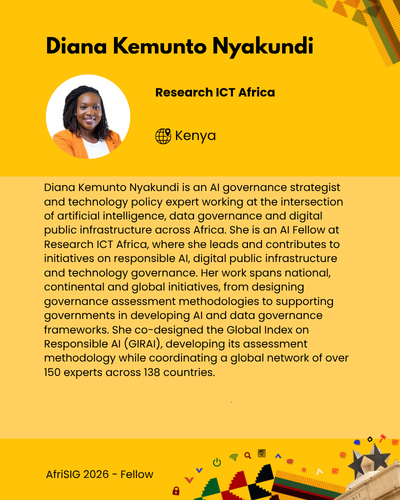
- Diana Kemunto Nyakundi
- Doreen Kapoteza
- Edrine Wanyama
- Folaranmi Umoru
- Fuseini Yakubu
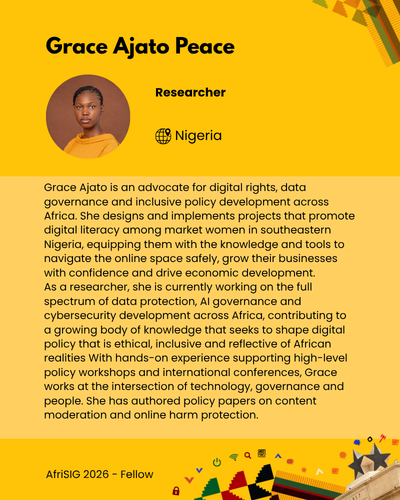
- Grace Ajato Peace
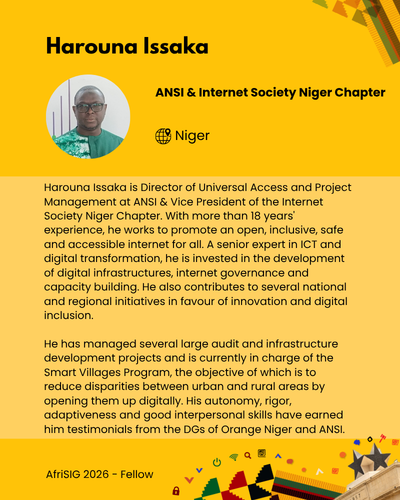
- Harouna Issaka
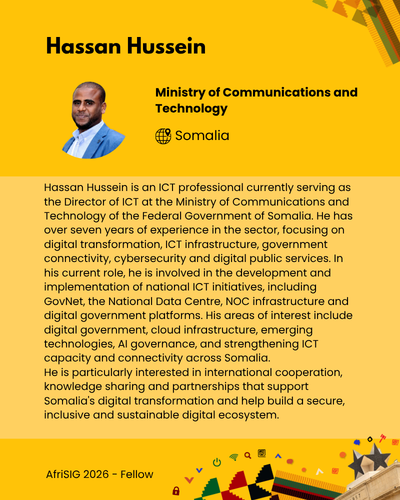
- Hassan Hussein
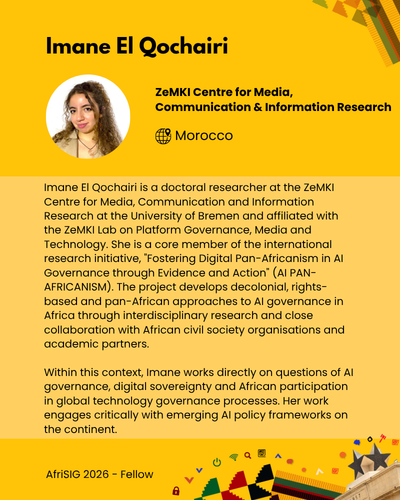
- Imane El Qochairi
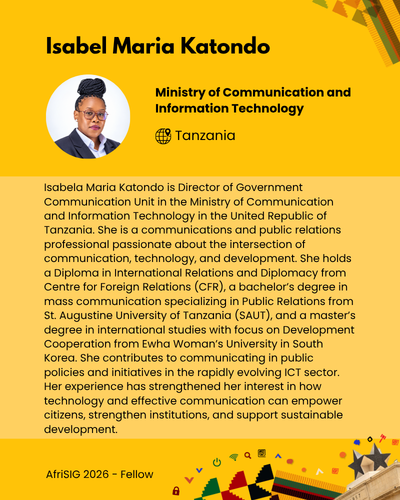
- Isabel Maria Katondo
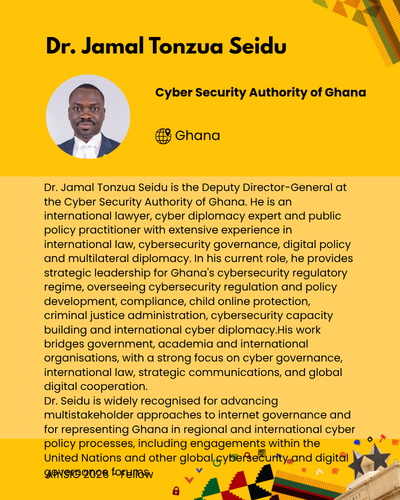
- Dr. Jamal Tonzua Seidu
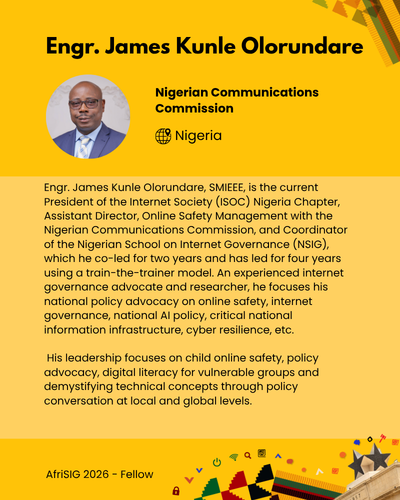
- James Kunle Olorundare
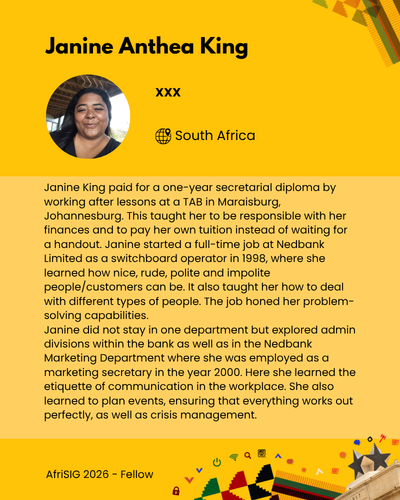
- Janine Anthea King
- Jennifer Abena Dadzie
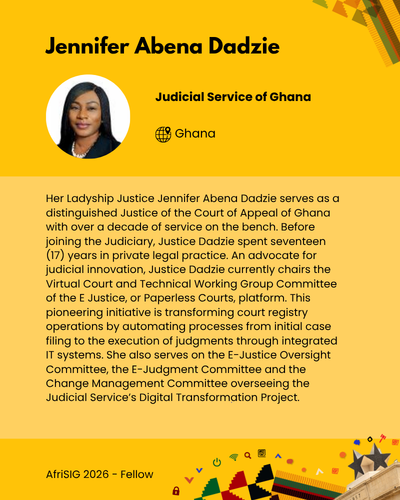
- John Mathuri Kathure
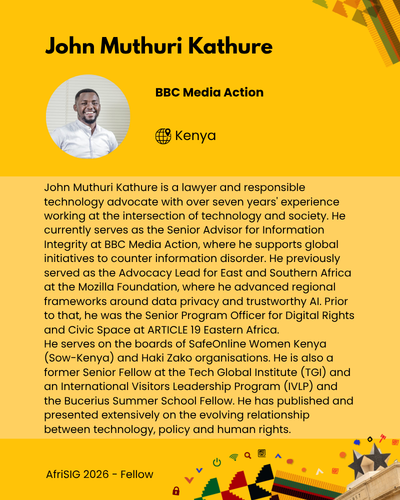
- Kenley Sérgio Cossa
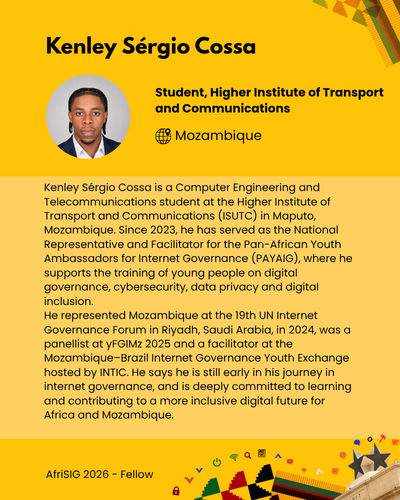
- Khouzeifi Issakha Doud-bane
- Lucy Okonkwo
- Maman Lourwana Issaka
- Melat Haile
- Dr. Mohamed Babah Turay
- Moussa Waly Sene
- Nana Nyama Danso
- Dr. Nazarius Kirama
- Nhlanhla Ngwenya
- Olaitan Olanrewaju
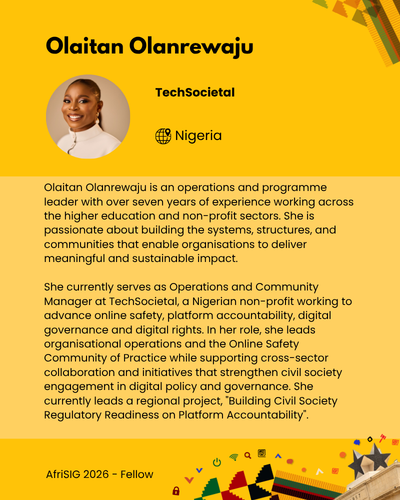
- Ompha Tshamano
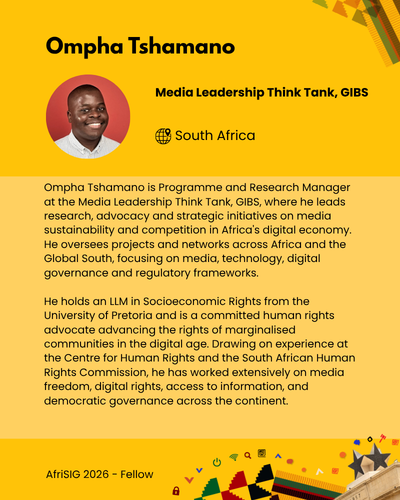
- Patricia Adafienu
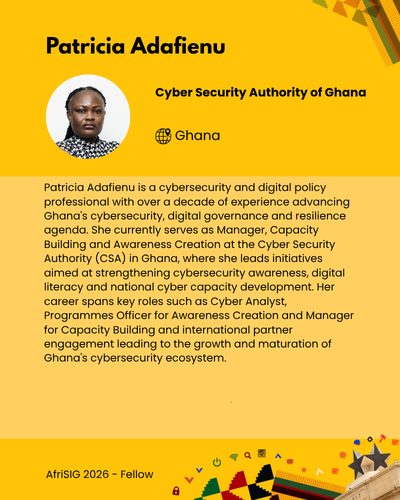
- Ramatu Mohammed Sidi
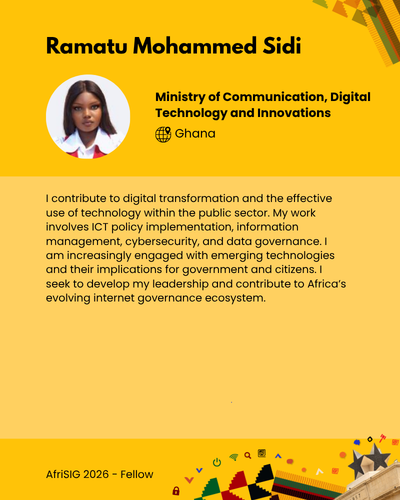
- Rehema Patricks
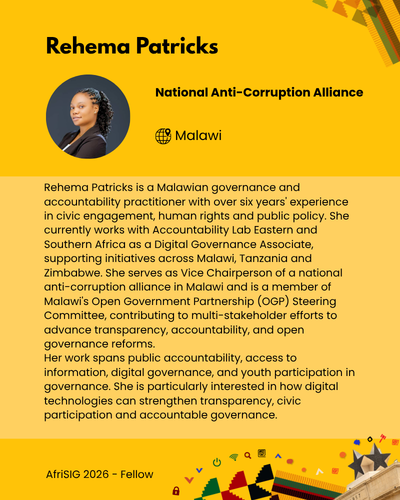
- Samuel Ayode Longe
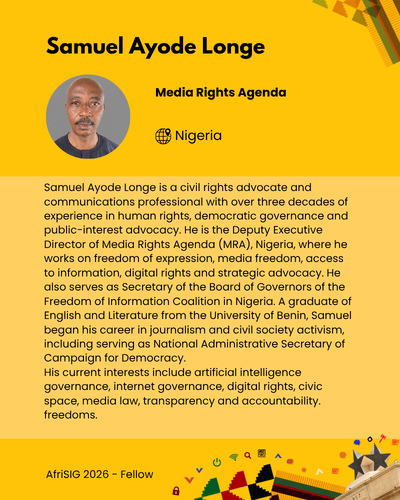
- Sihle Nyathi
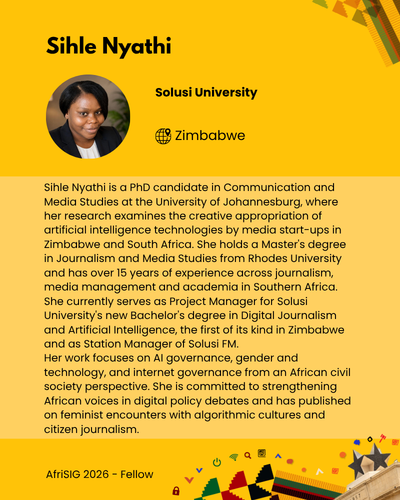
- H.H Siran Mahama
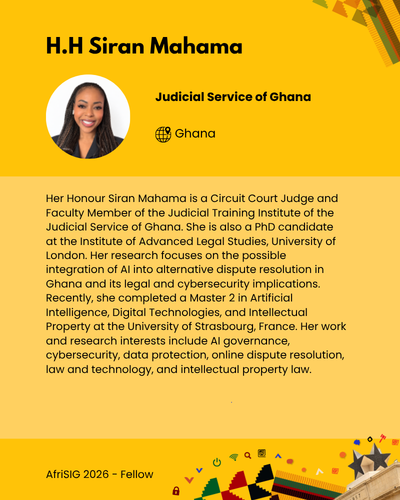
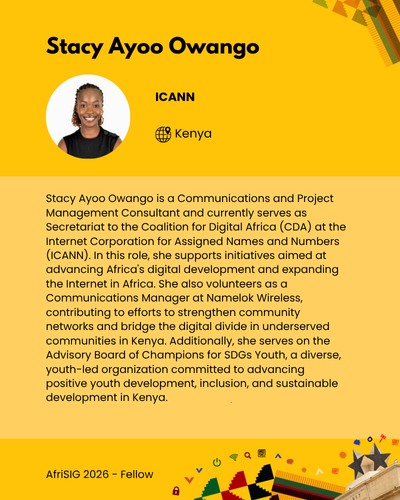
- Stacy Ayoo Owango
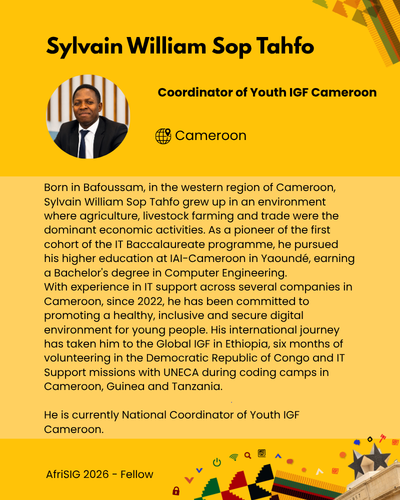
- Sylvain William S. Tahfo
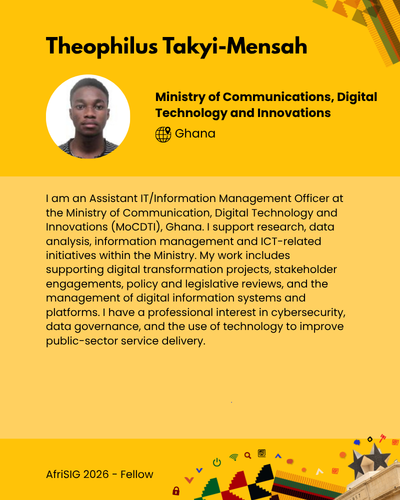
- Theophilus Takyi-Mensah
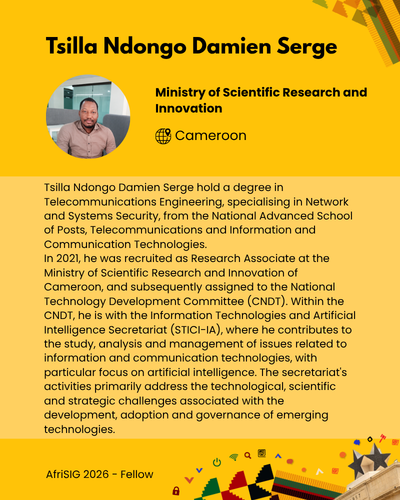
- Tsilla N.D Serge
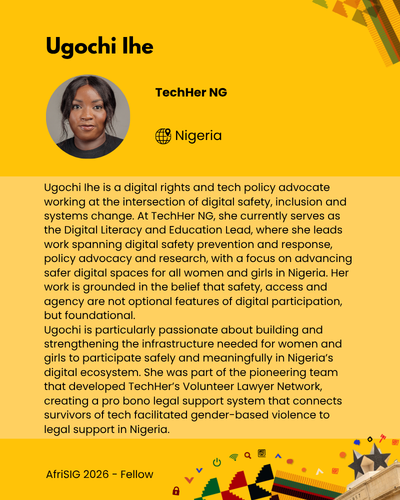
- Ugochi The
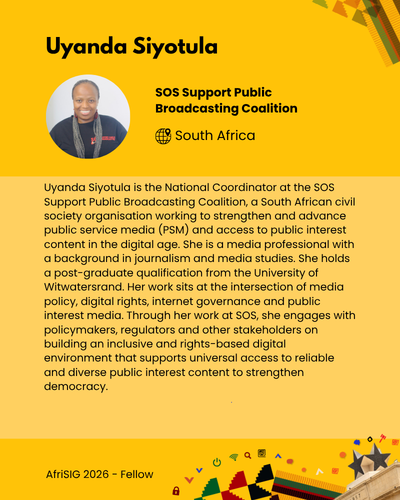
- Uyanda Siyotula
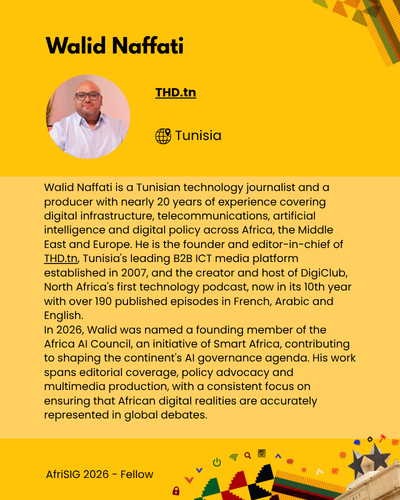
- Walid Naffati
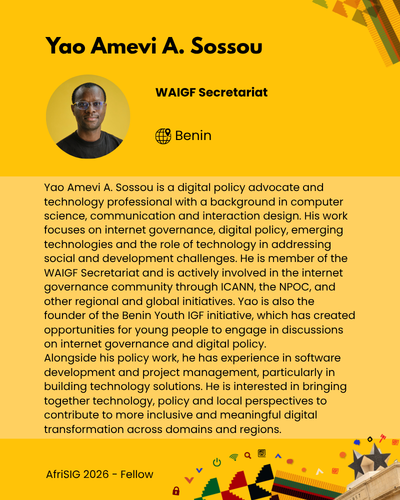
- Yao Amevi A. Sossou
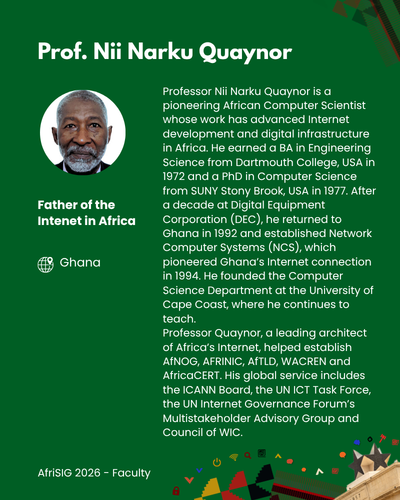
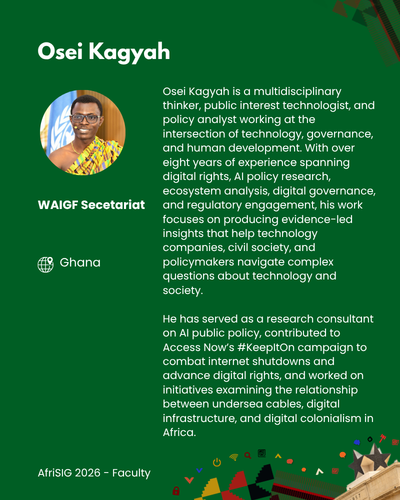
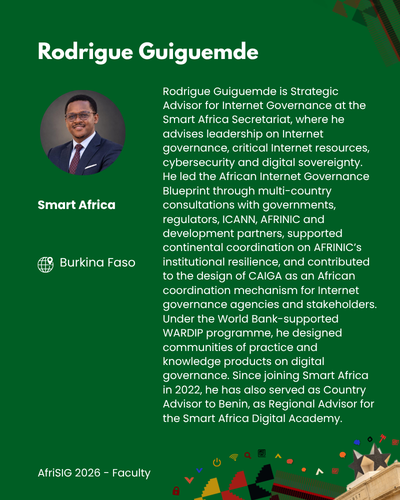
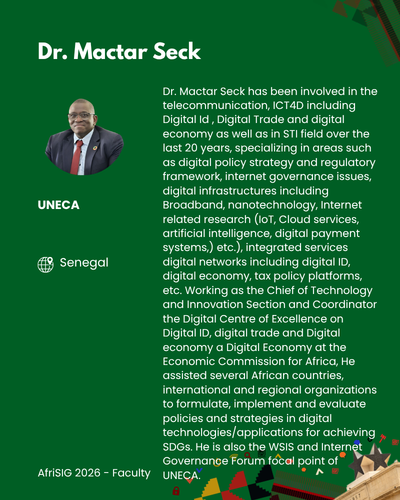
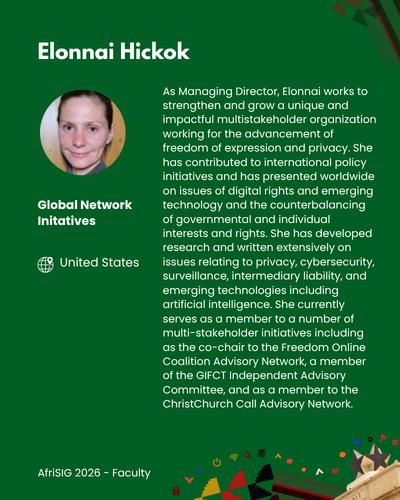
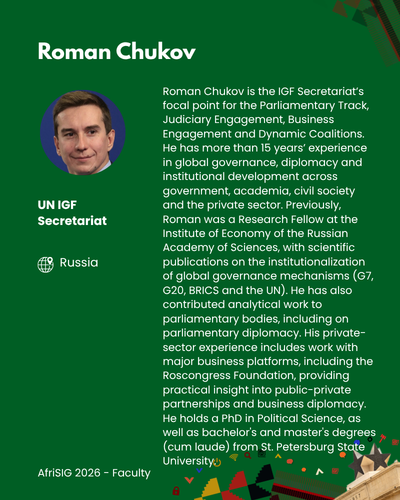
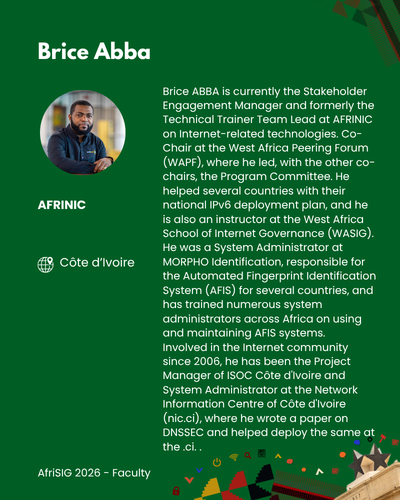
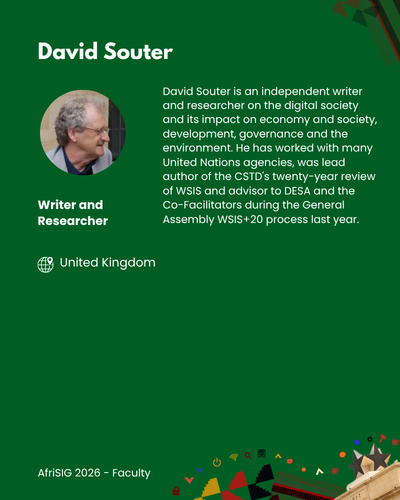
- ✔️ Faculty Profiles
- AfriSIG Ground Rules and APC Principles of Participation
- ↗️ AfriSIG 2026 Website & Sponsors
- 🎶 Music Playlists for the School (Please let us know if you have recommendations!)
Welcome to AfriSIG'26
Karibu. Akwaaba. Bienvenue. Welcome.
Congratulations on making it here. We are very proud to welcome you to the 14th edition of the African School on Internet Governance — AfriSIG 2026, taking place in Accra, Ghana.
You are joining a community of African leaders, thinkers, practitioner, and advocates who believe that Africa's voice in shaping the future of the internet and digital technologies is not optional — it is essential. By being here, you are already part of that commitment.
Background & Context
About AfriSIG
Since its founding in 2013, AfriSIG has brought together participants from across the continent — from government, parliament, civil society, the private sector, academia, the technical community, and the media — to build the knowledge, skills, and networks needed to engage meaningfully in internet governance processes at the national, regional, and global levels.
Over 600 alumni later, AfriSIG's impact can be felt in policy rooms, regulatory bodies, civil society organizations, and international forums across Africa and beyond. This year, you join that growing community.
AfriSIG 2026: AI Governance in the African Context
This edition of AfriSIG arrives at a defining moment. Artificial intelligence is reshaping economies, public services, democratic institutions, and everyday life — and Africa is not a bystander in this transformation. African data, African labour, and African communities are already deeply implicated in the global AI value chain. The question is whether Africa will shape the governance of these technologies, or have that governance shaped for it.
AfriSIG 2026 places AI governance at the centre of its curriculum, alongside the foundational internet governance topics the school has always covered. Through sessions, discussions, and our practicum exercise, you will explore what just, rights-respecting, and development-oriented AI governance looks like from an African perspective — and what it will take to make it a reality.
What to Expect
The five days programme will be intellectually rich, practically grounded, and at times challenging. You will hear from some of Africa's leading voices on internet and AI governance. You will work in stakeholder groups, negotiate positions, and produce a collective outcome document through the AfriSIG practicum. You will have the opportunity to ask difficult questions, share your own experiences, and learn as much from your fellow participants as from the faculty.
AfriSIG is not a passive learning experience. It is a space for engagement, debate, and collaboration. We encourage you to bring your full self — your expertise, your questions, your perspective, and your voice.
This Wiki
This wiki is your companion resource throughout the school and beyond. Here you will find the programme, session materials, reading resources, practical information about your stay in Accra, and more. We encourage you to explore it, return to it during the week, and use it as a reference after AfriSIG 2026 has concluded.
⏳ UTC Time Converter
As AfriSIG 2026 brings together participants from across Africa and beyond, you may come across session times, meeting invitations, and communications that reference UTC (Coordinated Universal Time). This explains what UTC is and how to convert it to your local time.
Understanding & Using UTC Time
What is UTC?
UTC is the global standard used to coordinate time across the world. It does not change with seasons or daylight saving adjustments, which makes it a reliable reference point for international events and communications.
Why does it matter for AfriSIG?
Any online sessions, virtual meetings, or communications scheduled before or after the in-person school in Accra may be shared in UTC to avoid confusion across different time zones. It is important that you know your local time difference from UTC so you do not miss any sessions.
What is Ghana's time zone?
Accra, Ghana operates on GMT (Greenwich Mean Time), which is the same as UTC+0. This means that if you are physically present at AfriSIG in Accra, UTC time and local time are the same — no conversion needed.
How to convert UTC to your local time
| UTC Offset | Countries |
|---|---|
|
UTC +0 |
Ghana, Senegal, Mali, Burkina Faso, Guinea, Guinea-Bissau, Ivory Coast (Côte d'Ivoire), Liberia, Mauritania, Sierra Leone, The Gambia, Togo, São Tomé and Príncipe |
| UTC +1 | Nigeria, Cameroon, Niger, Chad, Benin, Central African Republic, Republic of the Congo, Democratic Republic of the Congo (west), Gabon, Equatorial Guinea, Angola, Namibia, Tunisia, Algeria |
| UTC +2 | South Africa, Zambia, Zimbabwe, Botswana, Lesotho, Eswatini, Malawi, Mozambique, Rwanda, Burundi, Democratic Republic of the Congo (east), Libya, Egypt, Sudan |
|
UTC +3 |
Kenya, Uganda, Tanzania, Ethiopia, Eritrea, Djibouti, Somalia, South Sudan, Comoros, Madagascar |
| UTC +1/2 (seasonal) | Morocco (UTC+1 in winter, UTC+2 in summer) |
Example: If a meeting is scheduled for 14:00 UTC and you are joining from Nairobi, Kenya (UTC +3), the meeting starts at 17:00 your local time.
A note on seasonal changes
Most African countries do not observe daylight saving time, meaning their UTC offset stays the same throughout the year. The main exception is Morocco, which shifts between UTC+1 and UTC+2 seasonally. If you are based in Morocco, please verify your current offset at the time of any scheduled online session.
Quick Tip
If you are ever unsure of your exact UTC offset at a given moment, the following free tools can help:
- timeanddate.com/worldclock — enter your city to find your current UTC offset
- time.is/UTC — shows the current UTC time alongside your local time in real time
🛫 Logistics Advisory


LOGISTICS ADVISORY
The 14th African School on Internet Governance (AfriSIG)
Accra, Ghana (27 Oct - 1 Nov 2026)
1. Travel documents checklist 2
2. WhatsApp group while travelling 2
4. Yellow fever & other vaccination certificates 2
7. Ground transportation - from home to airport 4
8. Airport transfers in Accra 4
9. Accommodation, venue & pick-up/drop-off schedules 5
13. Dietary and Special Requirements 6
14. Money, currency and payment methods 6
21. Ethics of care and solidarity 7
22. Care and well-being team 7
1. Travel documents checklist
When travelling to Ghana please remember to bring the following documents:
-
Your passport or travel document, valid for at least six months from the day you enter the country (with at least two full blank pages)
-
Valid visa or eTAs for Ghana (Only for nationalities that require e-visa or eTAs)
-
Valid transit visa (Only if your connecting country requires you to have a transit visa)
-
Yellow fever & other vaccination certificates
-
Accommodation confirmation
-
A copy of your round trip flight ticket
-
Invitation or supporting letter
-
A copy of your travel insurance
-
Printouts of the AfriSIG programme and practicum background document if you would like to have a hard copy
-
This logistics advisory
Please double-check transit and arrival requirements before you leave home. Printing the relevant documents is the best way to go, as well as keeping digital copies downloaded and available offline on your phone to have them ready for transit and/or arrival procedures.
2. WhatsApp group while travelling
Please join this WhatsApp Group before your travel to be in contact while travelling and for remote support on the go. All participants will be automatically added to this WhatsApp group who had provided their WhatsApp number/username via the logistics registration survey. You can exchange regular updates on your route, inform us about your travel status, arrival in Ghana, delays, and any issues related to immigration that you may have while travelling. If you join the group, we suggest you send a message before embarking, during transit, before border crossing, and upon landing.
3. Visa requirements
Please check Ghana’s visa requirements for your nationality, including visa-exempt status, referral visas, and eligibility for visa on arrival or an e-visa. If you have a transit stop, please also check whether you require a transit visa.
Ghana announced a visa-free entry policy for African passport holders in May 2026. However, travellers from certain countries are still required to obtain an electronic travel authorisation (eTA) before arrival.
If you are a citizen of any of the following countries, please apply for an eTA: Burundi, Cameroon, Ethiopia, Kenya, Malawi, Morocco, Mozambique, Somalia, South Africa, Tanzania, Tunisia, Uganda, Zimbabwe. Please apply from this official link: Ghana e-Visa Portal.
If you are a citizen of any of the following countries, you are eligible for visa-free entry: Nigeria, Côte d’Ivoire (Ivory Coast), Mali, Senegal, Niger, and Sierra Leone.
If you are travelling from Asia, the Americas, or Europe, you may need to apply for e-visa. Please check the details here: Ghana Immigration Service – Visa Information. Please apply from this official link: Ghana e-Visa Portal. If you need an invitation letter to apply for a visa, please let us know.
Check whether you need an eVisa or eTA here: https://evisa.immigration.gov.gh/#visa-eligibility.
4. Yellow fever & other vaccination certificates
Travellers arriving from countries classified as high-risk for yellow fever are required to present a Yellow Fever Vaccination Certificate. Regardless of whether you are travelling from a high-risk country or not, we recommend bringing your yellow fever vaccination certificate with you, just to be safe and to avoid any potential issues during immigration or entry. Therefore, it is important to
-
keep vaccination and other relevant health documentation
-
check health recommendations for Ghana before departure
-
ensure any regular medication is packed and appropriately documented
Please note that health regulations can change, travellers should verify the latest requirements before departure.
5. Health and safety
Malaria is present in Ghana and can become severe quickly, even if you have taken antimalarial medication. All participants are advised to take precautions before and during their stay.
Before travelling to Ghana
- Consult a healthcare professional or travel clinic well in advance, before departure, to discuss malaria prevention and whether antimalarial medication (prophylaxis) is appropriate for you
- If prescribed, obtain your medication before travelling and follow your healthcare professional’s instructions on when to start taking it, how often to take it, and how long to continue after leaving Ghana
- Pack enough medication for the entire trip, including any required doses after returning home
- Consider carrying insect repellent and lightweight, long-sleeved clothing
During your stay in Accra
- Use mosquito repellent containing DEET or picaridin, following the product instructions
- Wear long sleeves and long trousers, particularly in the evening and at night
- Stay in accommodation with air conditioning or window screens, and use a mosquito net if necessary
- Remember that antimalarial medication does not provide complete protection. Continue taking steps to prevent mosquito bites
If you feel unwell during your stay in Accra
- If you develop a fever, chills, headache, vomiting, or flu-like symptoms, inform the AfriSIG organising or logistics team. Contact us as soon as possible so we can help you identify a healthcare facility and arrange transport, if needed.
Healthcare Facilities & Contacts
Greater Accra Regional Hospital
- Contact: 0302428477, 0302428460
- Address: Castle Rd, Accra, Ghana
- Distance: 7 min drive from Central Ridge Hotel, 10 min drive from Coconut Grove Regency
- Contact: 0501407171
- Address: Castle Rd, Accra, Ghana (SU Tower)
- Distance: 9 min drive from Central Ridge Hotel, 11 min drive from Coconut Grove Regency
- Contact: 0303973990
- Address: Gamel Abdul Nasser Ave, Accra, Ghana (ABSA Bank Club House)
- Distance: 8 min walk from Central Ridge Hotel
- Contact: 0244894601
- Address: 2 Asafoatse Wiabo Ln, Accra, Ghana
- Distance: 15 min walk from Coconut Grove Regency
Accra is generally a safe city, but like any major urban center, it’s important to be aware of your surroundings. Petty theft is a concern. Exercise common sense precautions: avoid displaying large amounts of cash, keep valuables secure, and be cautious at night, especially in less crowded areas. Always have your hotel’s address handy. Use Uber or Bolt at night rather than flagging random taxis. Don't flash expensive jewellery or cameras in crowded areas.
LGBTQ+ individuals may face discrimination, harassment, or hostility in Ghana. Participants are advised to exercise caution, remain aware of their surroundings, and take additional care when going out at night. If you feel unsafe, experience harassment, or need assistance during the event, please contact the AfriSIG organising team.
6. Travel insurance
If APC booked your flight, your international travel insurance confirmation should have been shared by the logistics team. Please contact us if you haven’t received it. If you booked your own flight, please arrange international travel insurance for your stay in Ghana.
Logistics team
-
Cho - cho@apc.org
-
Pamela - pamela@apc.org
-
Shamiso - shamiso@apc.org
7. Ground transportation - from home to airport
As stated in the AfriSIG application form, participants are responsible for arranging their own transportation to and from the airport in their city of origin.
8. Airport transfers in Accra
Airport shuttles will be organised for your arrival and departure, and we have shared your arrival and departure flight details with the Central Hotel Ridge. On arrival, the driver will be waiting for you at the airport with a placard with your name and/or AfriSIG or Central Hotel Ridge on it at the international arrival gates.
If you are not able to locate your driver, please reach out either of these numbers on Whatsapp.
- Irene Lamptey - +233 275 305054 (Central Hotel Ridge)
- Meshack Odoi Yemoh - +233 279 208072 (AfriSIG onsite logistics coordinator)
Please note that if you’re arriving earlier or extending your trip for personal reasons or staying on for Africa Internet Governance Forum, you will be required to arrange your own transport to the hotel, or to the airport on the day of your departure.
9. Accommodation, venue & pick-up/drop-off schedules
For participants whose accommodation is covered by APC: bookings will be made for 27 October-2 November. If you’ve requested alternative or extended dates, your booking will be arranged accordingly. For extended stays: Any additional nights beyond the dates covered by APC must be paid for by you. The total cost will be included in your hotel confirmation letter, which we’ll share soon. Payment should be made directly to the hotel upon check-in.
If you are covering your own accommodation: The total cost will be stated in your hotel confirmation letter. Please settle the payment directly with the hotel upon check-in.
Accommodation will be provided in a single room (unless you have specifically requested to share) at either Central Ridge Hotel or Coconut Grove Regency Hotel, or the apartment located directly opposite Central Ridge Hotel. Your hotel assignment has already been arranged, and you will be directed to your assigned accommodation upon arrival.
| Hotel name | Address |
| Central Hotel Ridge | 10 Julius Nyerere Road, Ridge, Accra, Ghana |
| Coconut Grove Regency Hotel | 5 John Kasavubu Rd, Accra, Ghana |
- Contact person details:
- Name: Irene Lamptey
- Email: sales@centralhotelgh.com
- Whatsapp number: +233 27 530 5054
B. Venue
AfriSIG Venue: Ghana India Kofi Annan Centre for Excellency (GI-KACE)
Address: Haile Selassie St, Accra, Ghana
Additional information for Africa IGF
If you plan to attend AfIGF, please note that separate registration is required. Please refer to this link for more information.
Africa IGF venue: Labadi Beach Hotel
Address: Number one, La Rd, Accra, Ghana
Phone number: +233244747670
C. Pick-up/drop-off schedules
Transportation between Central Ridge Hotel, Coconut Grove Regency Hotel, the apartment opposite Central Ridge, and the AfriSIG venue has been arranged. The van will be waiting outside each hotel at the designated pick-up time.
- Central Ridge Hotel & Apartment: The van will depart at 8:00 AM
- Coconut Grove Regency Hotel: The van will depart at 7:45 AM
We recommend arriving at the AfriSIG venue by 8:30 AM. Please be ready at your designated pick-up point on time.
10. Meals
Breakfast is included with your room booking, for all days of accommodation from 27 October to 2 November. Lunch and two tea-breaks (morning and afternoon) will be provided for the duration of AfriSIG 2026. Dinner will be provided every day from 27 October to 1 November. Vans will be available to provide pick-up and drop-off services to and from the dinner venues.
Dinner schedules & locations:
- 27 Oct 26 - Coconut Grove Regency Hotel
- 28 Oct 26 - Central Ridge Hotel
- 29-31 Oct 26 - Coconut Grove Regency Hotel
- 1 Nov 26 - Join us for the social event! More details, including the venue, will be shared soon in Whatsapp group
11. AfriSIG practicum
The Practicum will involve evening work beyond regular hours, so please be prepared for an intensive five-day programme!
12. Personal expenses
International and local telephone calls, laundry, use of the mini bar and all other personal
expenses such as additional drinks including alcohol and meals must be paid by the individual who ordered them before you check out of the hotel. No per diem or reimbursements will be provided on-site, as AfriSIG covers all expenses and meals unless otherwise agreed with the organisers in advance.
13. Dietary and Special Requirements
The caterers has been informed of dietary and accessibility needs according to the information
received via the logistics registration survey.
14. Money, currency and payment methods
The official currency in Ghana is the Ghanaian Cedi (GHS). It’s a good idea to familiarize yourself with the exchange rate before you arrive. While ATMs are available in Accra and many larger establishments accept credit cards, it’s always wise to have some cash on hand. Small vendors, taxis, and local markets primarily operate with cash. You can exchange currency at the airport upon arrival, at forex bureaus, or withdraw from ATMs. ATM is available 7 min walk from Central Ridge Hotel. Always ensure you are using reputable banks for withdrawals. Travellers are advised to notify their banks before travelling and confirm whether their cards can be used internationally.
15. Data & Communication
You can purchase a local SIM card upon arrival. Several mobile network providers operate in Ghana, including MTN, Telecel, and AirtelTigo. Purchasing a local SIM card will allow you to make calls, send texts, and access data at much lower rates. You can buy SIM cards and credit (airtime) at kiosks and shops throughout the city. Wi-Fi is also widely available in hotels, restaurants, and cafes.
If your mobile allows, you may also find several e-SIM options. We recommend downloading the app Airalo to find several affordable options before you travel.
16. Language
In Accra, Ghana, the official language is English, but many locals also speak various indigenous languages such as Twi, Ewe, and Ga.
17. Electricity
Ghana uses Type D and Type G plugs, with a standard voltage of 230 V and frequency of 50 Hz. Type G (UK-style, three rectangular pins) is commonly used, so we recommend bringing a Type G travel adapter. For maximum compatibility, consider bringing a universal travel adapter that supports both plug types.

18. Water
Tap water is NOT safe to drink in Ghana, please only drink filtered or bottled water. Drinking water will be available at the AfriSIG venue throughout the event.
19. Green practice
We request participants to be cautious while using electricity, water and producing waste. Make sure that the lights and A/C are off when not in use.
20. Climate and weather
Accra is generally warm and humid in late October and November. Daytime temperatures typically range from 29–32°C, while nighttime temperatures remain around 24–25°C. October can bring occasional rain showers and heavy bursts of rain, while November is generally drier, although some rainfall is still possible. Lightweight, breathable clothing, comfortable walking shoes, sunscreen, and a compact umbrella or light rain jacket. Stay hydrated and be prepared for warm, humid conditions throughout the event.
21. Ethics of care and solidarity
AfriSIG values and is committed to providing a safe and welcoming experience for all the members of its community of participants attending these meetings. As APC is the lead organiser of AfriSIG, we would like to invite and remind everyone to read and familiarise yourself with APC’s commitments towards the ethics of care and solidarity.
All spaces that AfriSIG will host and organise during the meetings, social moments at restaurants or bars and other public spaces, as well as spaces that AfriSIG hosts online (Email, WhatsApp etc.), will follow these ground rules.
APC’s "Principles and practices of participation" and Code of conduct and ground rules for APC meetings are intended as concrete steps and good practices towards co-creation of safe spaces and welcoming and caring experiences.
22. Care and well-being team
If you experience discomfort during AfriSIG 2026, or if a participant, resource person, or team member engages in harassing behavior, reach out to the Care and Well-being contact person(s) listed below or to an APC staff member you trust.
|
|
Name |
|
|
|
On-site Care and well-being team |
Pavitra |
pavitra@apc.org |
+919902626193 |
|
Mariam |
mariam@collab.apc.org |
+220714 7454 |
|
|
Logistics On-site
|
Peace |
peace@apc.org |
+256701560185 |
|
Meshack |
meshack@mfwa.org |
+233 279 208072 |
|
|
Logistics Online |
Cho |
cho@apc.org |
ceee.44 |
|
Pamela |
pamela@apc.org |
+56993171560 |
|
|
Shamiso |
shamiso@apc.org |
+263778073804 |
We look forward to seeing you at AfriSIG 2026! Wishing you all safe and smooth travels.
Cho
On behalf of the AfriSIG Organising Team
📖 Reading List
This is a selection of readings, reports, policy documents, and resources to support your learning throughout AfriSIG 2026. All materials are and aligned with the school's curriculum. We encourage you to explore the pre-reading materials ahead of the school, and to return to this page during and after the event as a reference for your continued engagement in internet and AI governance.
An Analysis of National AI Strategies in Africa
An Analysis of National AI Strategies in Africa by Faidat Abdullahi, Ayantola Alayande and Fola Adeleke, September 2026
Article is available here
Another World Is Possible | Naomi Klein & Arundhati Roy w/ Karen Hao
Video
Read here.
Building the Architecture for Global Digital Governance
Digital technologies have become integral to the functioning of contemporary societies. Yet their governance remains fragmented and increasingly difficult to navigate for many Member States. The adoption of the Global Digital Compact (GDC) and the WSIS+20 Outcome Document represents a landmark in digital governance, not to add new mechanisms, but to make the existing architecture more coherent, inclusive, and effective.
Read here.
Can Africa supply its own digital infrastructure?
Regional data localisation only works if African-owned operators can run the trusted zone. They can.
Read here.
How the internet really works
An accessible illustrated guide to how the internet works. Published by Article 19.
Read here.
Rewriting the rules of an era of JUST AI
AI is no longer a distant or abstract policy issue. It is becoming part of the infrastructure through which states govern, firms compete, and citizens access services. Across the world, states are developing national AI strategies, international bodies are debating governance frameworks, and private actors continue to expand the use of AI in everyday decision-making. In that context, much of the discussion has focused on fairness, transparency, accountability, and explainability. Those principles remain important. Yet for Africa, they are not enough on their own.
The deeper question is not only whether AI systems are fair in a technical sense. The question is whether they will reinforce existing inequalities or help correct them. That is why justice should shape Africa’s AI future. A fairness-centred approach often asks whether a system treats cases similarly or whether it reduces measurable bias. A justice-centred approach asks broader questions: who develops the technology? Who owns the infrastructure? Who controls the data? Who captures the value? And who is excluded from participation? Those are not secondary issues. For Africans, they are the core of the AI governance challenge.
Read full essay here.
The Implementation Gap: Why Africa’s Digital Strategies Rarely Become Digital Reality
This essay examines why Africa's ambitious digital transformation strategies so often fail to translate into reality, identifying seven recurring institutional, governance and capacity challenges that prevent policy from becoming practice.
Read here.
Keep the Future Human
Keep the Future Human explains how unchecked development of smarter-than-human, autonomous, general-purpose AI systems will almost inevitably lead to human replacement. But it doesn't have to.
Read here.
The Missing Link / Maitland Report
In 1982, the ITU Plenipotentiary Conference held in Nairobi, Kenya, decided to set up the Independent Commission for World-Wide Telecommunications Development. Chaired by Donald Maitland, the Commission was mandated to identify the obstacles hindering communications infrastructure development, and to recommend ways in which the expansion of telecommunications across the world could be stimulated. The Commission submitted its report in January 1985.
Read here.
Preliminary Report of the Independent International Scientific Panel on AI
Preliminary Report of the Independent International Scientific Panel on AI: Evidence-based assessment of opportunities, risks and impacts of artificial intelligence
Report can be found here.
Nigeria AfCFTA Implementation Report
Nigeria’s AfCFTA Consolidated Implementation Report (2024 - 2025)
Read here.
The Road Not Taken?
Geopolitical fragmentation, one-way value extraction, and why the Global South should rethink its role in the “AI race”.
Read here.
Understanding the AI Governance Dialogue and what it means for Africans
Introduction to the UN's first universal AI governance platform, tracing its origins in the Global Digital Compact and the High-Level Advisory Body on AI, and examining what it means for Africa — arguing that the Dialogue offers a critical but time-limited opportunity for African states to address fragmentation, asserts the AU Continental AI Strategy as a regional baseline, and translate global norm-setting into domestic accountability structures.
Read here.
UNESCO Digital Platform Governance Toolkit
This piece is practical toolkit exploring how African regulators across different institutions — from cybersecurity to electoral bodies — can navigate the complex, overlapping challenges of governing digital platforms while balancing competing rights and mandates in contexts shaped by Africa's diverse social, economic, and political realities.
Read here.
What’s the Whole Fuss About AI?
What artificial intelligence actually means for those of us in the Global South, what is really going on in the world’s policy rooms, and what we should keep in mind.
Read here.
Why we need women’s scepticism about AI
Women use AI less than men and it is scepticism born out of risk aversion and realisation that reckless AI adoption is going to cost them jobs.
Read here.
ROAM-X National Assessment Reports
Access here.
State of Internet Freedom In Africa 2026
The Promise of Digital Public Infrastructure and the Reality of Its Impact on Human Rights and Democratic Participation in Africa.
Read here.
10 African AI Startups You Should Know About
AI is being built everywhere, but a different kind of story begins to emerge when you look closely at what’s happening in Africa.
Read here.
Thirty years of Original Sin of Digital and AI Governance
On 8 February 1996, two events created the original sin of digital and, increasingly, AI governance, shaping tech developments to this day.
In Davos, John Perry Barlow’s Declaration of the Independence of Cyberspace cast the internet as a sovereign realm beyond the authority of states.
Read here.
🔦 School Agenda at a glance
Programme; at a glance
DAY 0
DAY 1
DAY 2
DAY 3
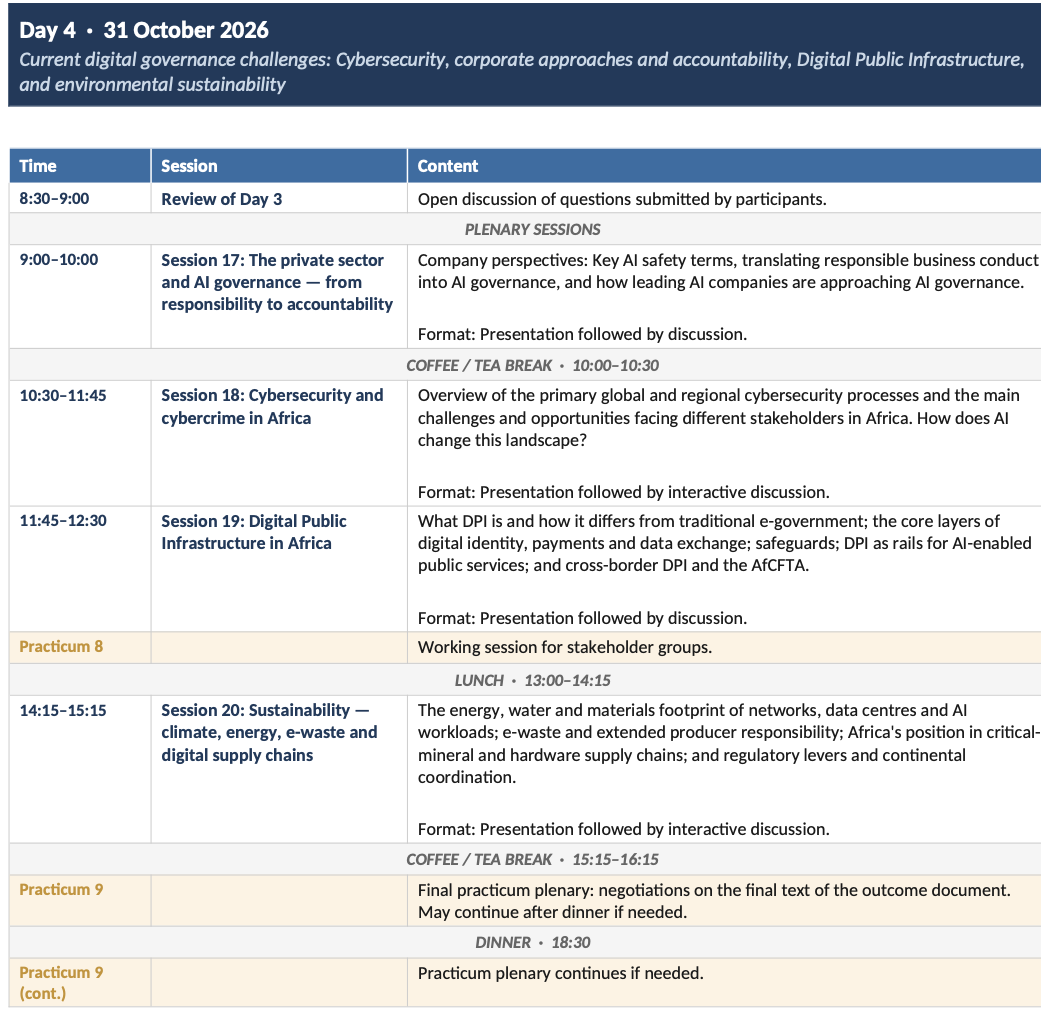
DAY 4
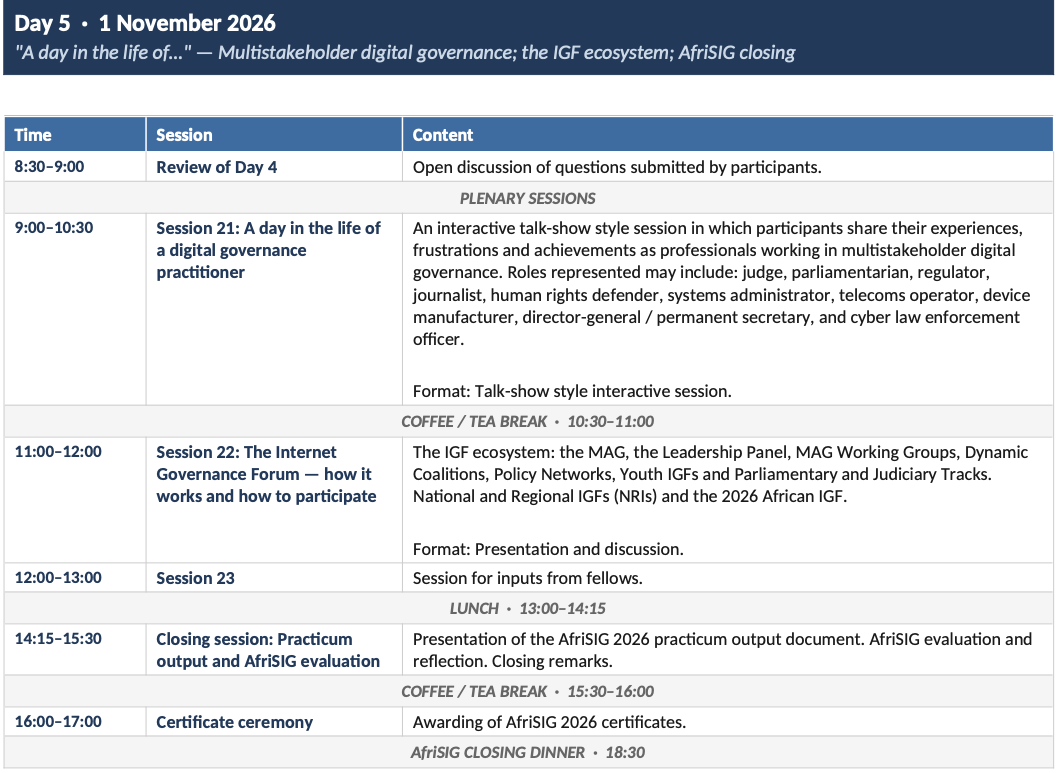
DAY 5
🎁 Detailed Agenda & Key Readings
Day 0 | 27 Oct — 17:00 - 21:00
Day 1 | 28 Oct — 08:30 - 20:30
Day 2 | 29 Oct — 8:30 - 20:30
Day 3 | 30 Oct -- 8:30 - 18:00
Day 4 | 31 Oct -- 8:30 till late
Day 5 | 1 Nov
📑 Essential Links
Presentations
Presentations are sorted by day and can be accessed here.
Reading Materials
Session specific requested readings can be found here.
Zoom Link
For online faculty, kindly join your session(s) via Zoom.
🔖 Essential Practicum Documents
Practicum Guide
Kindly view and download the practicum guide here.
Practicum Schedule
The practicum is a simulation exercise that runs across the full AfriSIG week. Participants are divided into stakeholder groups — representing governments, civil society, the business sector, the technical community and observers — and work collaboratively to produce a joint outcome document on a digital governance challenge. The practicum mirrors the real-world dynamics of multistakeholder internet governance negotiations.
The nine practicum sessions are interspersed throughout the week's programme. Each session builds on the day's learning and advances the groups' drafting and negotiation toward a final outcome document, which is presented at the closing session on Day 5.
|
# |
Day / Time |
When |
Activity |
Purpose |
|---|---|---|---|---|
|
Prior to Accra |
Online introduction, role assignment and research into roles by fellows. Reading background material. |
Building identity and understanding of roles. Gaining a clear grasp of the process and its goals. |
||
|
1 |
Day 1 12:30–13:00 |
After Session 3 |
Assignment for lunch: participants identify initial questions and concerns to bring to their stakeholder groups. |
Activate prior knowledge; surface participant priorities before the formal practicum begins. |
|
2 |
Day 1 16:45–17:15 |
After Session 5 |
Informal plenary: stakeholder groups present their initial questions and concerns at a chaired plenary session. |
First cross-group exchange; test initial positions before groups begin drafting. |
|
3 |
Day 1 19:30–20:30 |
After dinner |
Self-organised informal working sessions in stakeholder groups at hotels. Goal: produce written submissions to be sent to the secretariat the following morning. |
Begin drafting; distribute writing work across groups. |
|
4 |
Day 2 17:30–18:30 |
After Session 10 |
Working session: stakeholder groups prepare text contributions for the formal practicum plenary after dinner. All written inputs to be shared with the secretariat by 18:45. |
Consolidate Day 2 learning into group positions; prepare for formal negotiation. |
|
5 |
Day 2 19:30–20:30 |
After dinner |
Formal practicum plenary: stakeholder groups present their text contributions to the outcome document at a formal chaired session. |
First formal negotiation session; groups test and defend their positions. |
|
6 |
Day 3 12:30–13:00 |
After Session 13 |
Working session for stakeholder groups. |
Integrate Day 3 themes (human rights, gender, media) into group drafts. |
|
7 |
Day 3 17:00–18:00 |
After Session 15 |
Formal plenary and negotiations: groups discuss the draft output document based on compiled inputs from all stakeholder groups. |
Advance negotiations toward a consolidated draft; resolve key divergences. |
|
8 |
Day 4 12:30–13:00 |
After Session 18 |
Working session for stakeholder groups. |
Integrate Day 4 themes (cybersecurity, DPI, sustainability) into group drafts. |
|
9 |
Day 4 16:15–17:30 + evening if needed |
After Session 19 |
Final practicum plenary: negotiations on the final text of the outcome document. Continues after dinner if needed. |
Reach consensus on the final text; close all outstanding items. |
|
10 |
Day 5 14:15–15:30 |
Closing session |
Presentation of the AfriSIG 2026 practicum outcome document to the full group. |
Celebrate and share the product of five days of collaborative work. |
Note: All written submissions from stakeholder groups to be shared with the AfriSIG secretariat by 18:45 on Day 2 (29 October). The secretariat will compile and circulate a consolidated draft before the Day 3 evening plenary.
AU Continental AI Strategy
In French, view here.
In English, view here.
RIA JustAI Framework of Inquiry
View here
✔️ Fellows' Profiles
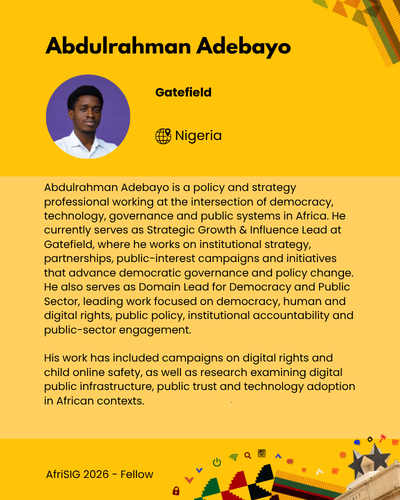
Abdulrahman Adebayo
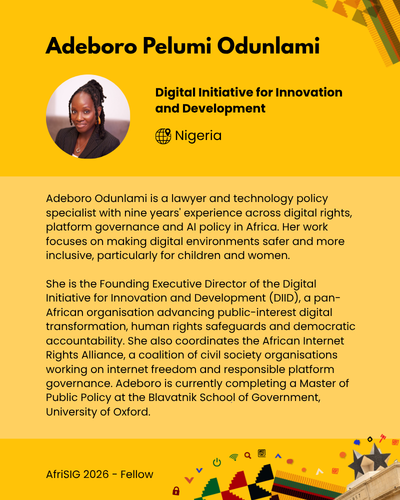
Adeboro Pelumi Odunlami
Afua Akyaa Mensah Amirikah
![] Akyaa Mensah Amirikah.png](https://wiki.afrisig.org/uploads/images/gallery/2026-10/B05wuB6Irak8N1qf-akyaa-mensah-amirikah.png)
Dr. Aminata Dembélé
Hon. Amongin Jacqueline
Athandiwe Saba
Audrey Kawire Wabwire
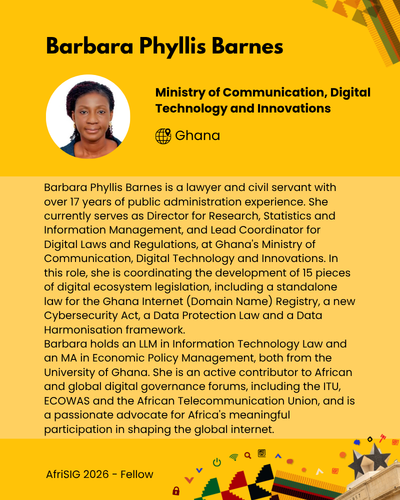
Barbara Phyllis Barnes
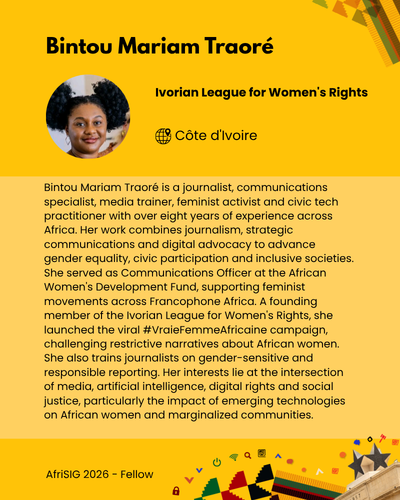
Bintou Mariam Traoré
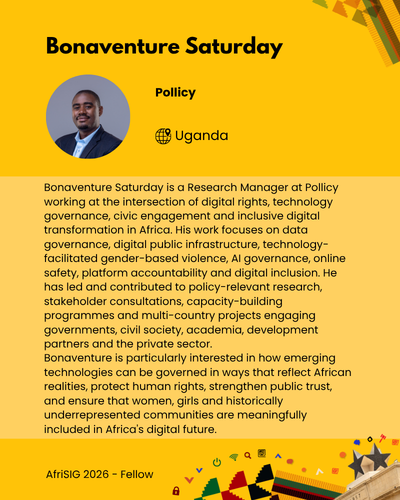
Bonaventure Saturday
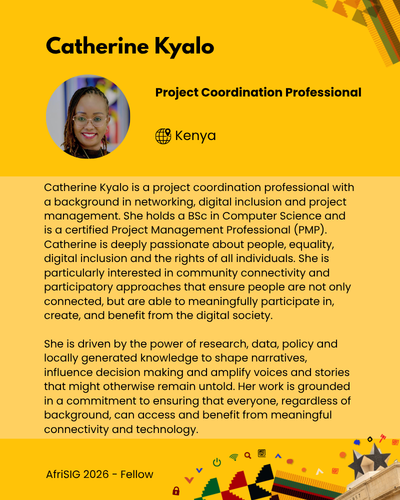
Catherine Kyalo
Charles Ikem
Christella Nizigama
Clairette M. Ngoutane
Diana Kemunto Nyakundi
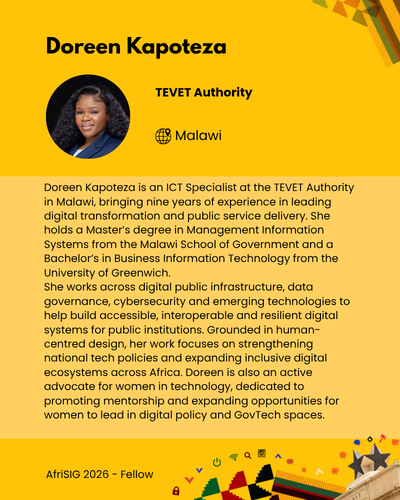
Doreen Kapoteza
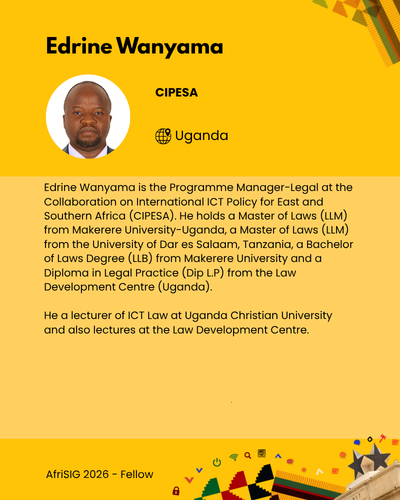
Edrine Wanyama
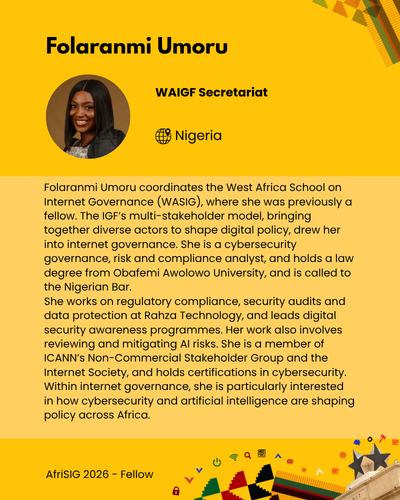
Folaranmi Umoru
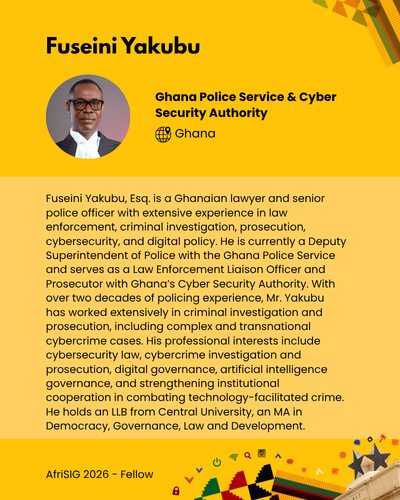
Fuseini Yakubu
Grace Ajato Peace
Harouna Issaka
Hassan Hussein
Imane El Qochairi
Isabel Maria Katondo
Dr. Jamal Tonzua Seidu
James Kunle Olorundare
Janine Anthea King
Jennifer Abena Dadzie
John Mathuri Kathure
Kenley Sérgio Cossa
Khouzeifi Issakha Doud-bane
Lucy Okonkwo
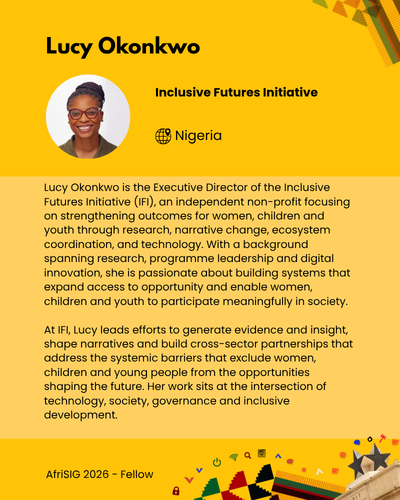
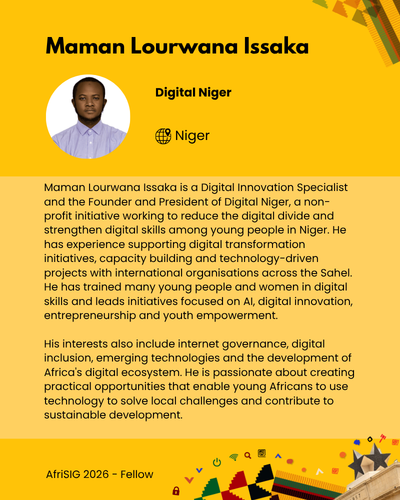
Maman Lourwana Issaka
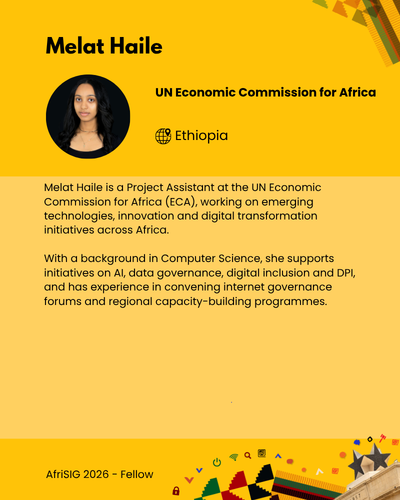
Melat Haile
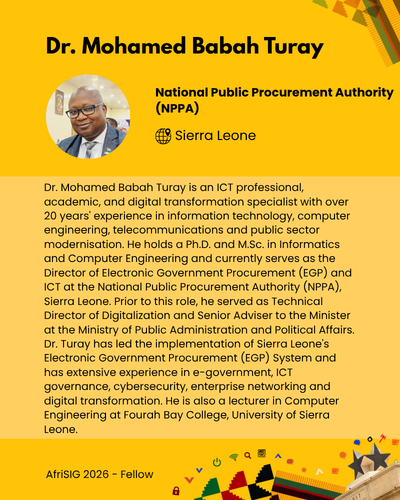
Dr. Mohamed Babah Turay
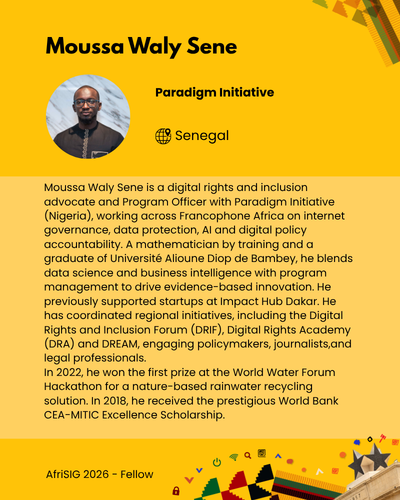
Moussa Waly Sene
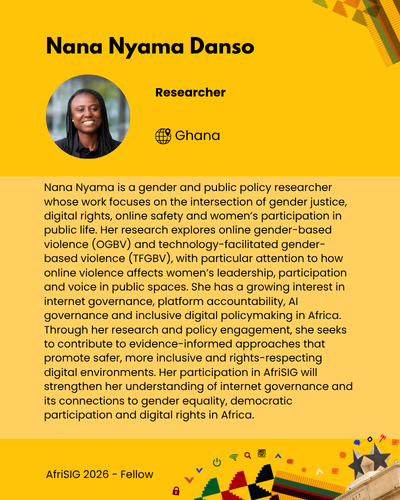
Nana Nyama Danso
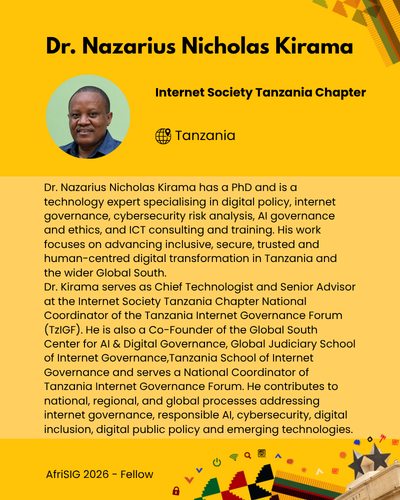
Dr. Nazarius Kirama
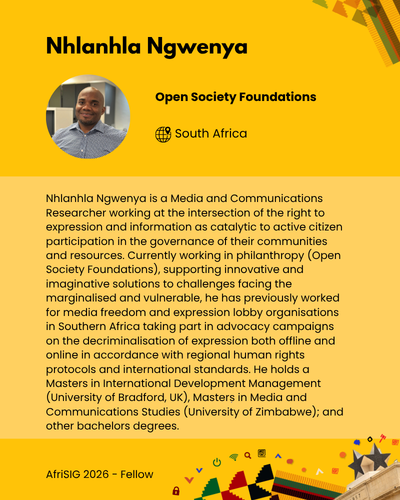
Nhlanhla Ngwenya
Olaitan Olanrewaju
Ompha Tshamano
Patricia Adafienu
Ramatu Mohammed Sidi
Rehema Patricks
Samuel Ayode Longe
Sihle Nyathi
H.H Siran Mahama
Stacy Ayoo Owango
Sylvain William S. Tahfo
Theophilus Takyi-Mensah
Tsilla N.D Serge
Ugochi The
Uyanda Siyotula
Walid Naffati
Yao Amevi A. Sossou
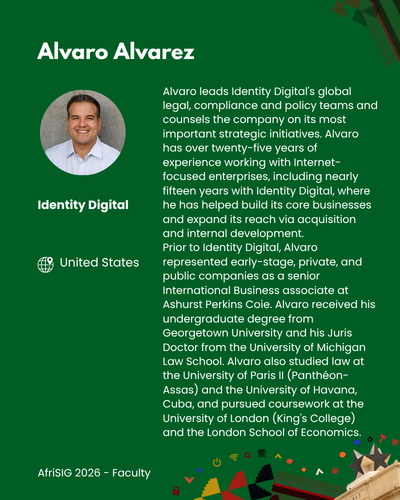
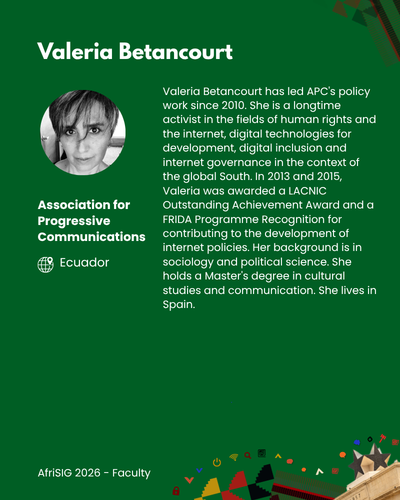
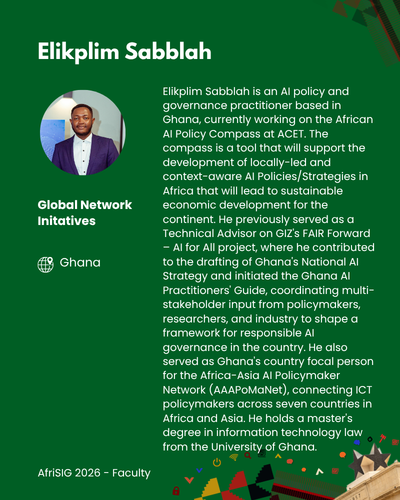
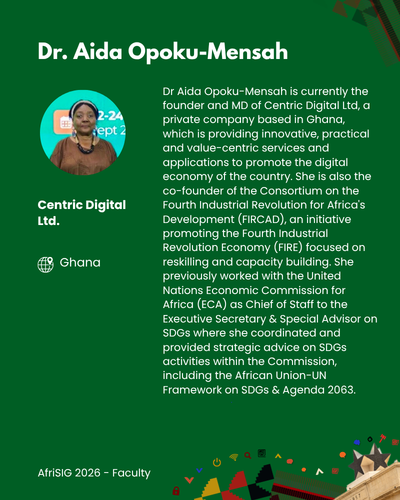
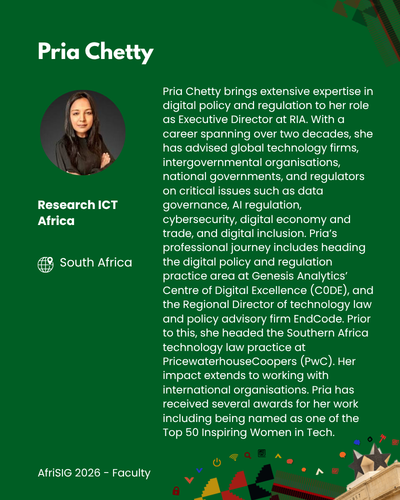
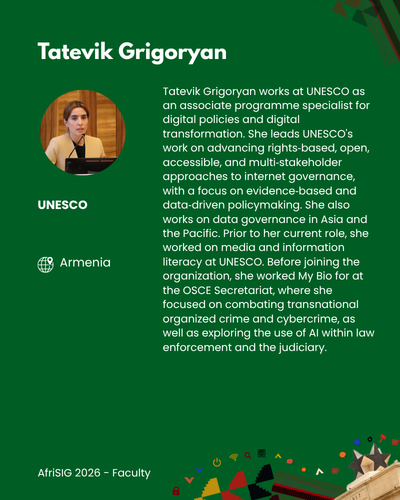
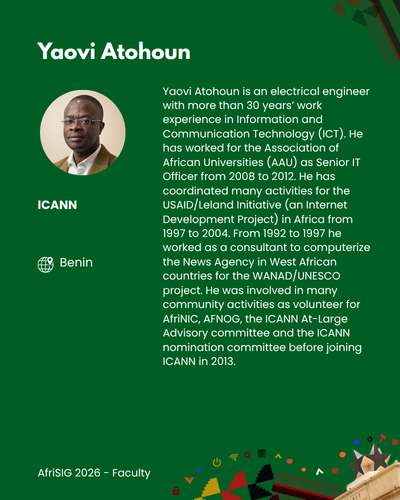
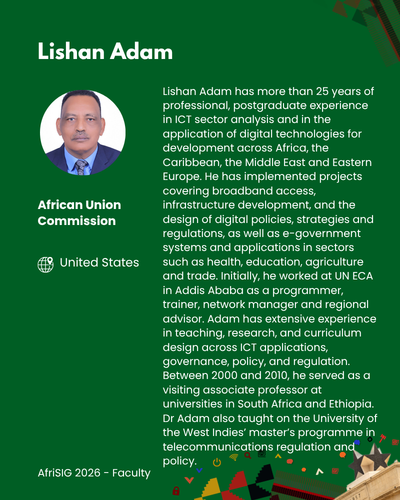
✔️ Faculty Profiles
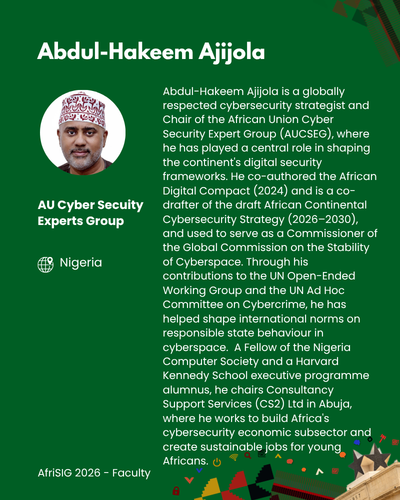
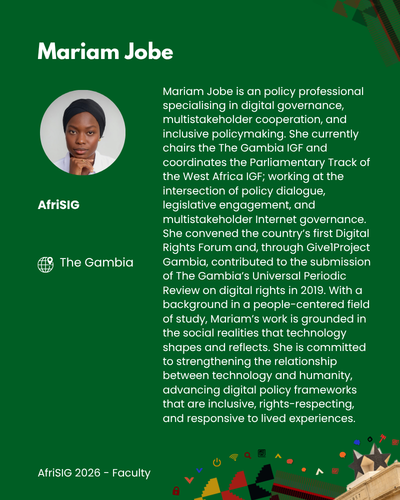
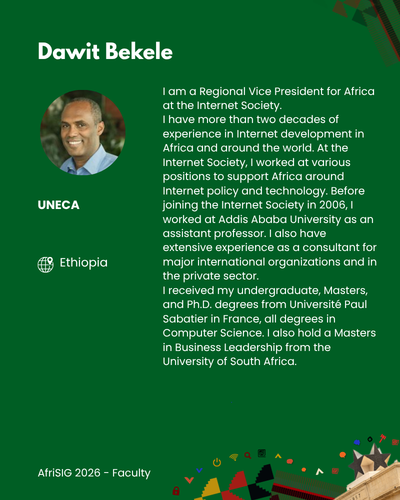
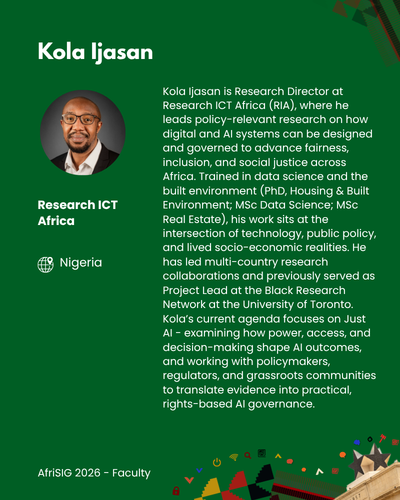
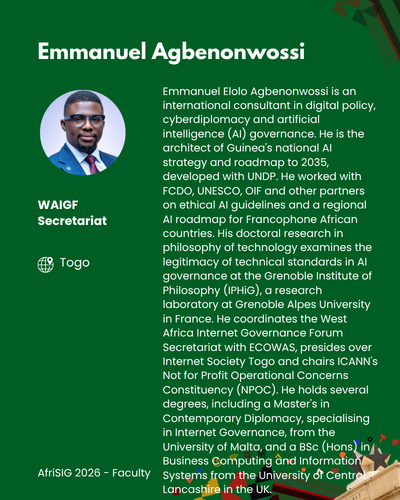
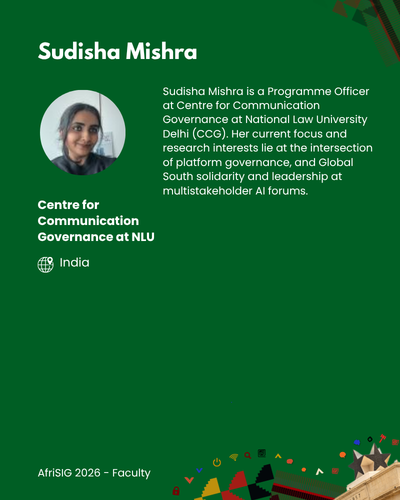
Core Faculty
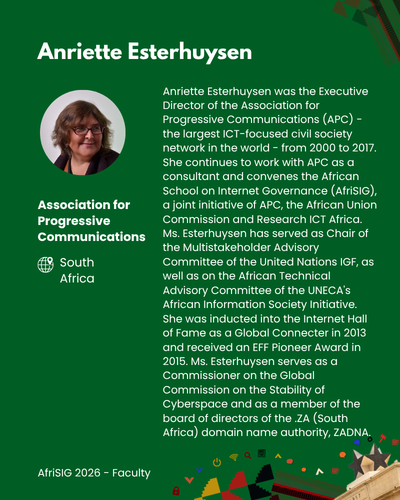


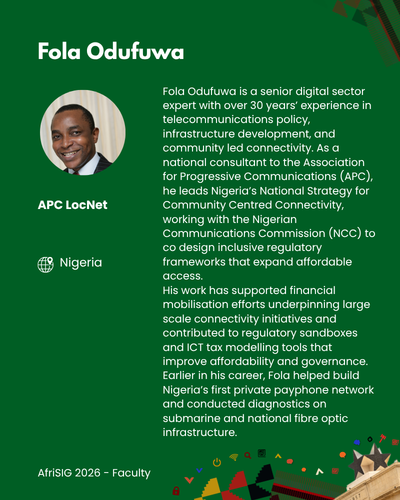
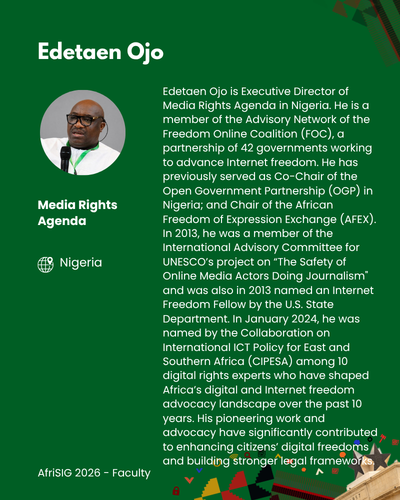
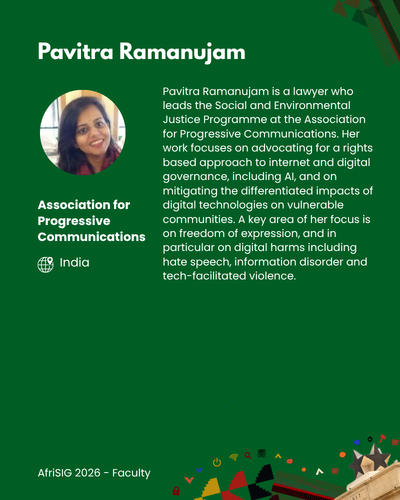
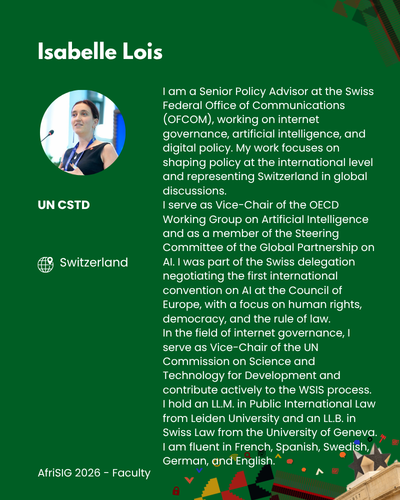
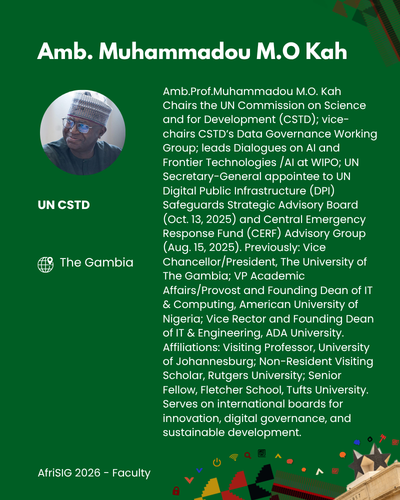
Expert Guests
AfriSIG Ground Rules and APC Principles of Participation
AfriSIG Ground Rules
At AfriSIG we are all equals - except for the time keepers
Every person in the room has valuable and legitimate expertise, knowledge and experience. AfriSIG tries to create a level playing field and we should assume that all protocols are observed. We generally refer to one another by our first names. Take this into account when using or not using terms like Honourable, or Excellency, or Doctor or Professor. People who have done the hard work that it takes to achieve these titles should not be offended if we do not make use of these consistently. However when we convene for the purpose of the Practicum it might make sense to use these terms during negotiations.
No question is irrelevant. The more questions and comments that we share, the more we will learn.
Punctuality
Sessions will start at the time indicated in the programme even if there are only a few people in the room. The only session where arrival is flexible is the morning Q and A where we recap what happened the previous day. We often have the best conversations during these sessions.
Participation in the process and AfriSIG communications.
Several fellows will participate from time to time as panelists. There is also a session being curated by Mariam Jobe on the last day where participants will have an opportunity to give a lighting talk on a topic or activity that they want to share. We also invite people to share their favourite energise with the "Well being and response team" Mariam and Pavi. And dont' forget the music and dancing!
Communications and photographs
Please get the consent of anyone before you take a picture of them. Please do not record any video while we are in session. The AfriSIG communications team will be reaching out to participants who want to write blogs about the experience and to do interviews. We will take a group picture and pictures of the certificate award ceremony at the end. Feel free to share on social media but you must adhere to the Chatham House Rule.
The Chatham House Rule
AfriSIG is made up of a diverse group of participants from different countries, sectors and stakeholder groups. To ensure that everyone feels comfortable to share their questions and perspective freely without fear of being quoted we apply the Chatham House Rule. This means that participants are free to use or refer to comments made in the discussions during AfriSIG sessions and during the practicum, but neither the identity nor the affiliation of the speaker(s), nor that of any other participant, may be revealed. Here is a practical example that illustrates the Rule
What you CAN say after the meeting (Sharing the what):
"In a high-level energy meeting this week, it was pointed out that current supply chains cannot support a full phase-out of natural gas by 2030 without risking blackouts."
"Participants discussed how public corporate targets for green energy might clash with physical infrastructure limits."
What you CANNOT say (Revealing the who or affiliation):
Incorrect: "The CEO of [Company X] told us that natural gas phase-outs won't work by 2030."
Incorrect: "The energy minister admitted behind closed doors that blackouts are a real risk."
Incorrect: Publishing a list of who attended the roundtable
Why It WorksBy stripping away the risk of public backlash, media misquoted soundbites, or professional punishment, the rule enables high-profile figures to test unconventional ideas, acknowledge weak spots, or share confidential perspectives they would never voice in a press conference. In the internet governance context this Rule has helped to facilitate the application of the multistakeholder approach.
APC Principles of Participation
The Association for Progressive Communications is committed to providing a safe and welcoming environment for discussing issues related to its community. The APC Community comprises members of the network, all APC staff and team and its larger network of partners, friends and allies. As APC is the lead organiser of AfriSIG, AfriSIG makes use of the APC Principles of Participation.
The code of conduct and ground rules apply to this meeting, all APC hosted events, conference-related social events, such as parties or gatherings at restaurants or bars and spaces, and includes our mailing lists, wikis, platforms, websites and any other spaces that APC hosts, both online and off. Participants are responsible for knowing and abiding by these guidelines. In this event, the code applies to anyone who is part of the event, which includes organisers, resource persons, participants and performers.
All APC meetings, virtual and physical meetings, are intended to be SAFE spaces and we ask participants to be guided by the following:
|Be respectful
|Listen actively
|Be respectful of others’ views even when you disagree
|Be collaborative
|Recognise diversity
|Respect privacy of participants
|Ask for consent for photography, audio-visual recordings or quotes
|Be aware of language diversity
|Handle disagreement constructively
|Act fairly, honestly, and in good faith with other participants
It is vital that discussions include and acknowledge a diversity of opinions and experiences, and that the community does not tolerate harassment of any kind.
We expect the members of the APC community to treat one another with respect and to acknowledge that everyone can make a valuable contribution. We may not always agree, but the space and conversation must always have openness to positions that may not be aligned or in agreement. Frustration cannot turn into a personal attack. It's important to remember that a community where people feel uncomfortable or threatened is not a productive one, and that the meeting conduct and ground rules are anchored in the APC values we have all committed to uphold. It is our collective responsibility to ensure that we create a safe, creative, productive and welcoming space that can hold us in all of our diversity.
We will take action in response to harassment related to gender, gender identity and expression, sexual orientation, disability, physical appearance, body size, race, nationality, caste, ethnicity or religion. APC does not tolerate harassment of participants in any form.
Definitions
Harassment
includes, but is not limited to:
- Offensive comments related to gender, gender identity and expression, sexual orientation, disability, mental illness, neuro(a)typicality, physical appearance, body size, race, caste, ethnicity or religion.
- Unwelcome comments regarding a person’s lifestyle choices and practices, including those related to food, health, parenting, drugs, and employment.
- Physical contact and simulated physical contact without consent or after a request to stop.
- Deliberate intimidation.
- Sustained disruption of discussion.
- Continued one-on-one communication after requests to cease.
- Sexual harassment
Sexual harassment
is a broad term. For the purposes of this event it is defined as:
Any unwelcome sexual advance in the form of words, images, gestures or physical contact in physical, digital or communication spaces which may reasonably be expected, or be perceived, to cause distress, intimidation, fear, humiliation, or harm to another. The term also covers any request for a sexual favour, or a threat of a sexual nature. Sexual harassment may occur in any space, including the workplace. This includes activities of face-to-face meetings, virtual meetings and digital communication of all kinds. It can be a one-time incident or a series of incidents. Sexual harassment may be unintended, deliberate, or coercive. Sexual harassment may occur both within formal working hours and spaces, and outside these. Men, women, transitioning and transgender individuals may be victims or offenders.
Sexual harassment may result in discrimination, and it may create a hostile working environment. Other forms of behaviour which cause discrimination, fear, and/or a hostile working environment may be implicated in sexual harassment, such as harassment based on race, gender, sexuality, national origin, physical appearance, age, ancestry, disability, economic disparity, nationality, or religious or spiritual beliefs. APC recognises that APC's staff members, partners and event participants are from diverse contexts, and that sexual harassment experiences are embedded within the cultural, social, historical and personal contexts.
Sexual harassment should not be confused with unintentional careless communication in a diverse working environment, or with our efforts to create a working culture which is open to conversations on sexuality and human rights.
We understand that the impact of sexual harassment on APC's working culture can be highly destructive, and we understand the harmful impact of sexual harassment on any person’s work, mind and body.
Examples of sexual harassment include (but are not limited to):
- Gratuitous or off-topic sexual images or behaviour in spaces where they are not appropriate.
- Unwelcome sharing of sexualised content in visual, audio or text form
- Deliberate stalking, following or intimidation, online and/or offline
- Harassing photography, video or audio recording
- Inappropriate and/or unwanted physical contact
- Unwelcome sexual attention, in any form of communication
- Requests for sexual favours, verbal or physical contact of a sexual nature in exchange for an opportunity
- Threats, either explicit or implicit, to withdraw an opportunity or resources unless sexual contact and/or communication is permitted
- Advocating for, or encouraging, any of the above behaviour.
If you believe you have been harassed, or notice that someone else is being harassed, or have any other concerns, you are encouraged to raise your concerns in confidence to the Event Incidents Team.
APC commits that each case will be considered, and concrete actions will be taken as appropriate.
Please refer to APC’s sexual harassment policy for how APC responds to sexual harassment.
Code of Conduct and Anti-Harassment Policy Response Process
If you are being harassed by a member of the community or a participant or organiser at the conference, or have any other concerns, please contact a member of the Event Incidents Team.
When a complaint is made or an incident occurs that breaches this code, the Event Incidents Team will confidentially review and respond to any participant who has experienced harassment or inappropriate behavior.
If the person who is harassing you is on the Event Incidents Team, they will recuse themselves from handling your incident. If the person who is harassing you is a member of the organising team, they will not receive differential treatment than any other participant in the handling of the complaint.
We will try to respond as promptly to complaints as we can. These steps will be taken once you make a complaint:
- One or more members of the Event Incidents team will discuss the issue with you.
- They may take notes, with your consent, of what you say.
- One or more members of the Events Incidents team will separately speak with the person(s) against whom the complaint is lodged.
- The process will involve attaining resolution while ensuring safety, dignity and respect for everyone involved.
If a participant engages in harassing behavior, the Response Team may take any action they deem appropriate, up to and including expulsion from all APC spaces during the event, and identification of the participant as a harasser to other APC members or the general public. The Event Incidents team will prioritise marginalised people’s safety over privileged people’s comfort.
Any member of the Event Incidents Team can be contacted with any questions or concerns participants may have throughout the duration of an APC event. Anonymous complaints can be reported to the team on Telegram or submitted via email.
↗️ AfriSIG 2026 Website & Sponsors
Website: www.afrisig.org
Sponsors:


