AfriSIG 2021
| 4 to 15 October 2021 |
This year marks AfriSIGs ninth edition. Given the continuing reality of the COVID 19 pandemic, the school will be held virtually over two weeks from 4 to 15 October 2021. Over the years, the school has brought together policy makers, government officials, researchers, regulators, engineers, system administrators, journalists, entrepreneurs and gender equality and human rights defenders. This year’s edition will be open to up to 40 participants including current or potential leaders involved in internet governance and internet-related policy on the continent.
- ⏳ UTC Time Converter
- 📖 Read Me
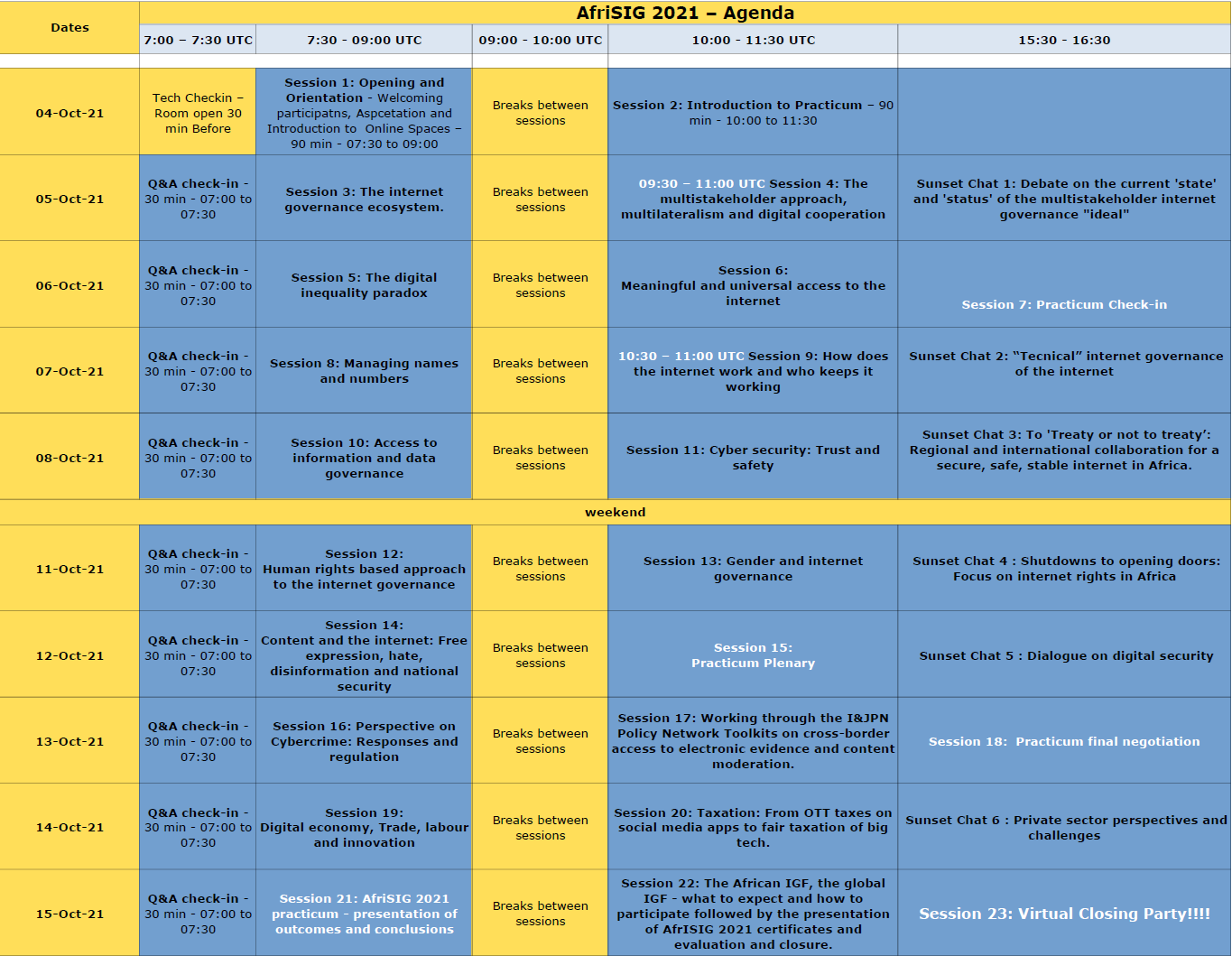
- 🔦 School Agenda at a glance
- 🎁 School Agenda and Overview (Interactive)
- Day - 1 | Session - 1: Opening and Orientation
- Day - 1 | Session - 2: Introduction to the practicum
- Day - 2 | Session - 3: The internet governance ecosystem
- Day - 2 | Session - 4: The multistakeholder approach, multilateralism and digital cooperation
- Day - 2 | Sunset Chat - 1: Debate on the current 'state' and 'status' of the multistakeholder internet governance "ideal"
- Day - 3 | Session - 5: The digital inequality paradox
- Day - 3 | Session - 6: Meaningful and universal access to the internet
- Day - 3 | Session - 7: Practicum Check-in
- Day - 4 | Session - 8: Managing names and numbers
- Day - 4 | Session - 9: How does the internet work and who keeps it working?
- Day - 4 | Sunset Chat - 2: "Technical" internet governance of the internet
- Day - 5 | Session - 10: Access to information and data governance
- Day - 5 | Session - 11: Cyber security: Trust and safety
- Day - 5 | Sunset Chat - 3: To 'Treaty or not to treaty’: Regional and international collaboration for a secure, safe, stable internet in Africa
- Day - 6 | Session - 12: Human rights-based approach to Internet Governance
- Day - 6 | Session - 13: Gender and internet governance
- Day - 6 | Sunset Chat - 4: Shutdowns to opening doors: Focus on internet rights in Africa
- Day - 7 | Session - 14: Content and the internet: Free expression, hate, disinformation and national security
- Day - 7 | Session - 15: Practicum plenary session
- Day - 7 | Sunset Chat - 5: Dialogue on digital security
- Day - 8 | Session - 16: Perspectives on cybercrime: Responses and regulation
- Day - 8 | Session - 17: Working through the I&JPN Policy Network Toolkits on cross-border access to electronic evidence and content moderation
- Day - 8 | Session - 18: Practicum final negotiation
- Day - 9 | Session - 19: Digital economy: Trade, labour and innovation
- Day - 9 | Session - 20: Taxation: From OTT taxes on social media apps to fair taxation of big tech
- Day - 9 | Sunset Chat - 6: Private sector perspectives and challenges
- Day - 10 | Session - 21: AfriSIG 2021 practicum - presentation of outcomes and conclusions
- Day - 10 | Session - 22: The African IGF, the global IGF - what to expect and how to participate followed by the presentation of AfrISIG 2021 certificates and evaluation and closure
- Day - 10 | Virtual Closing Party!!
- 🗺️ Zoom Rooms - All classes will take place here!
- 📑 Essential Links
- ⚙️ Pre-AfriSIG 2021 “Homework” Exercise: Mapping ICT laws and authorities in Africa
- 🔖 Essential Practicum Documents
- ✔️ Fellows' Profiles
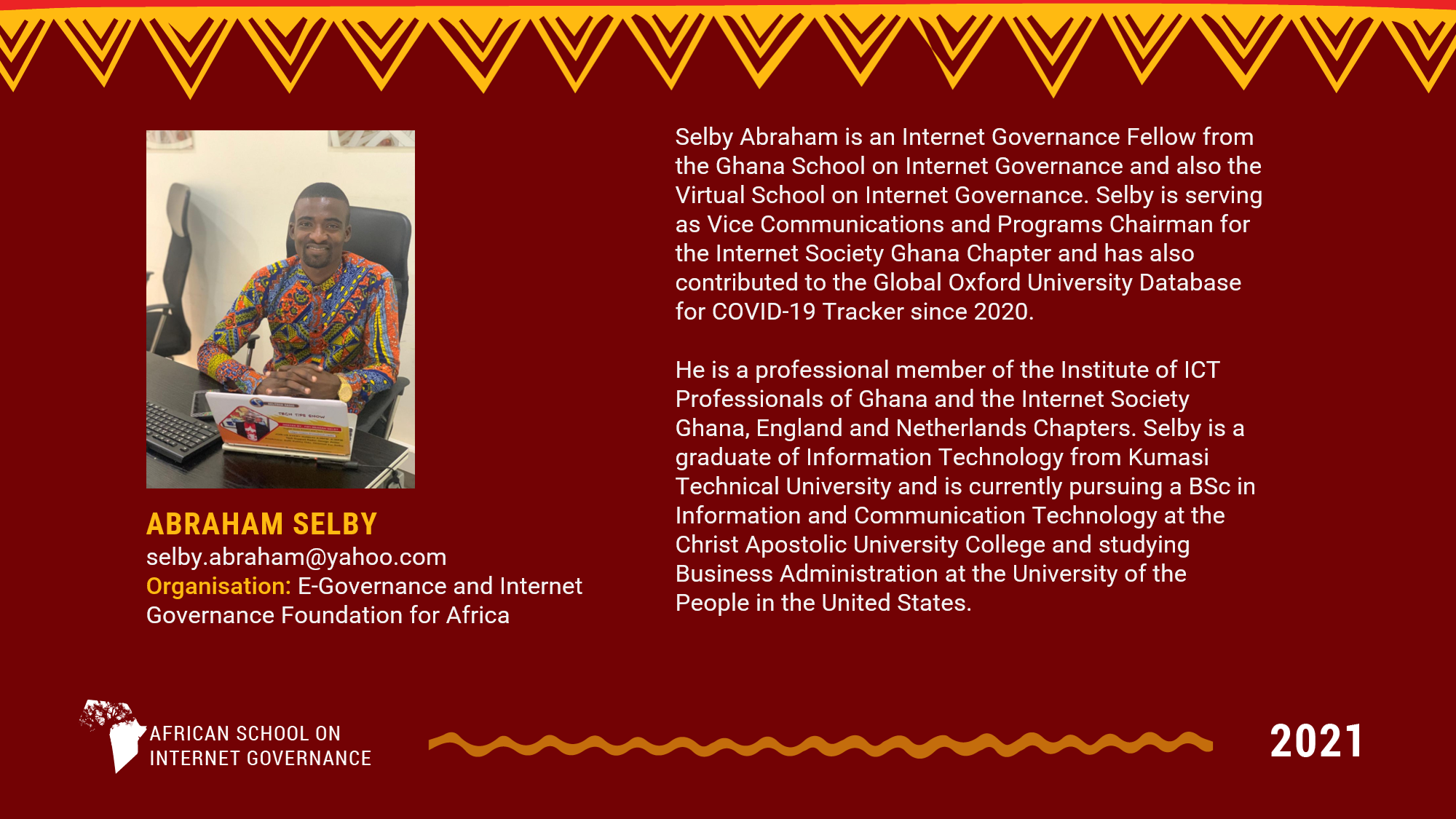
- ABRAHAM SELBY
- AHMAD ADEYINKA YUSUF
- ALBERTINE SHIPENA
- ALLAN CHEBOI
- ALPHONCE ODHIAMBO
- ANNE W. NJATHI
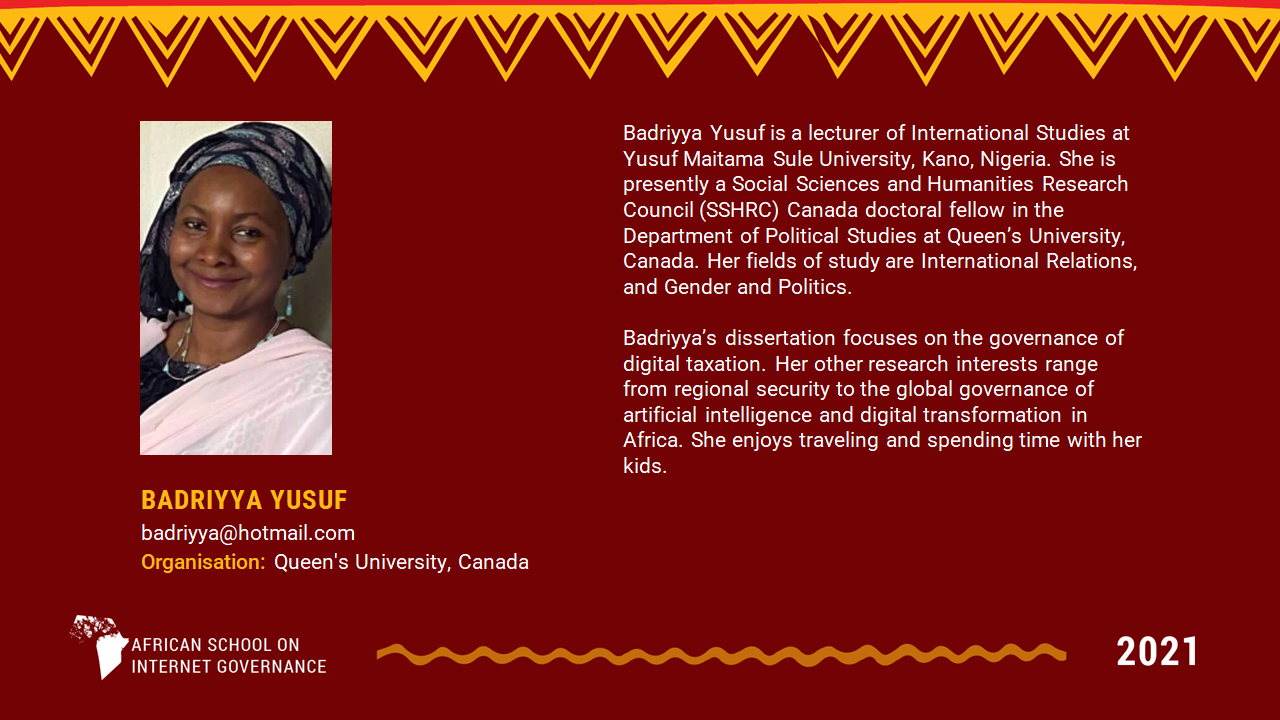
- BADRIYYA YUSUF
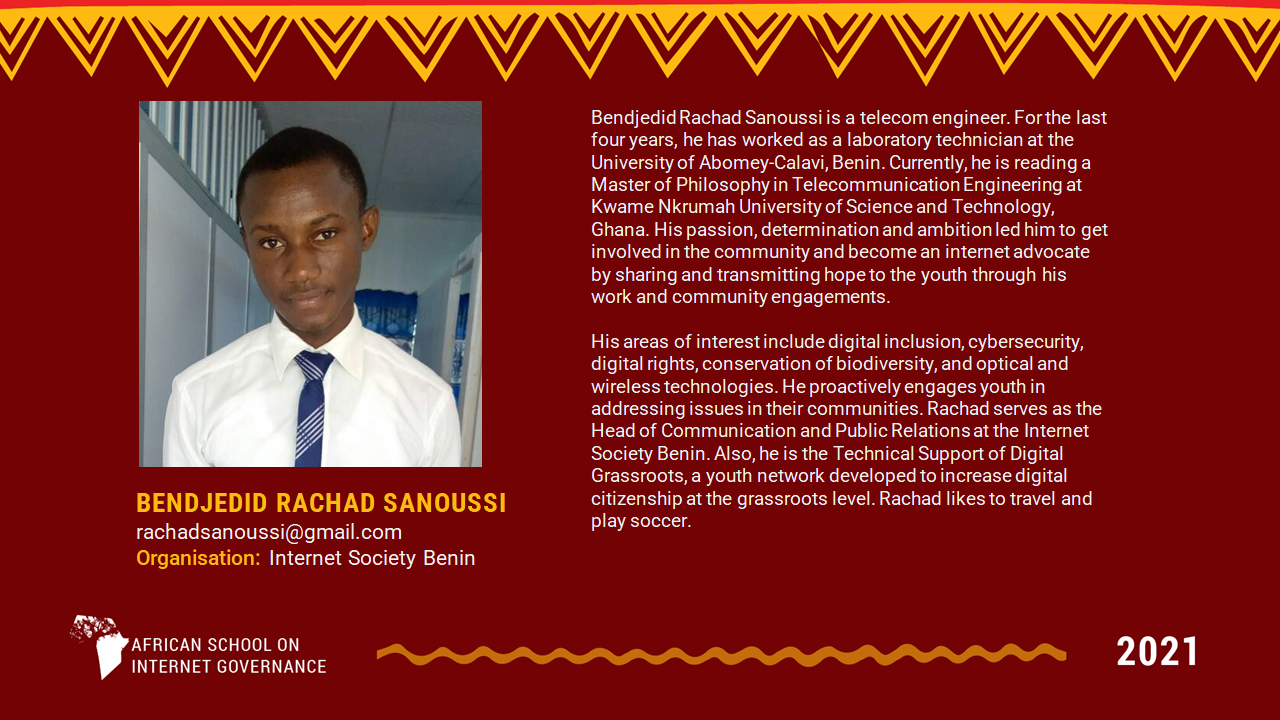
- BENDJEDID RACHAD SANOUSSI
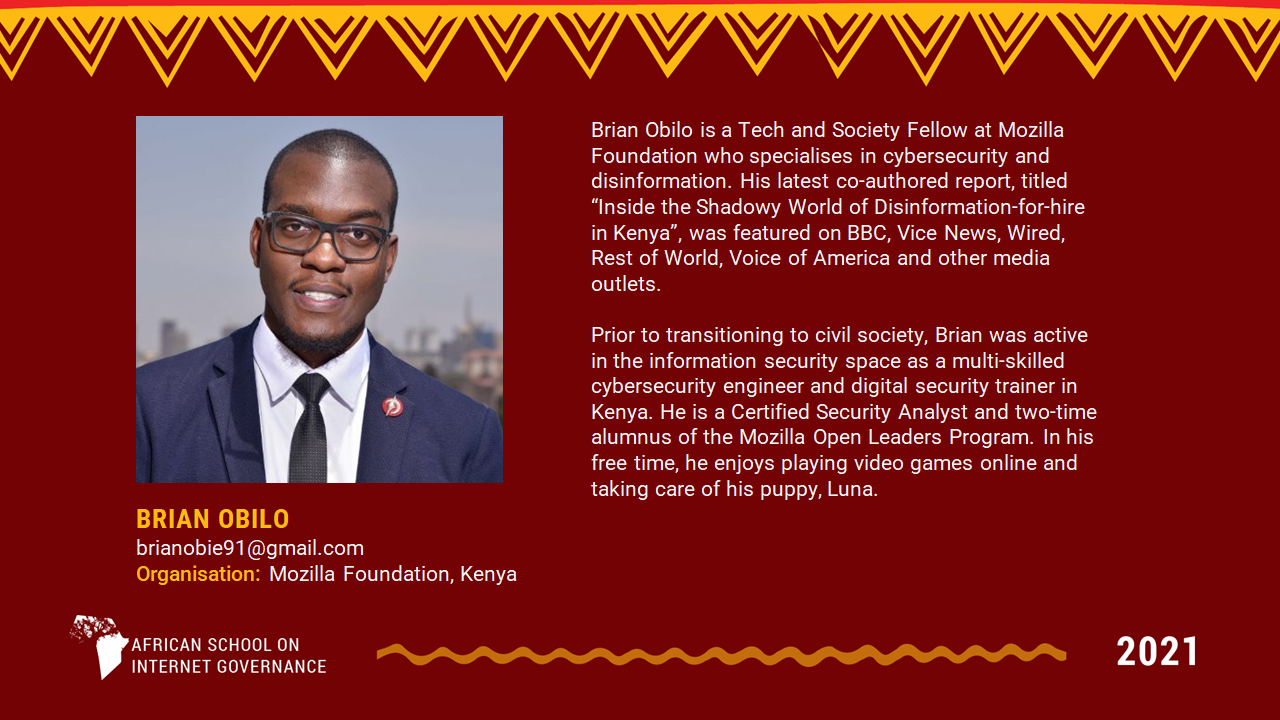
- BRIAN OBILO
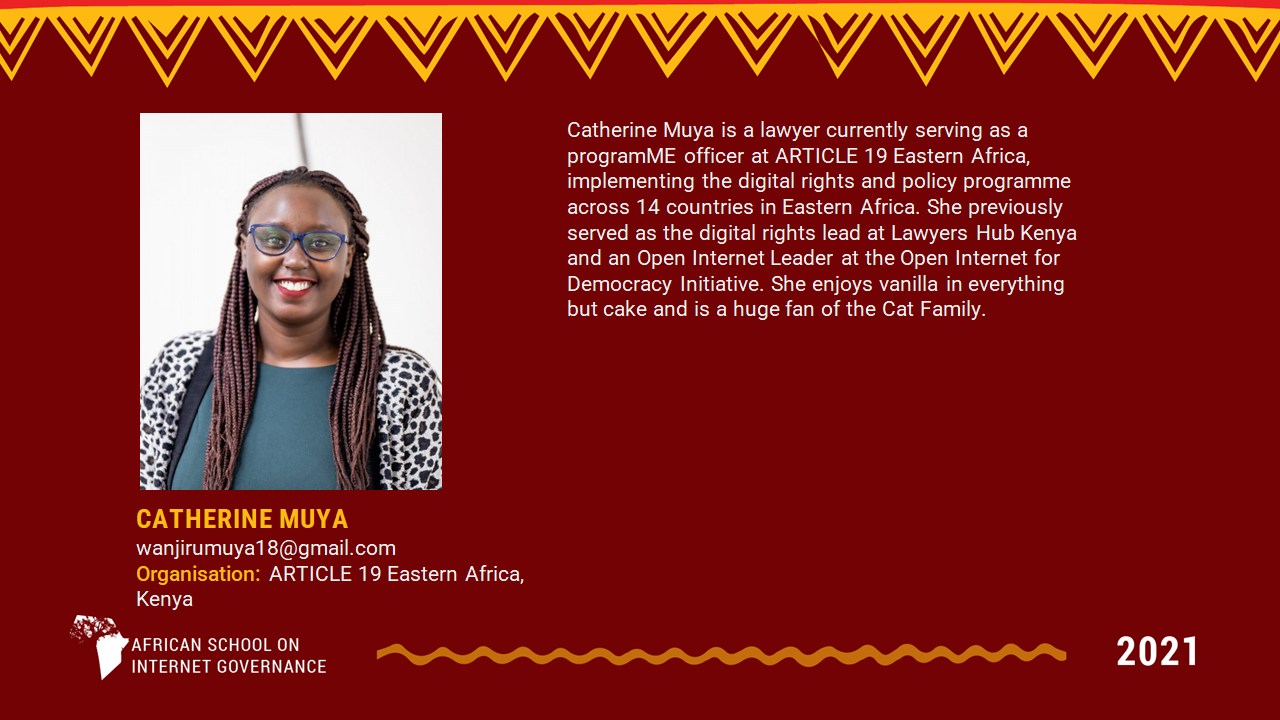
- CATHERINE MUYA
- CHRISTIAN NZHIE NGONO
- DIANA NAMANDA
- FATOU SARR
- FAVOUR BOROKINI
- HASTING TJIPUEJA
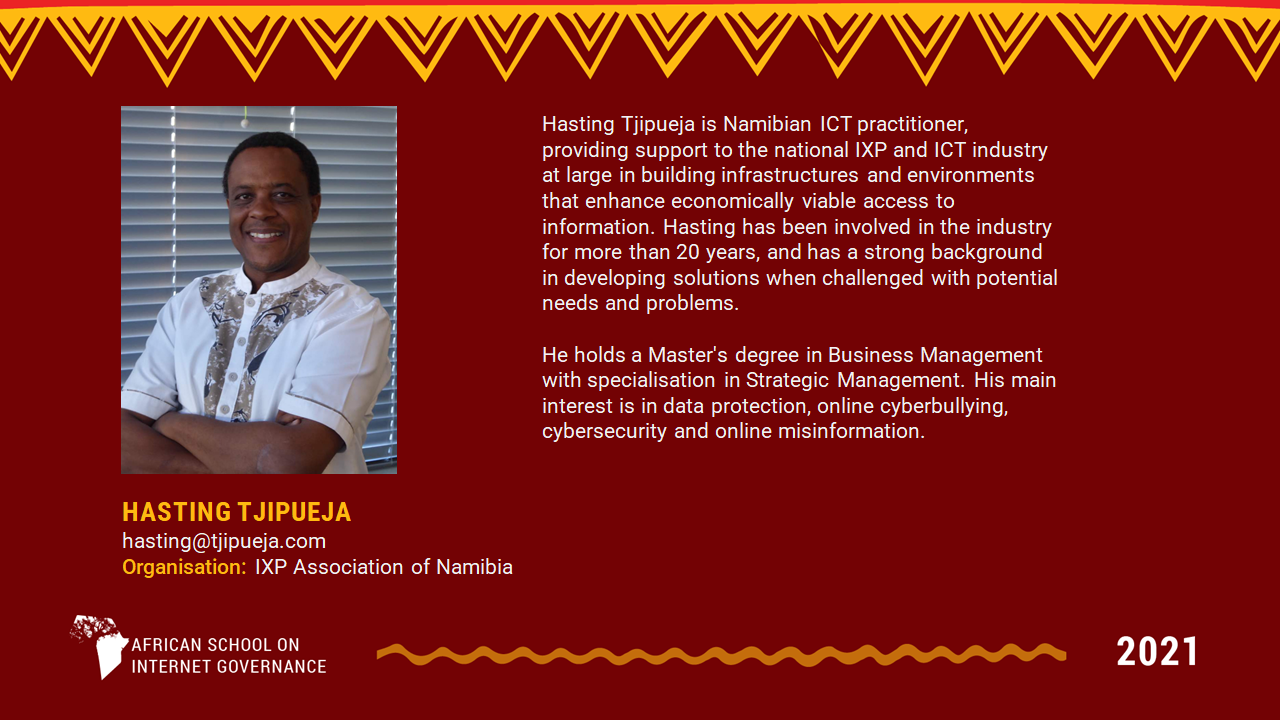
- HERMAN RAMOS
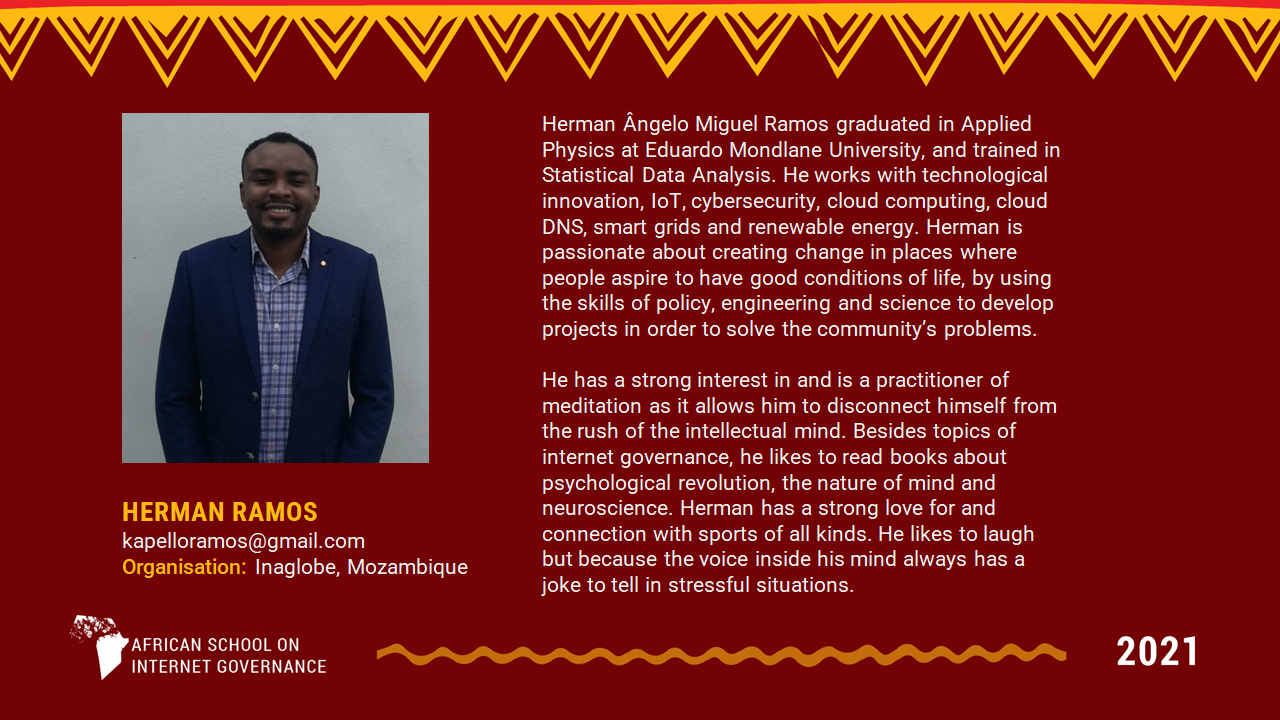
- JOSAPHAT TJIHO
- JULIJA KALPOKIENE
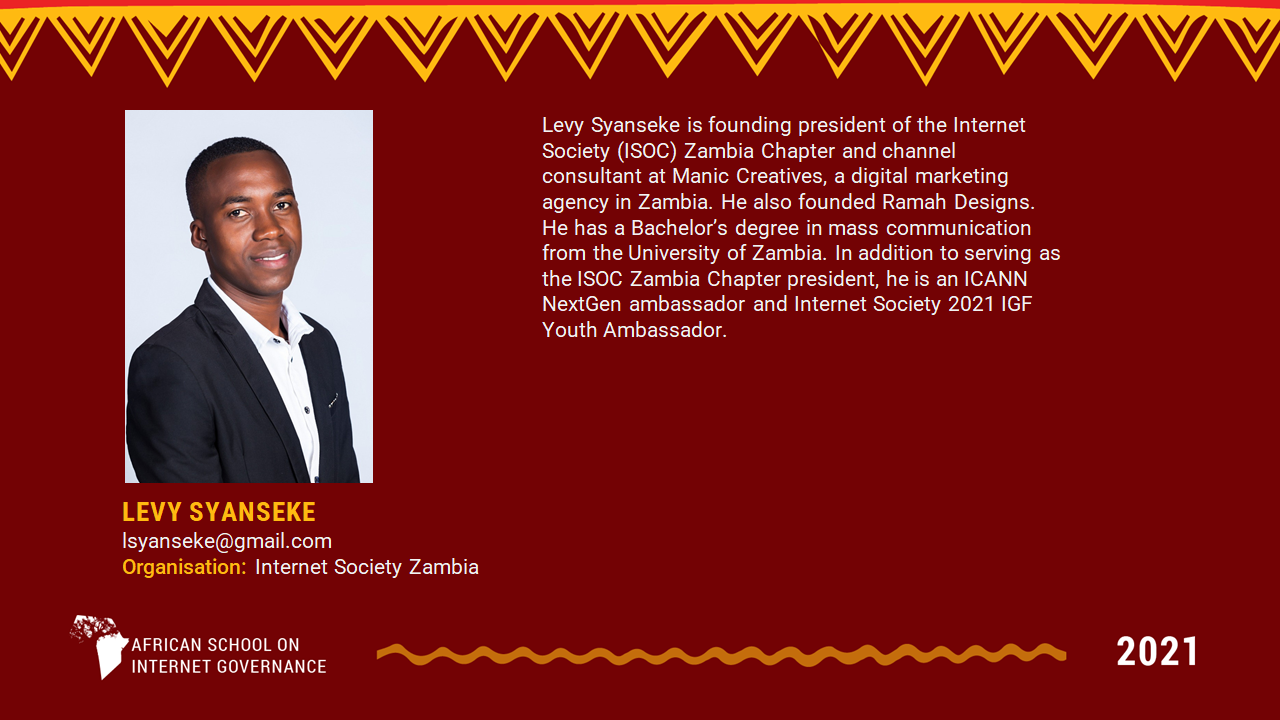
- LEVY SYANSEKE
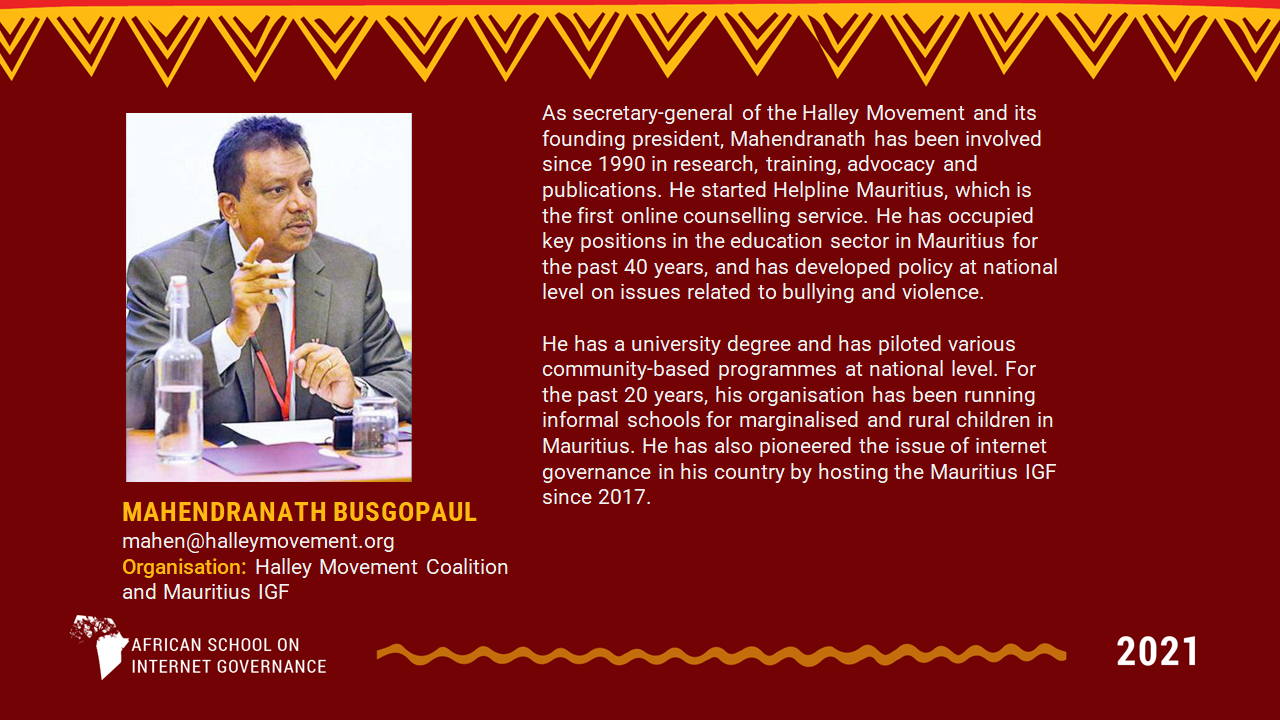
- MAHENDRANATH BUSGOPAUL
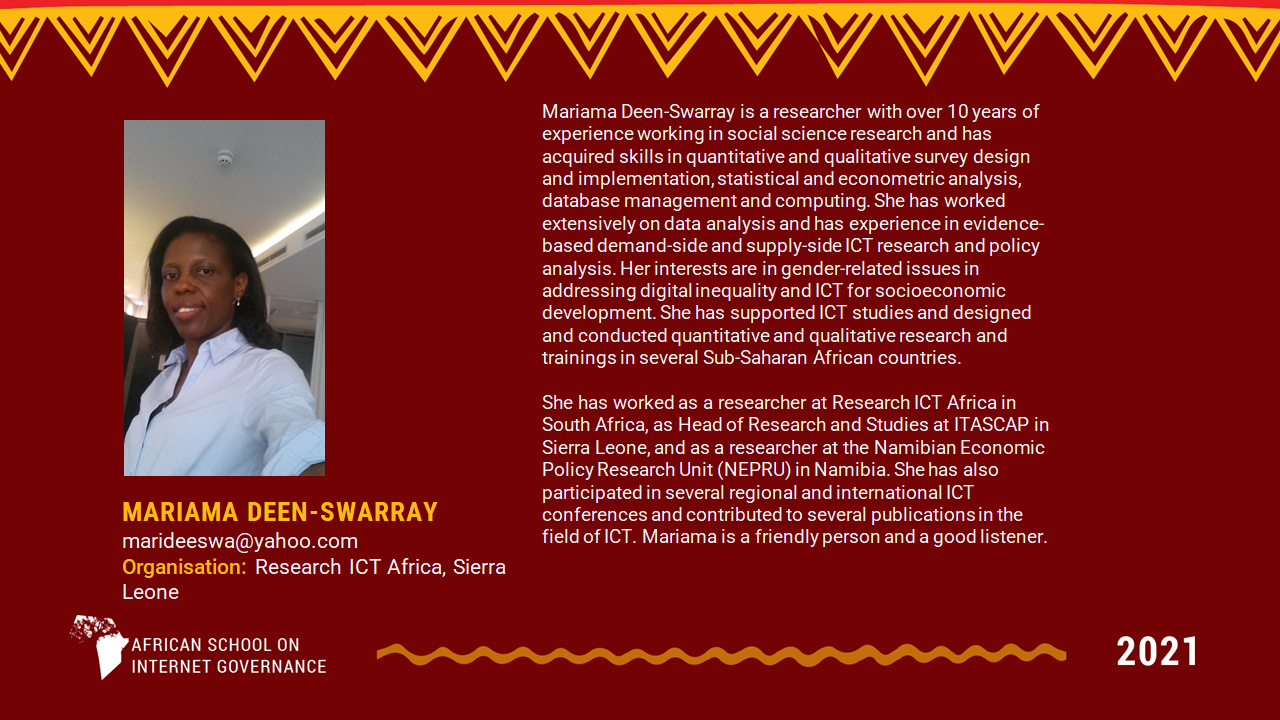
- MARIAMA DEEN-SWARRAY
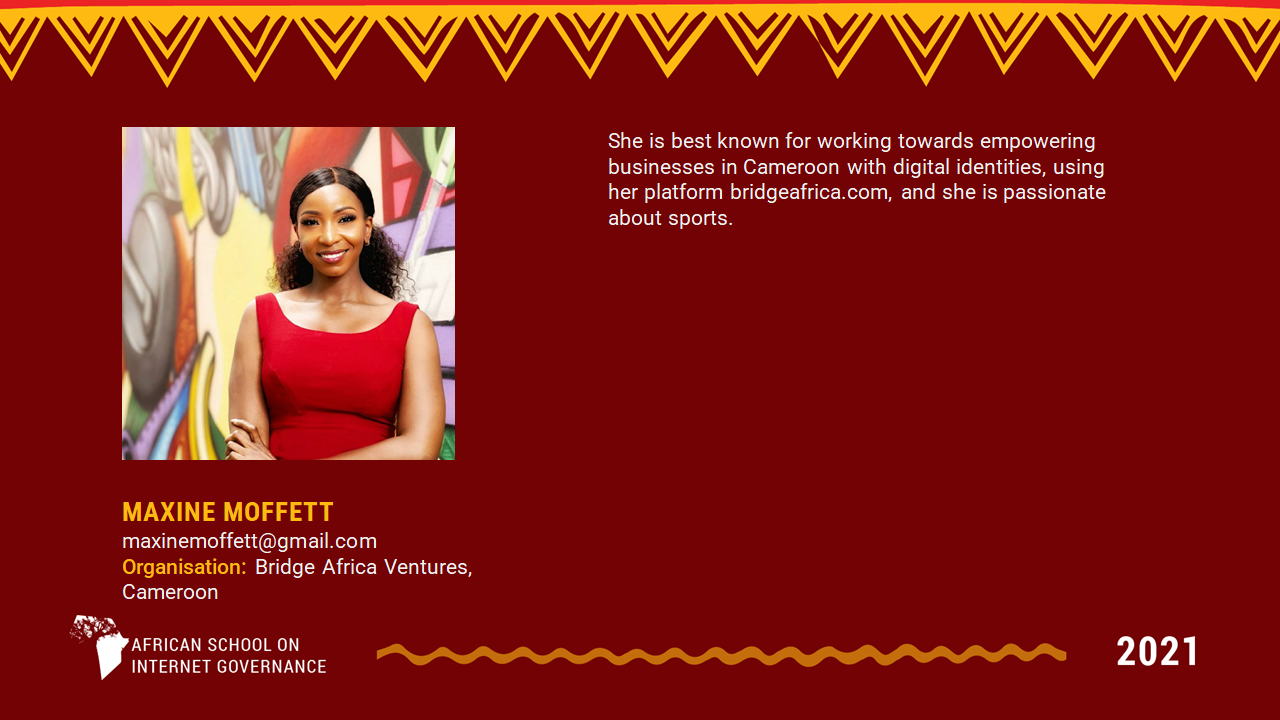
- MAXINE MOFFETT
- MOHAMAD SALAH
- MELISSA ZISENGWE
- REBECCAH WAMBUI
- NYOH MILLER
- OBIOMA OKONKWO
- PLANTINA TSHOLOFELO MOKONE
- PROVIDENCE BARAKA
- RUTH ATIM
- SANDRA ACENG
- SANDRA KWIKIRIZA
- TABANI MOYO
- TSEMA EDE
- TSHEPISO HADEBE
- WILFRED WARIOBA
- ZEPHE RADUMA ODHIAMBO
- ZANYIWE ASARE
- ✔️ Faculty Profiles
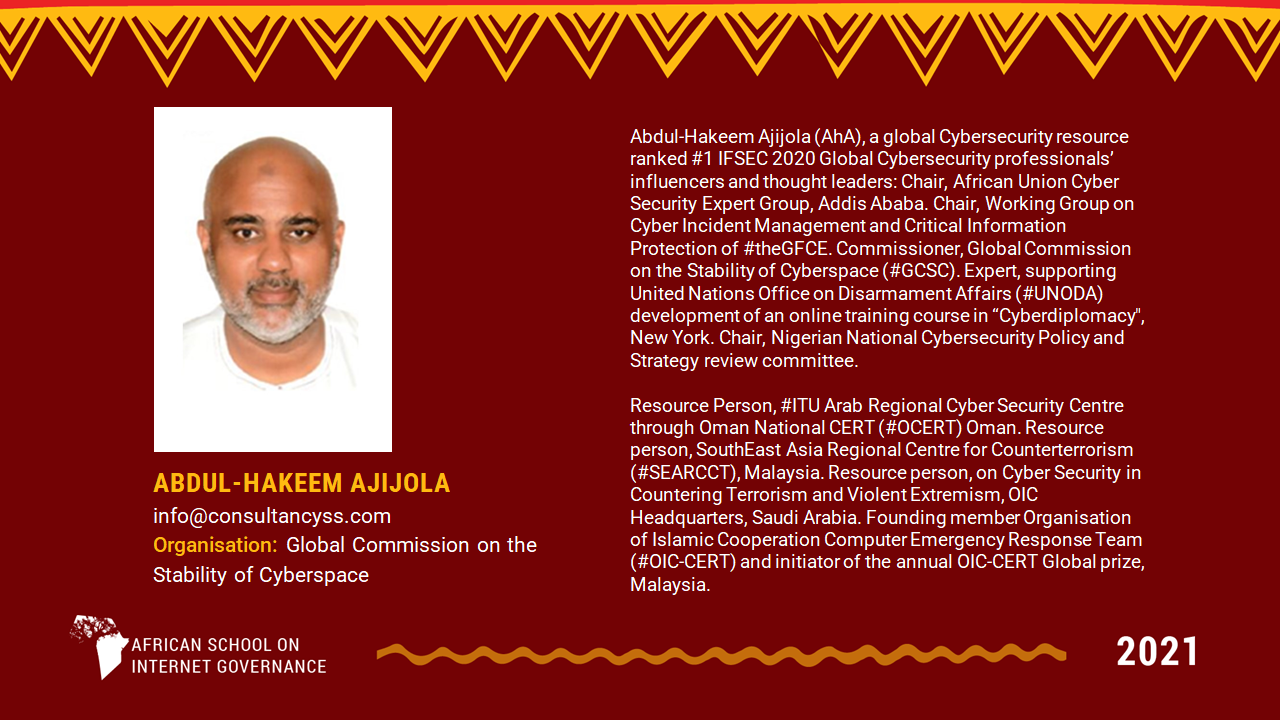
- ABDUL-HAKEEM AJIJOLA
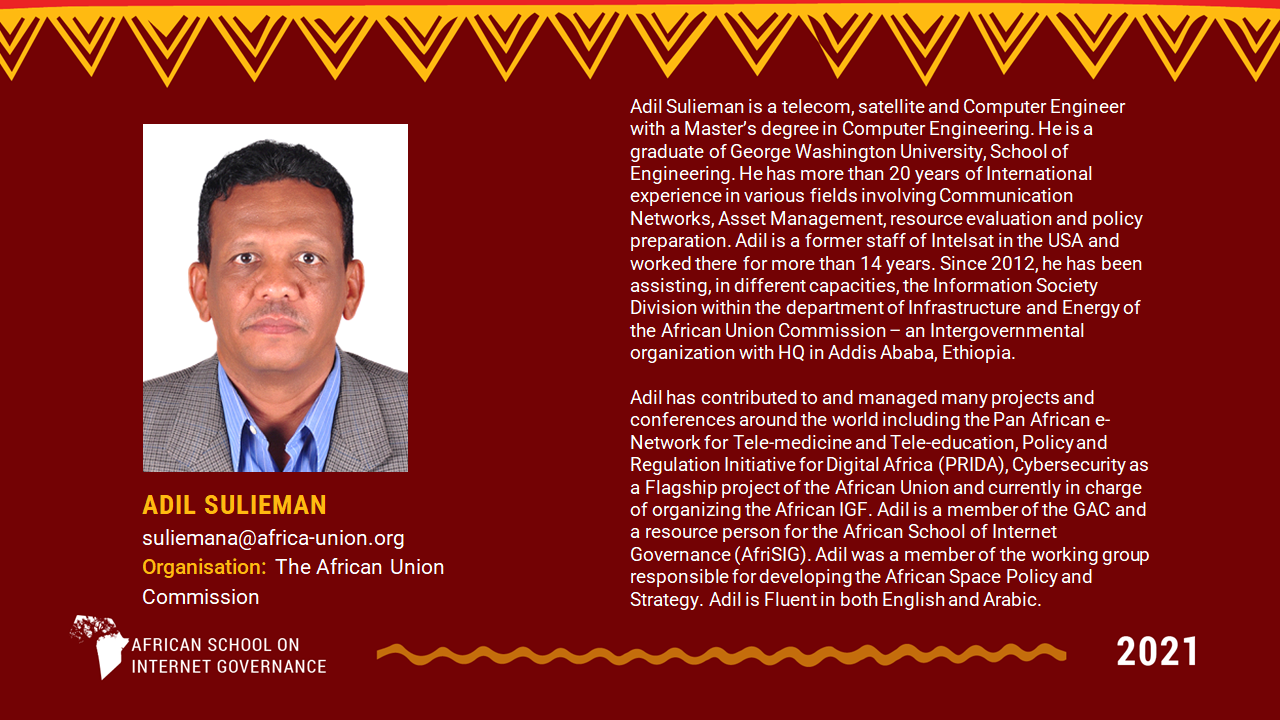
- ADIL SULIEMAN
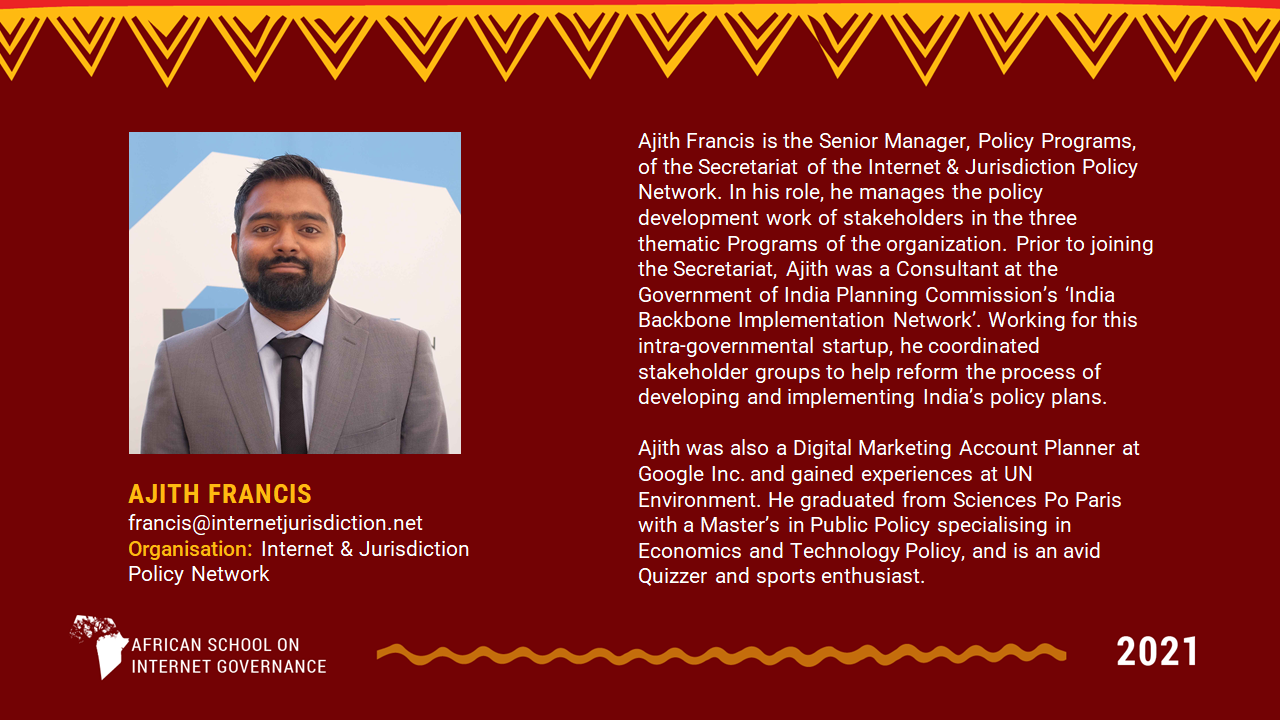
- AJITH FRANCIS
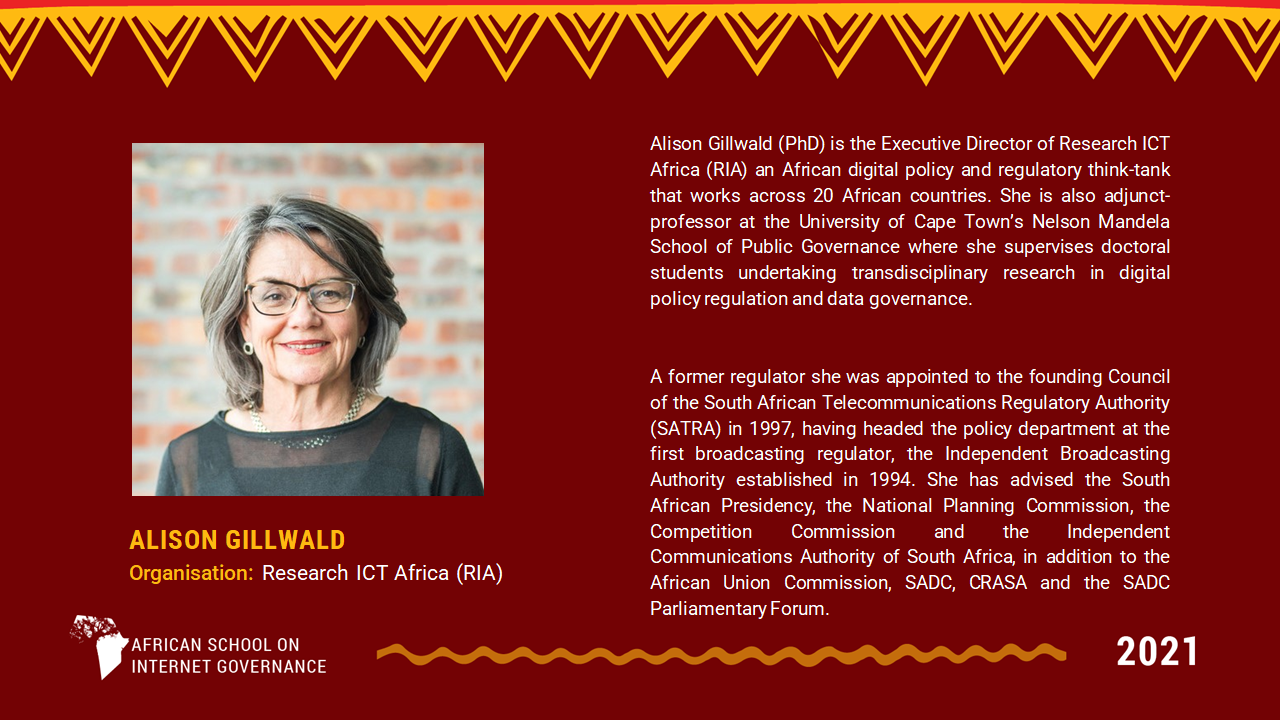
- ALISON GILLWALD
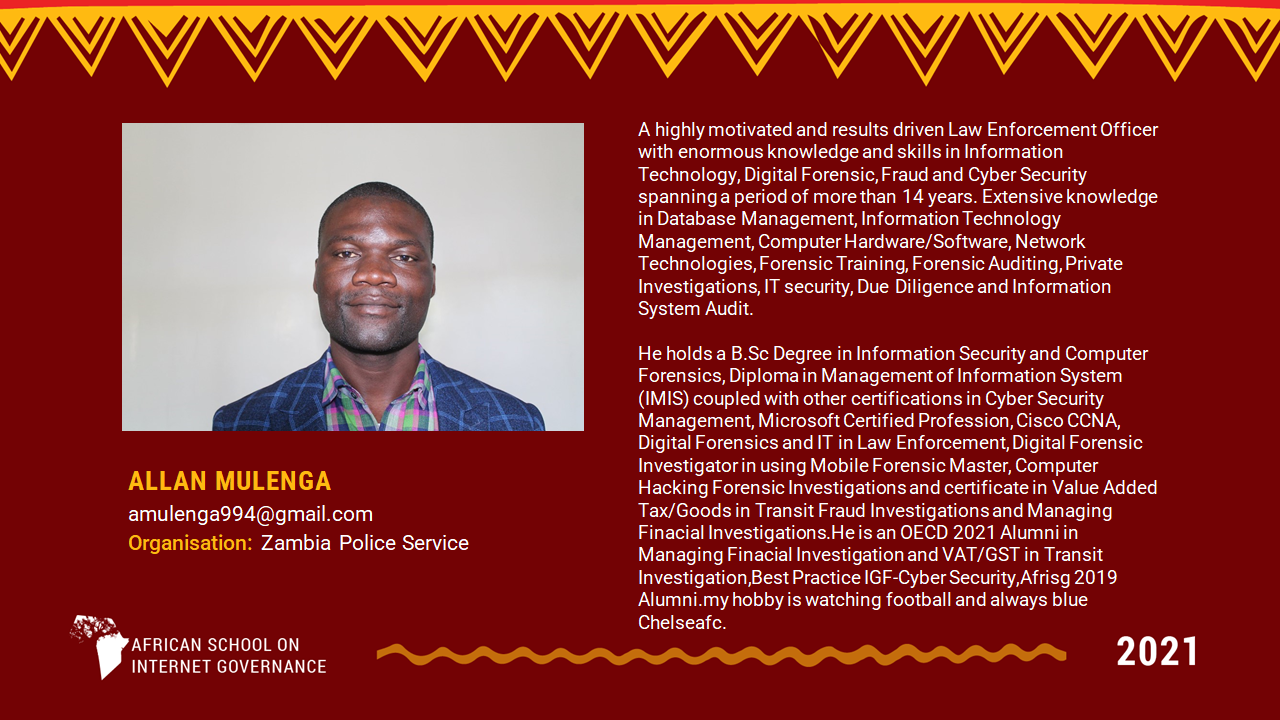
- ALLAN MULENGA
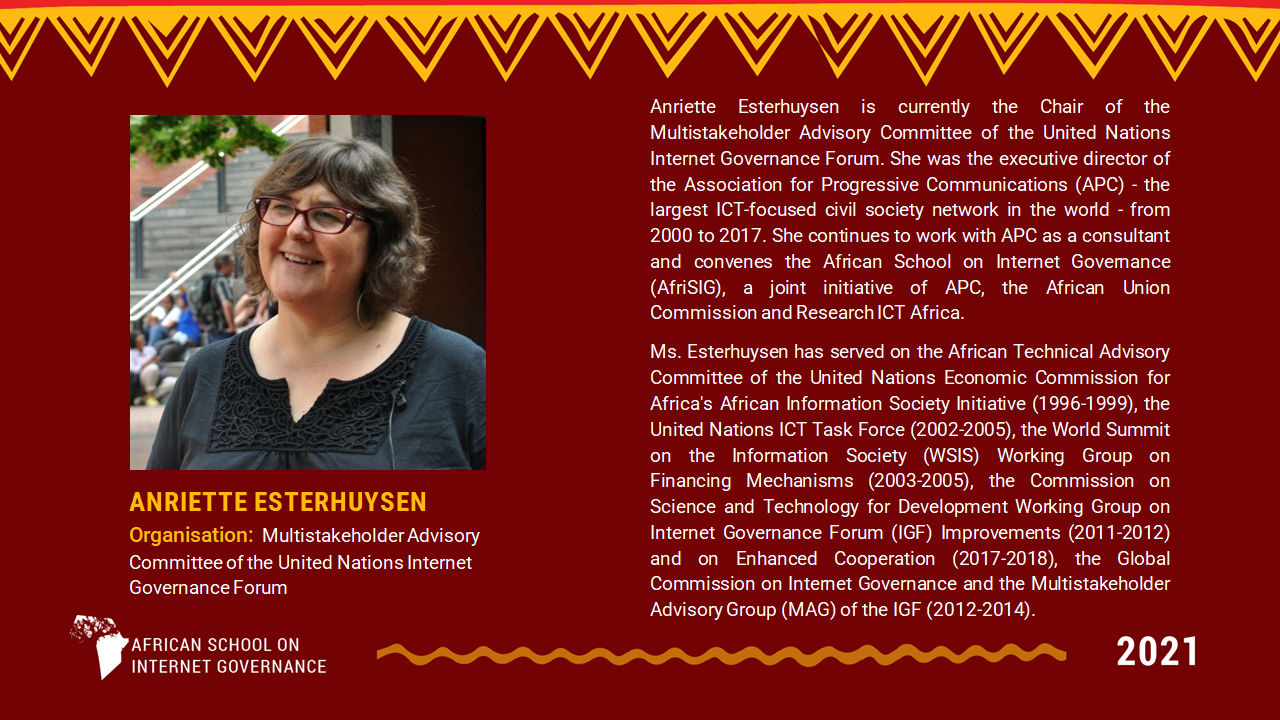
- ANRIETTE ESTERHUYSEN
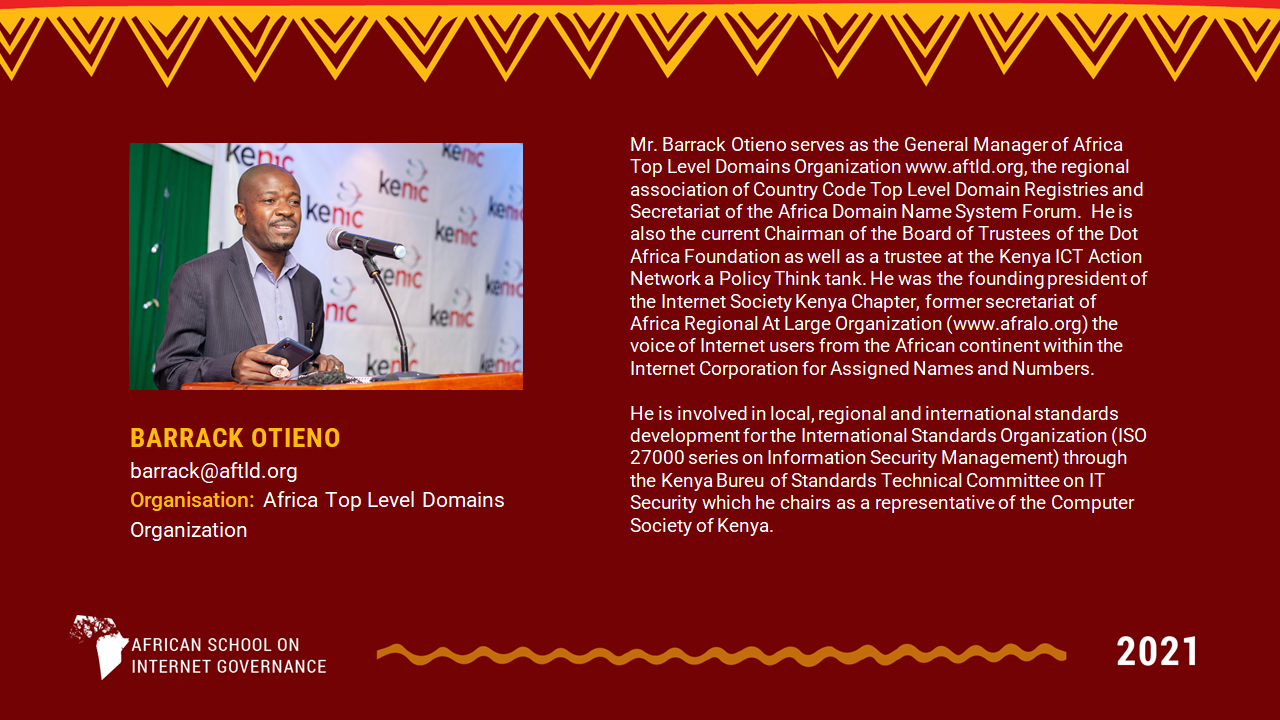
- BARRACK OTIENO
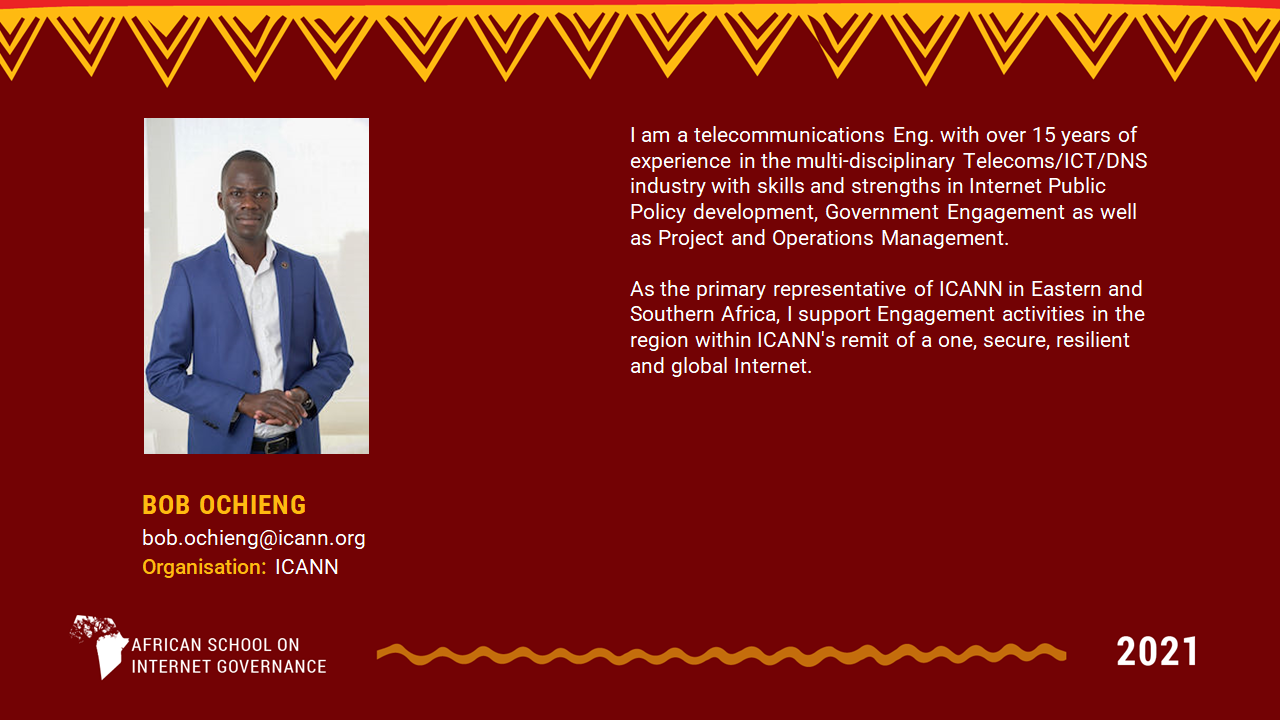
- BOB OCHIENG
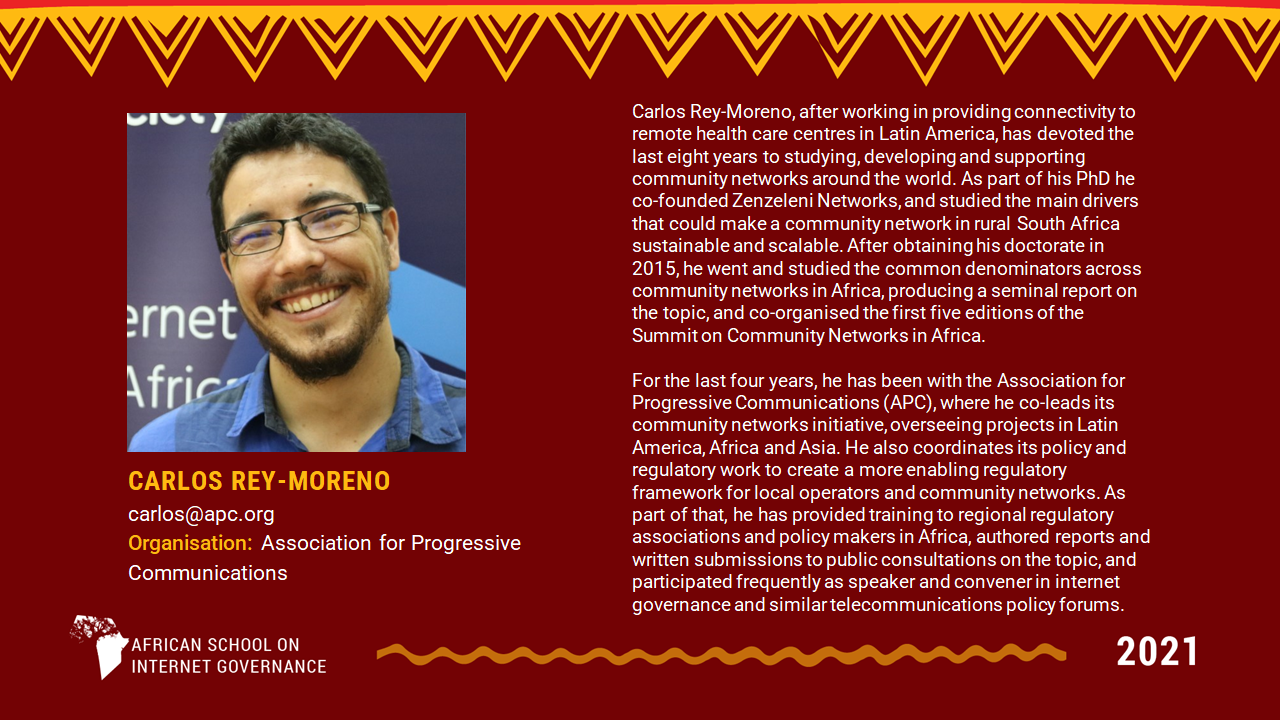
- CARLOS REY-MORENO
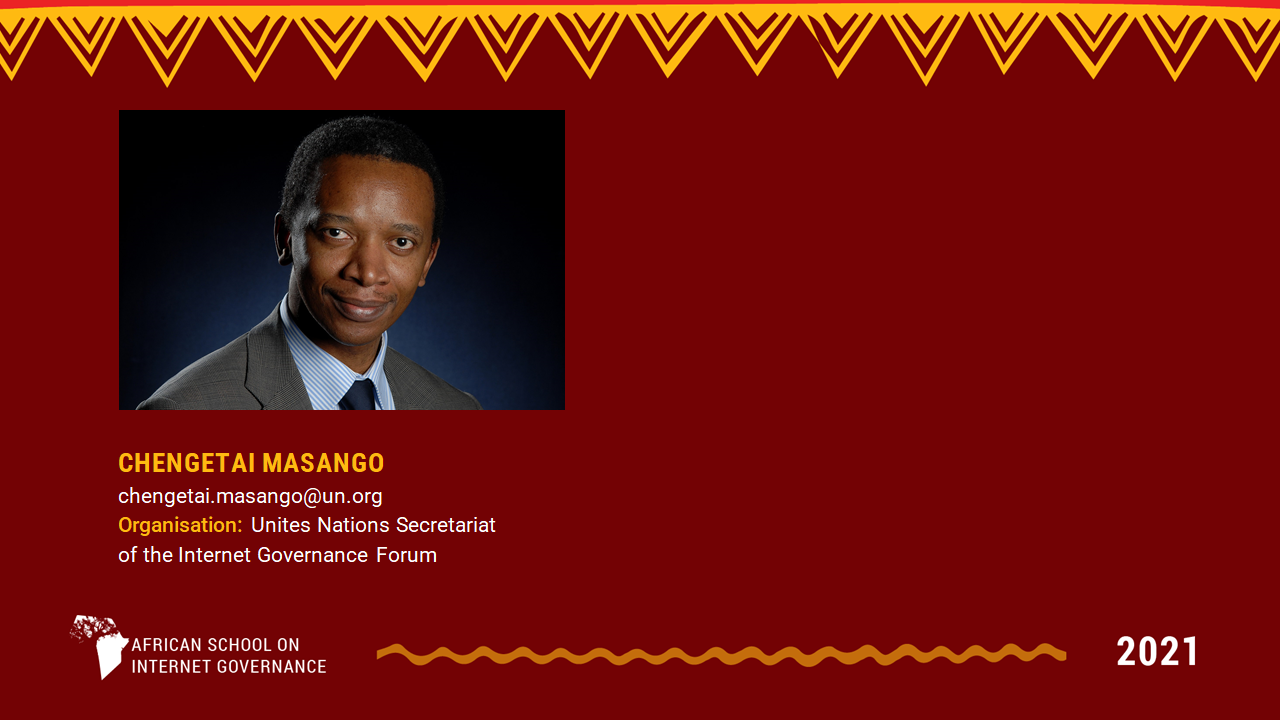
- CHENGETAI MASANGO
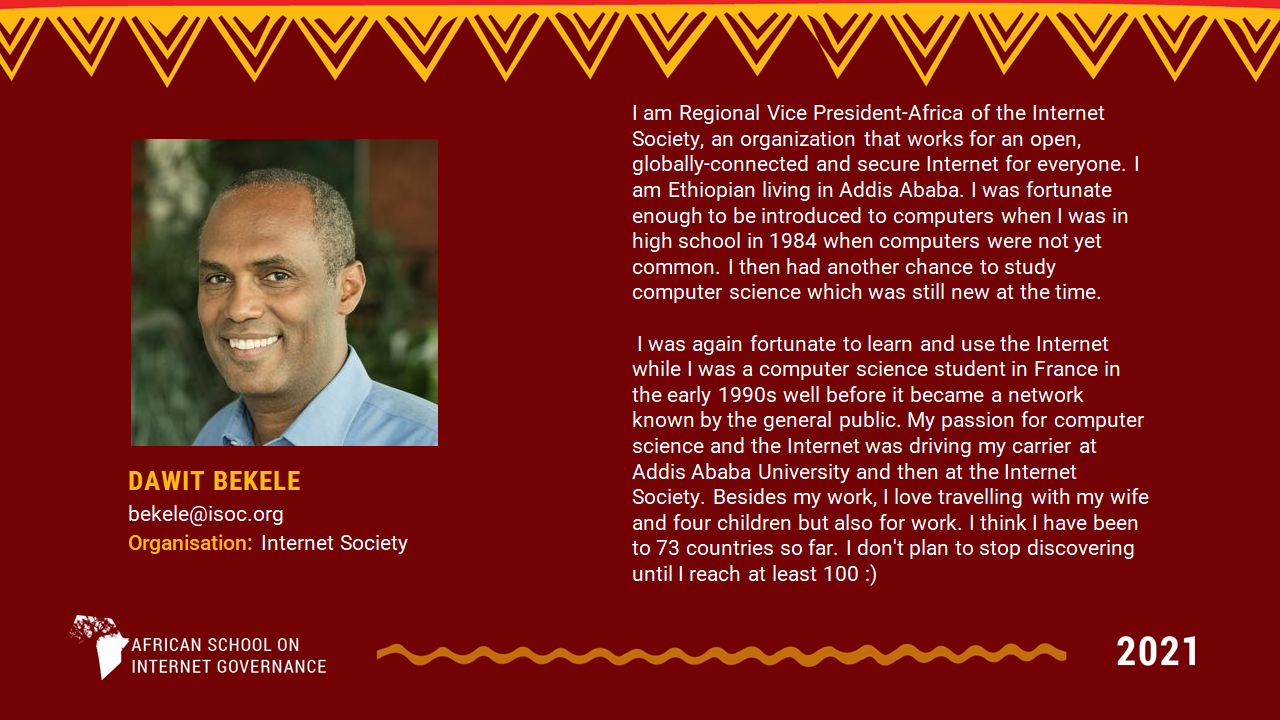
- DAWIT BEKELE
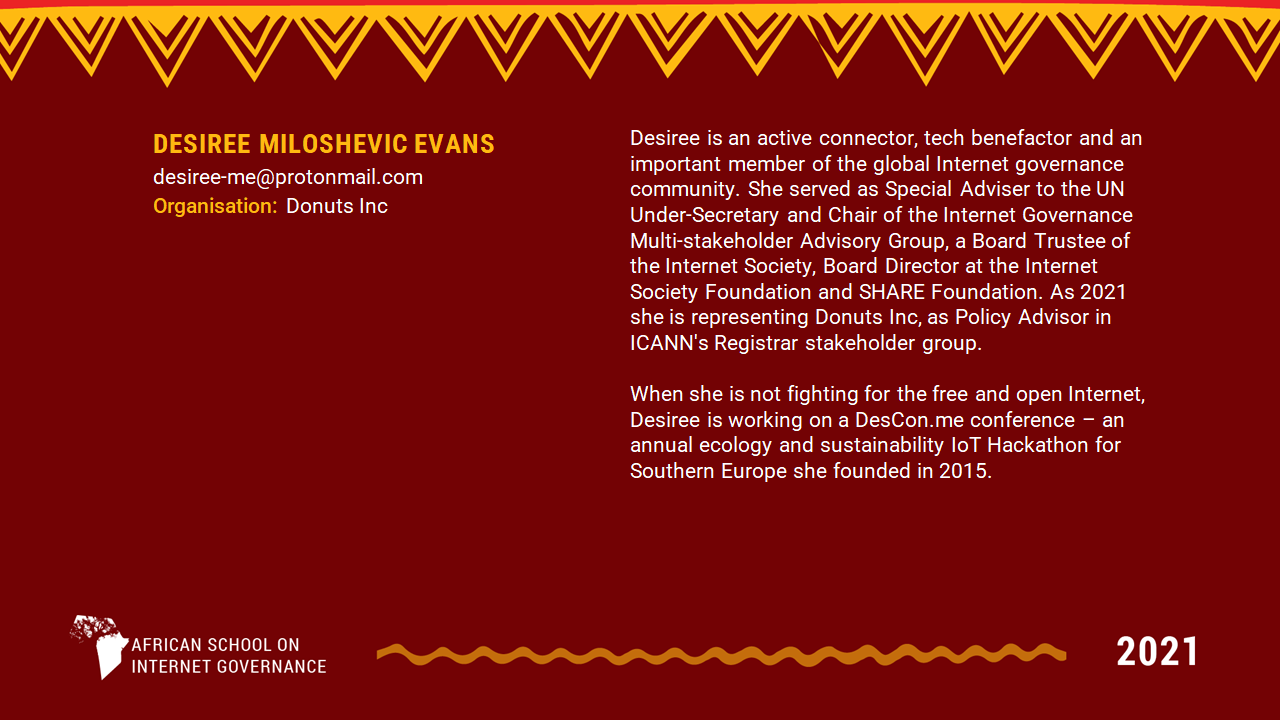
- DESIREE MILOSHEVIC EVANS
- DOMINIC CULL
- ENRICO CALANDRO
- EPHRAIM PERCY KENYANITO
- FELICIA ANTHONIO
- FIONA ALEXANDER
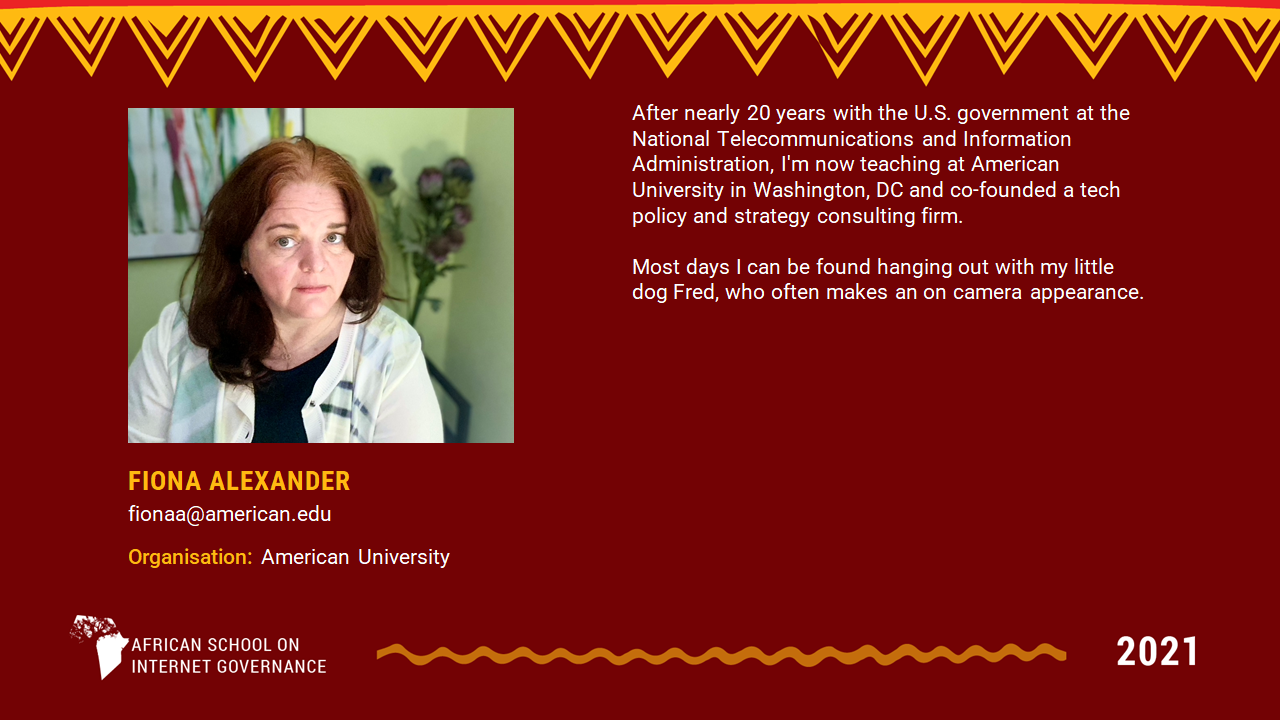
- GAYATRI KHANDHADAI
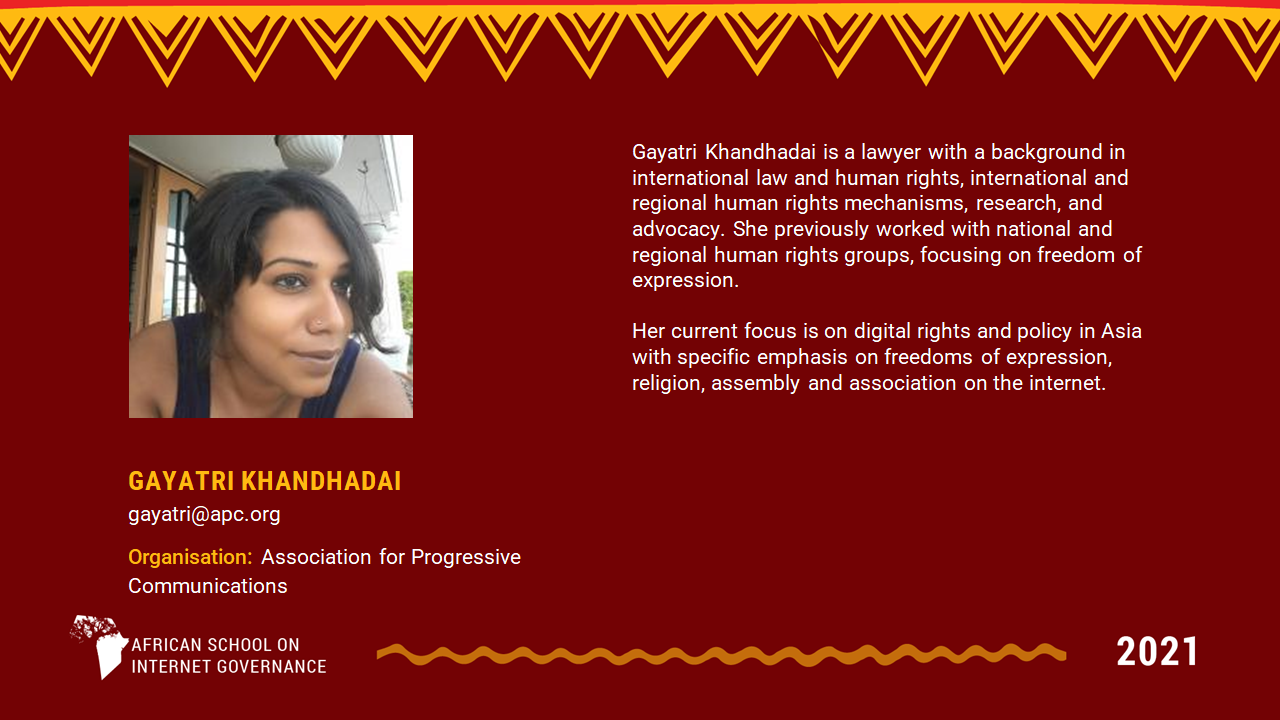
- 'GBENGA SESAN
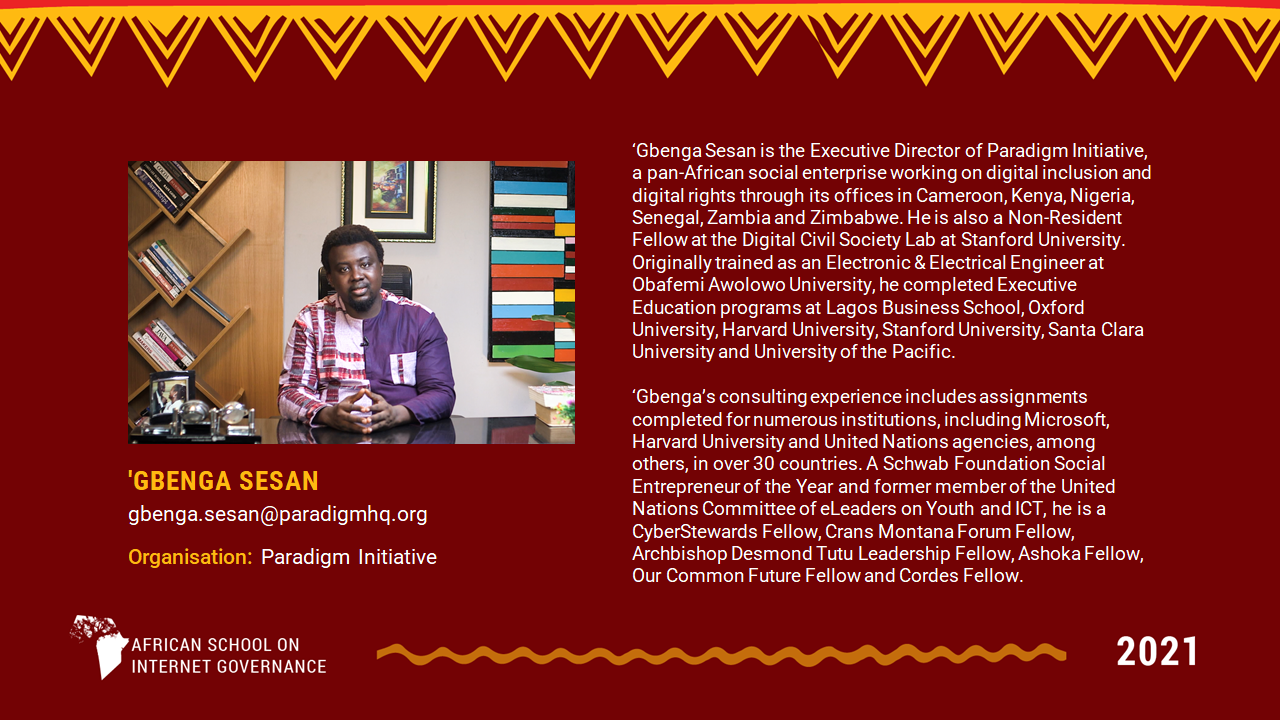
- KARIM ATTOUMANI MOHAMED
- KUDA HOVE
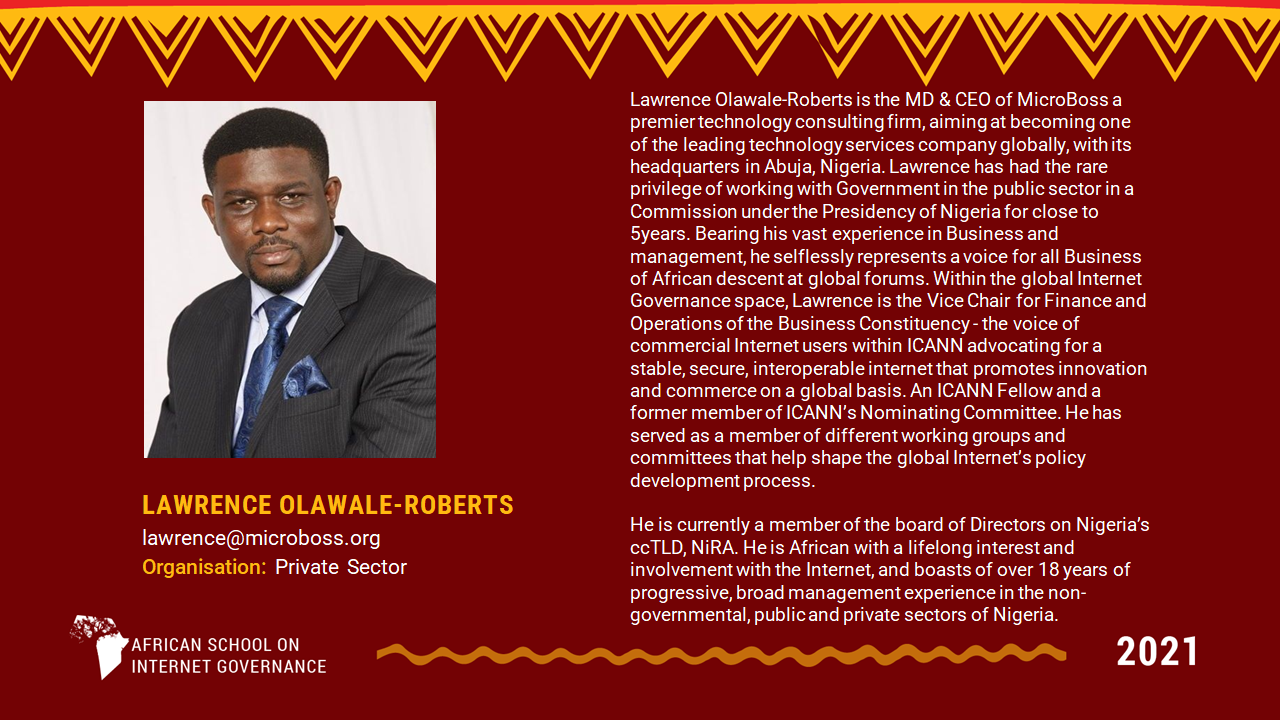
- LAWRENCE OLAWALE-ROBERTS
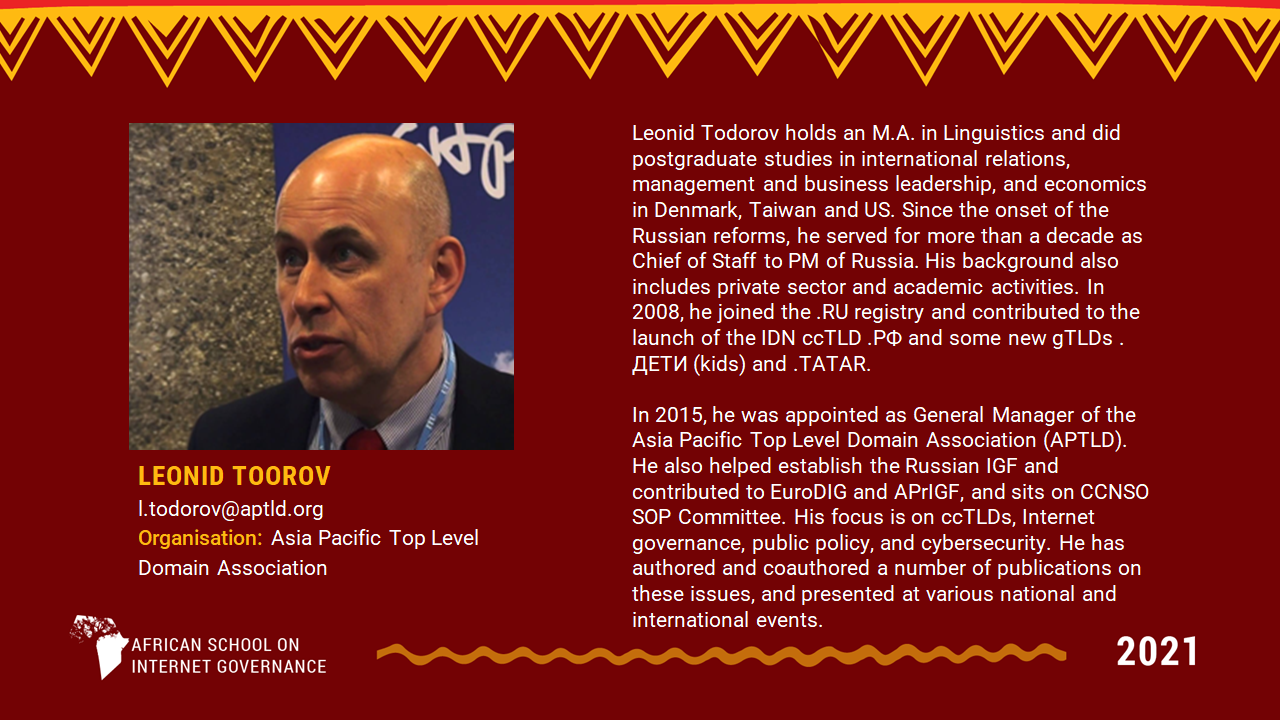
- LEONID TOOROV
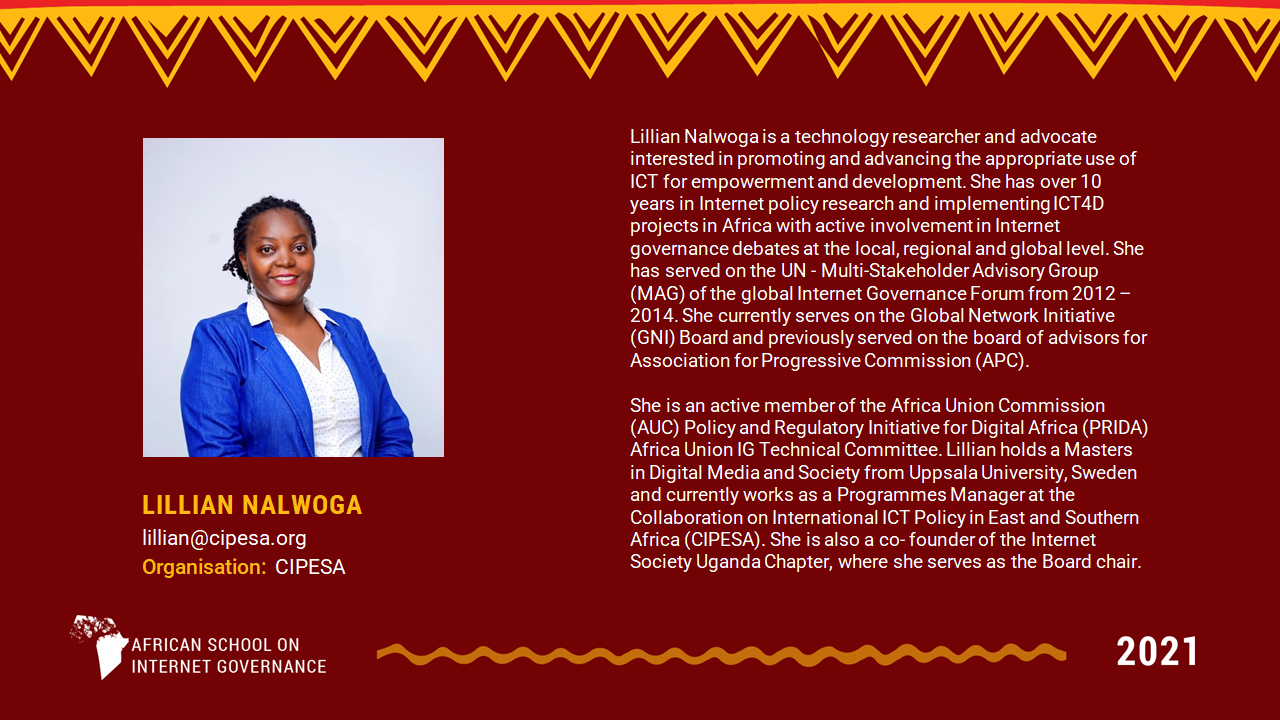
- LILLIAN NALWOGA
- MALLORY KNODEL
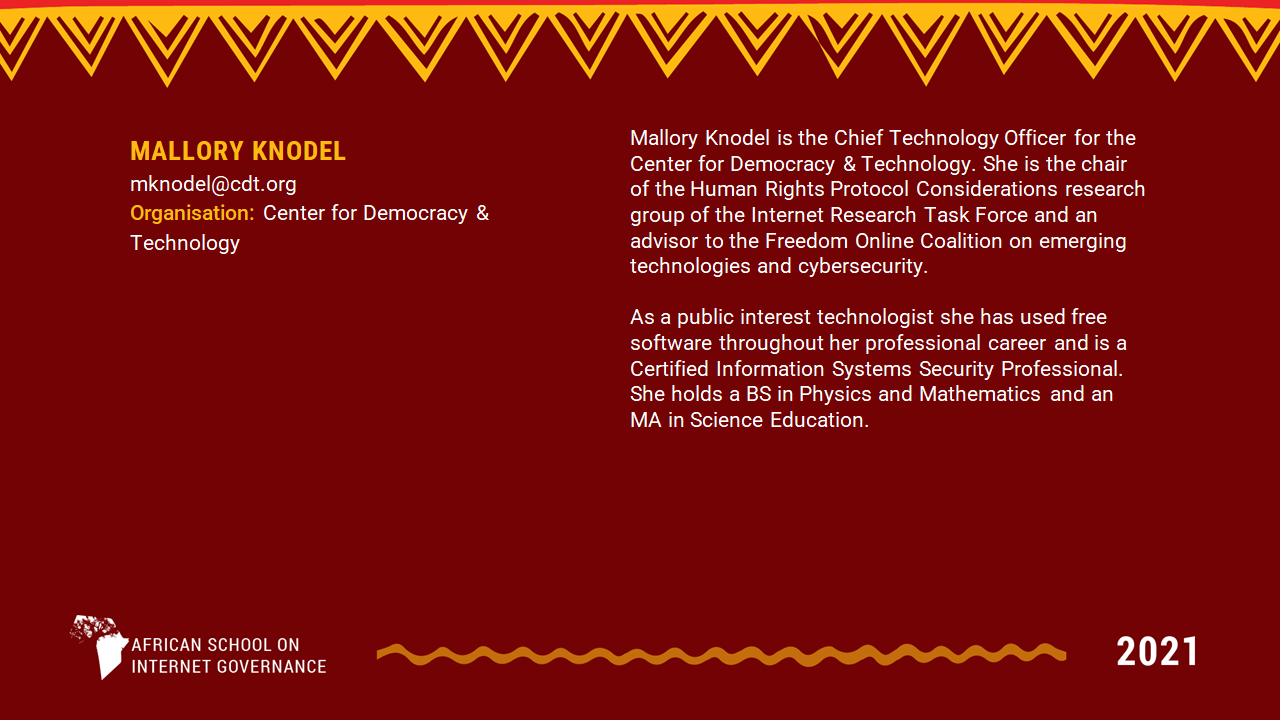
- MARGARET NYAMBURA NDUNG'U
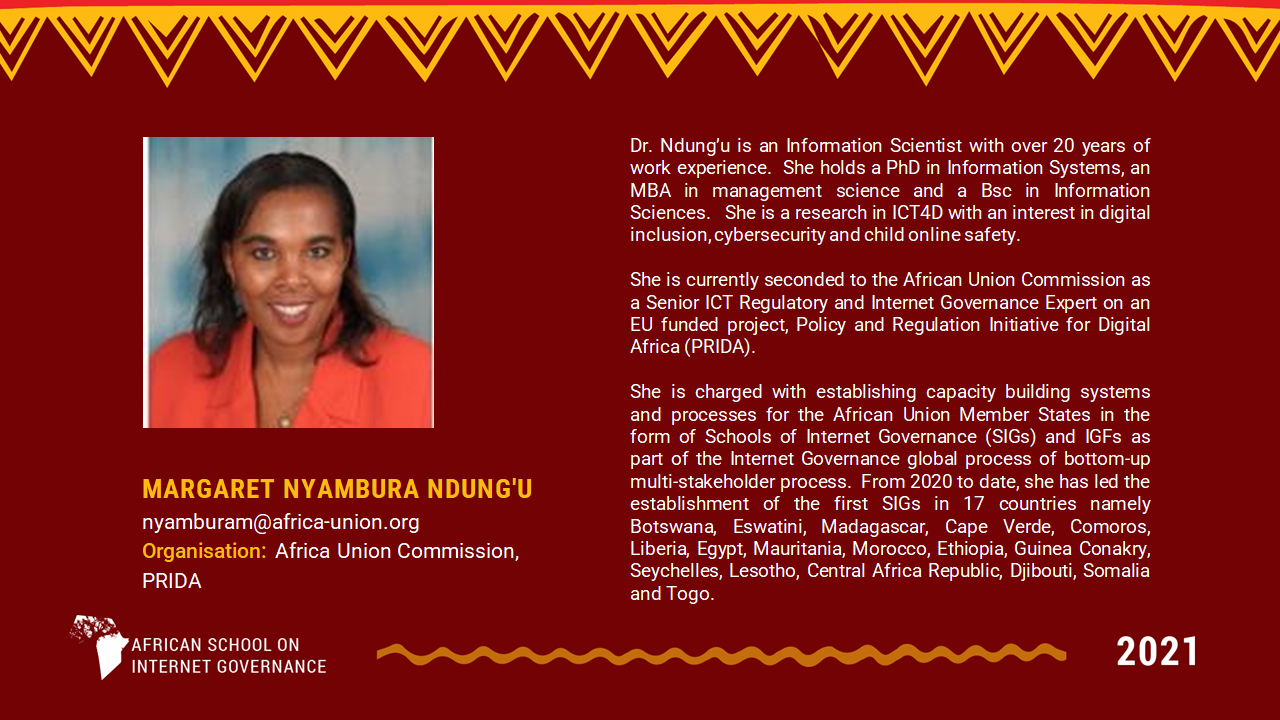
- MICHAEL ILISHEBO
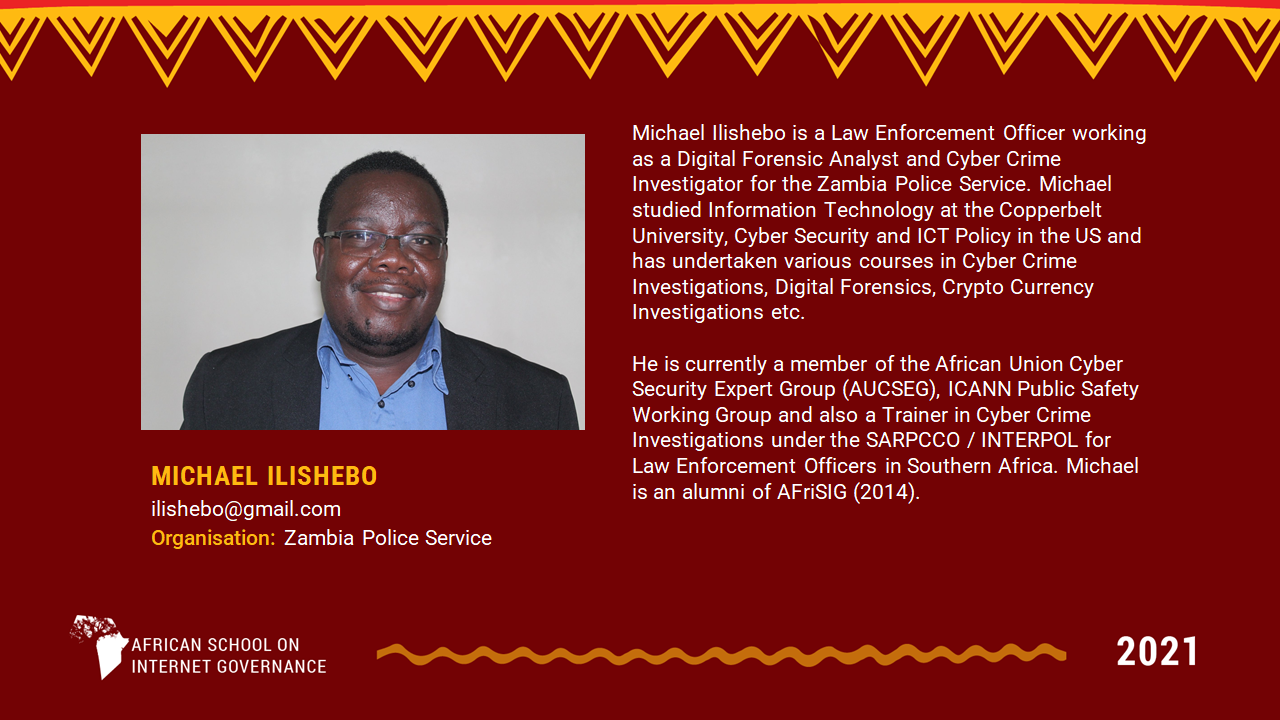
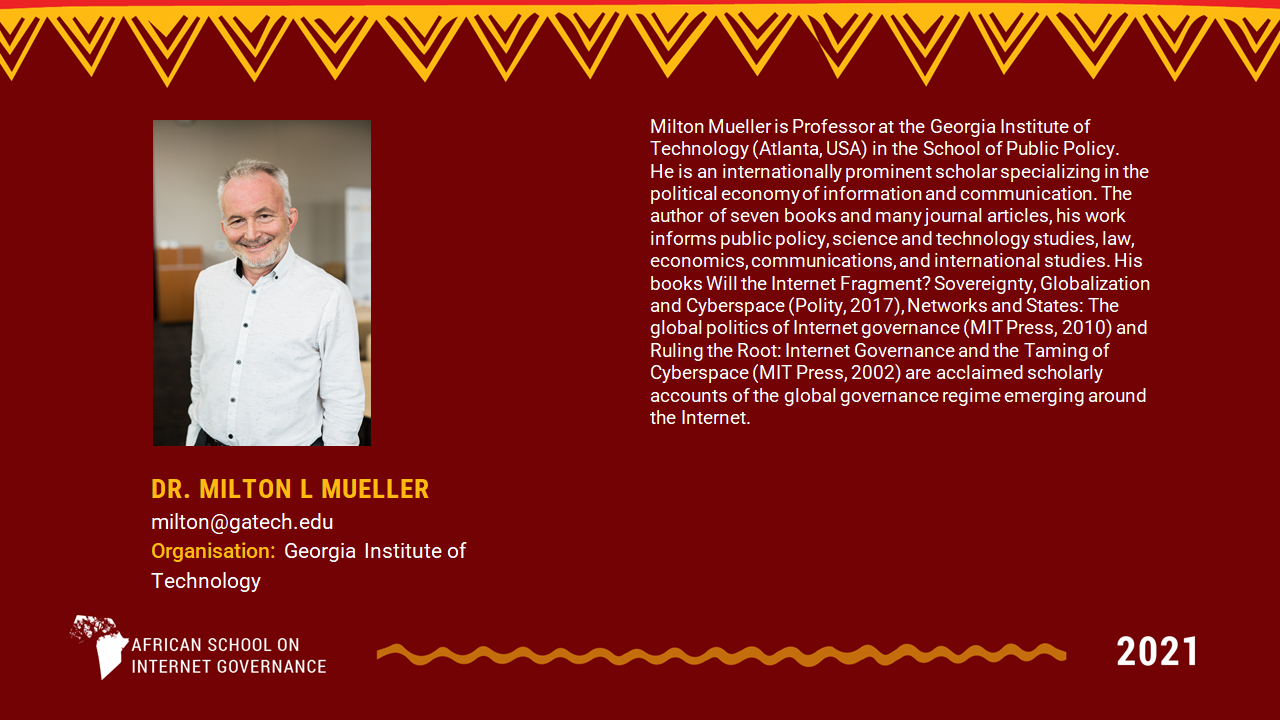
- DR. MILTON L MUELLER
- MOCTAR YEDALY
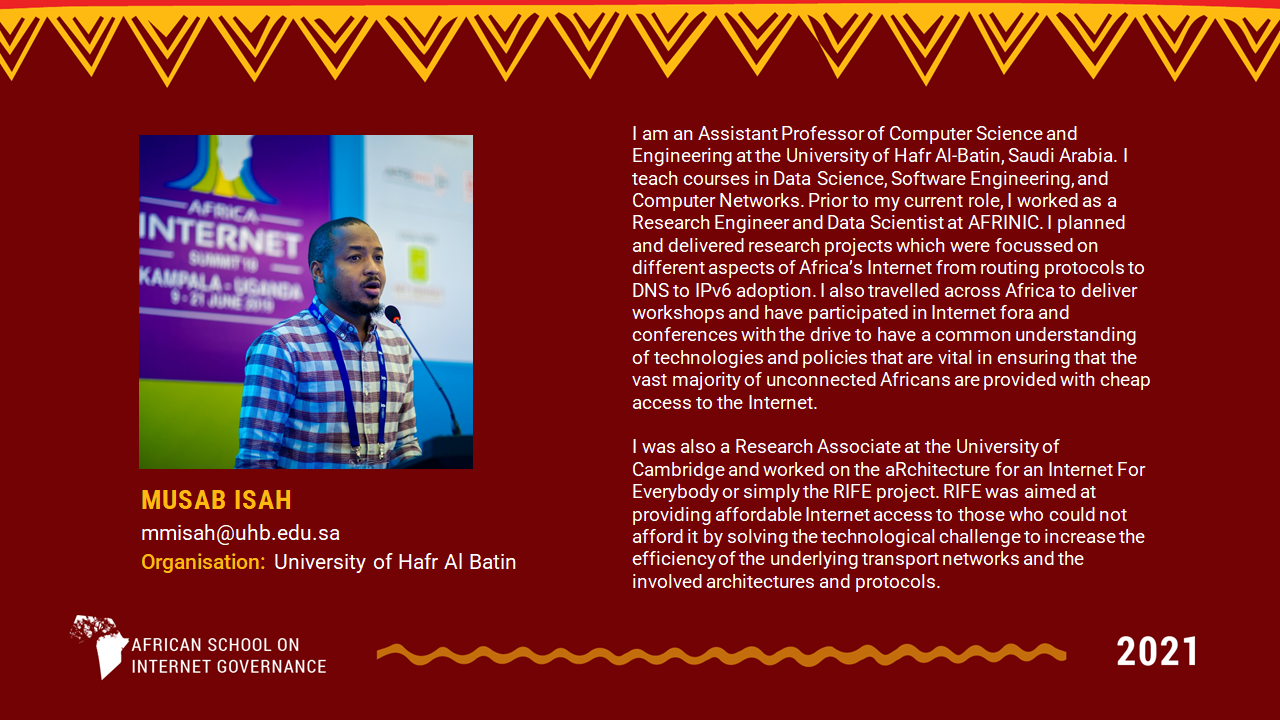
- MUSAB ISAH
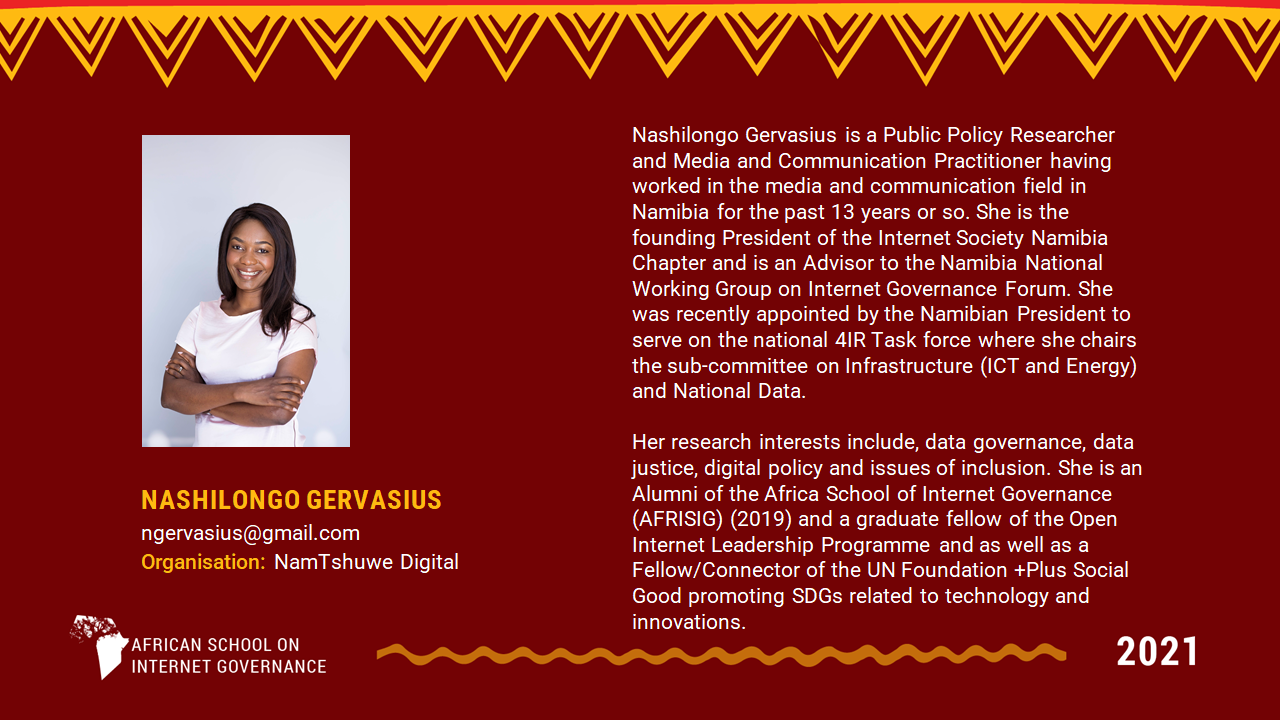
- NASHILONGO GERVASIUS
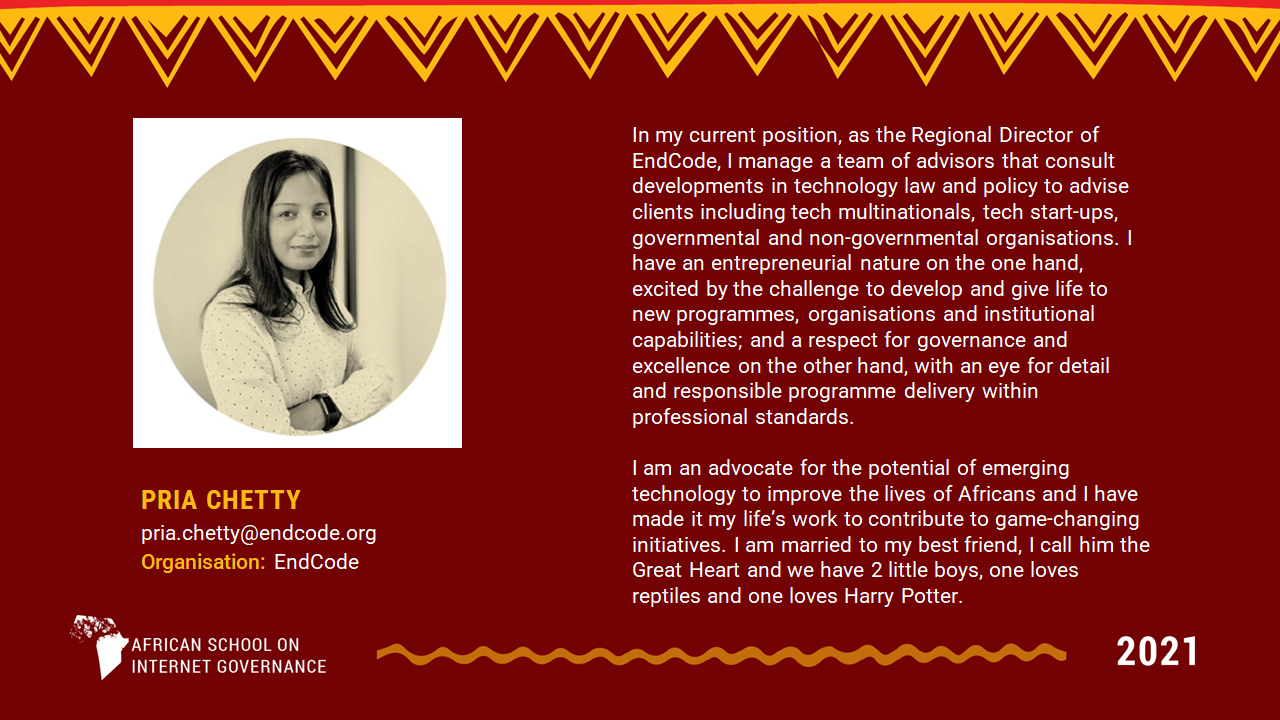
- PRIA CHETTY
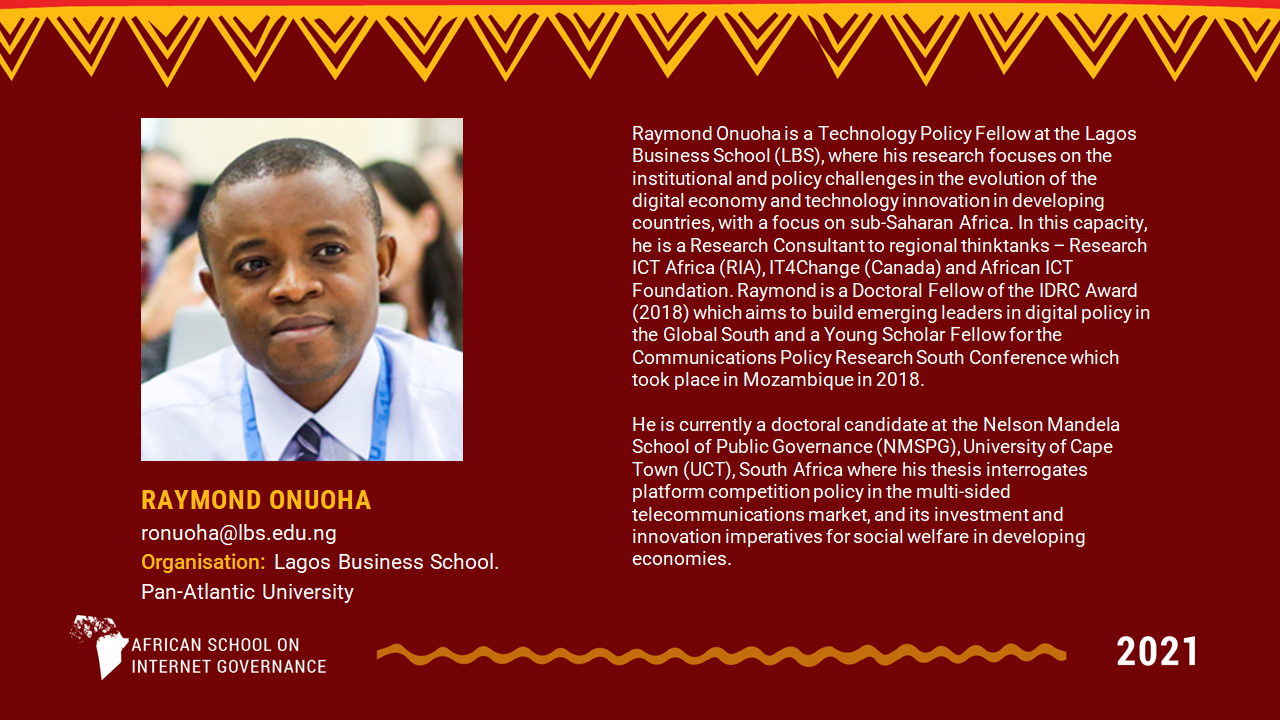
- RAYMOND ONUOHA
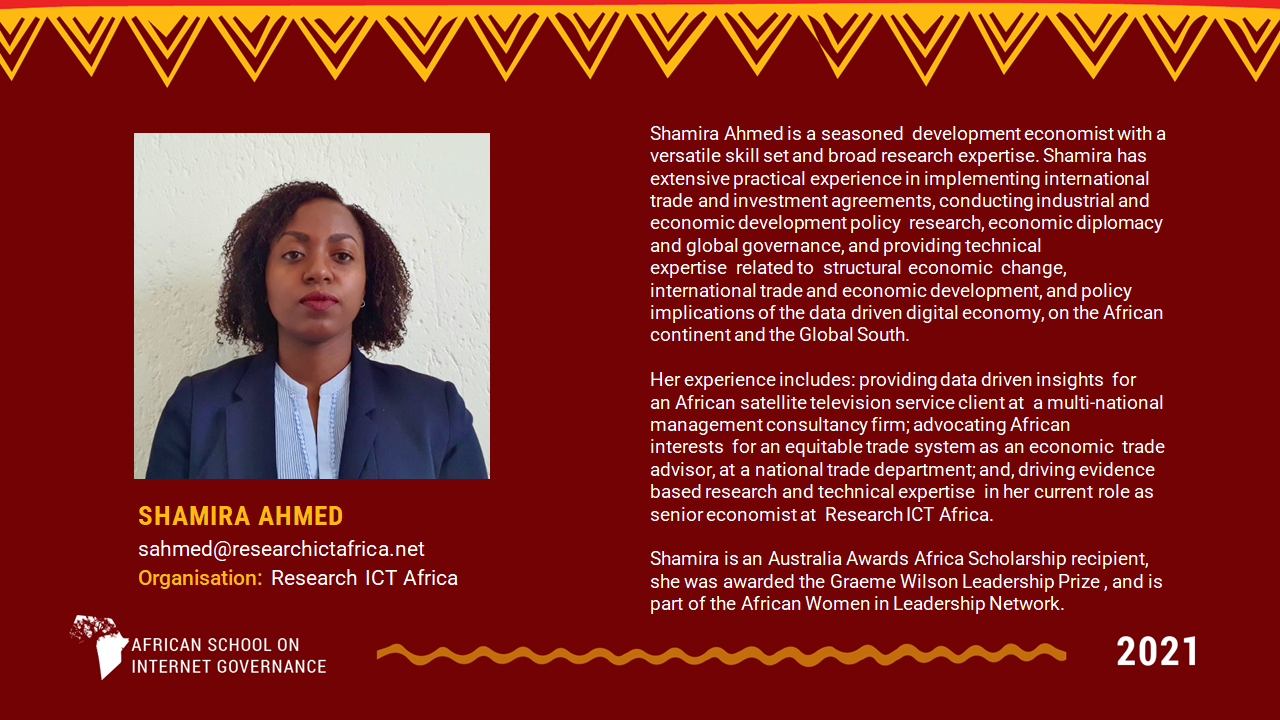
- SHAMIRA AHMED
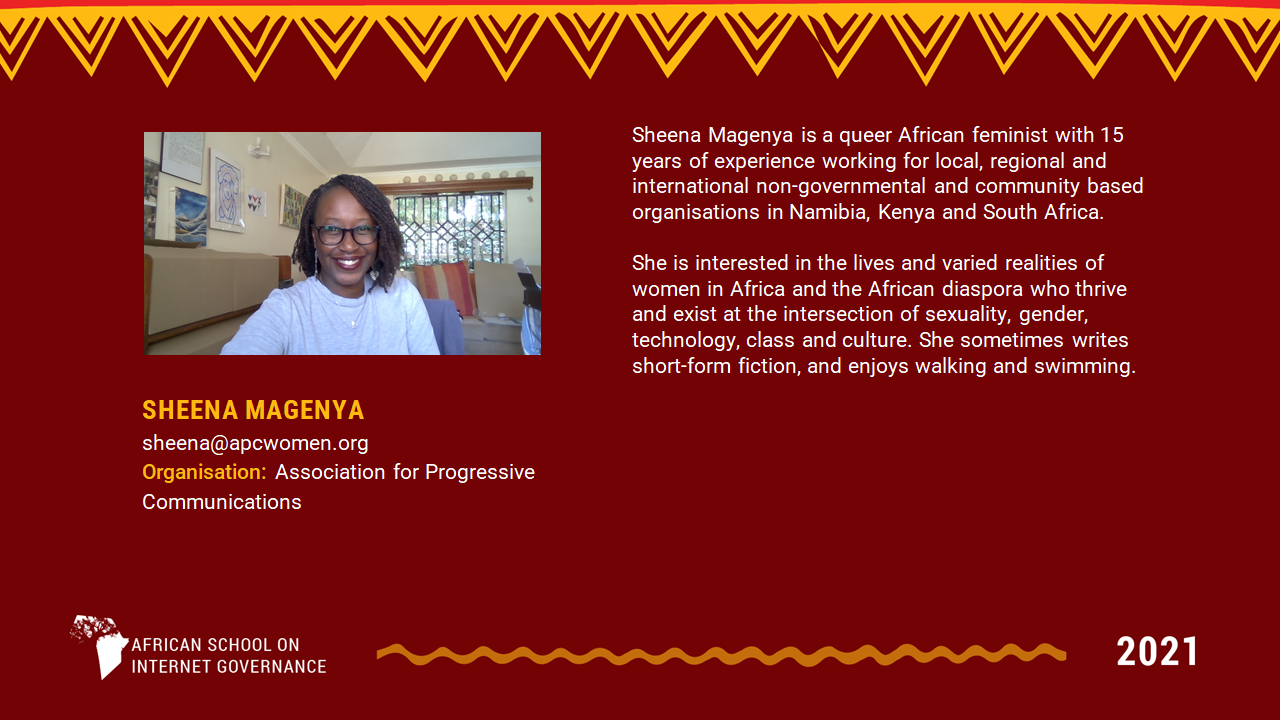
- SHEENA MAGENYA
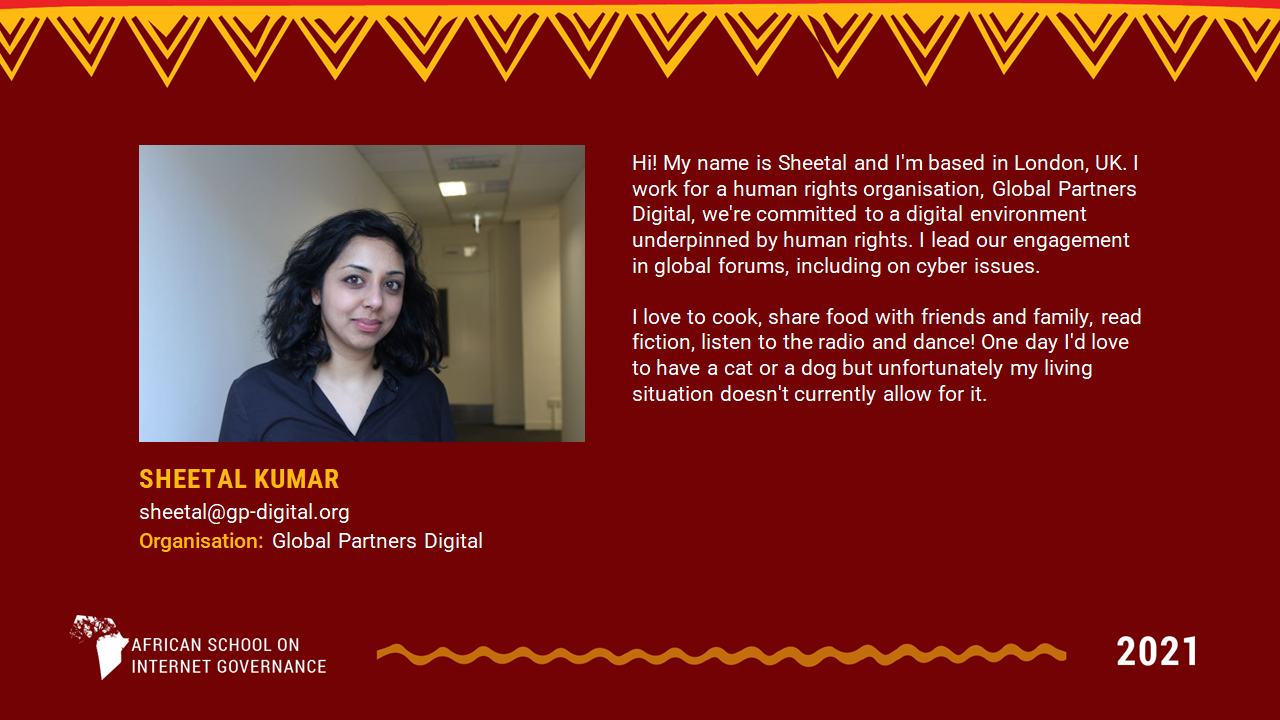
- SHEETAL KUMAR
- SOPHIE TOMLINSON
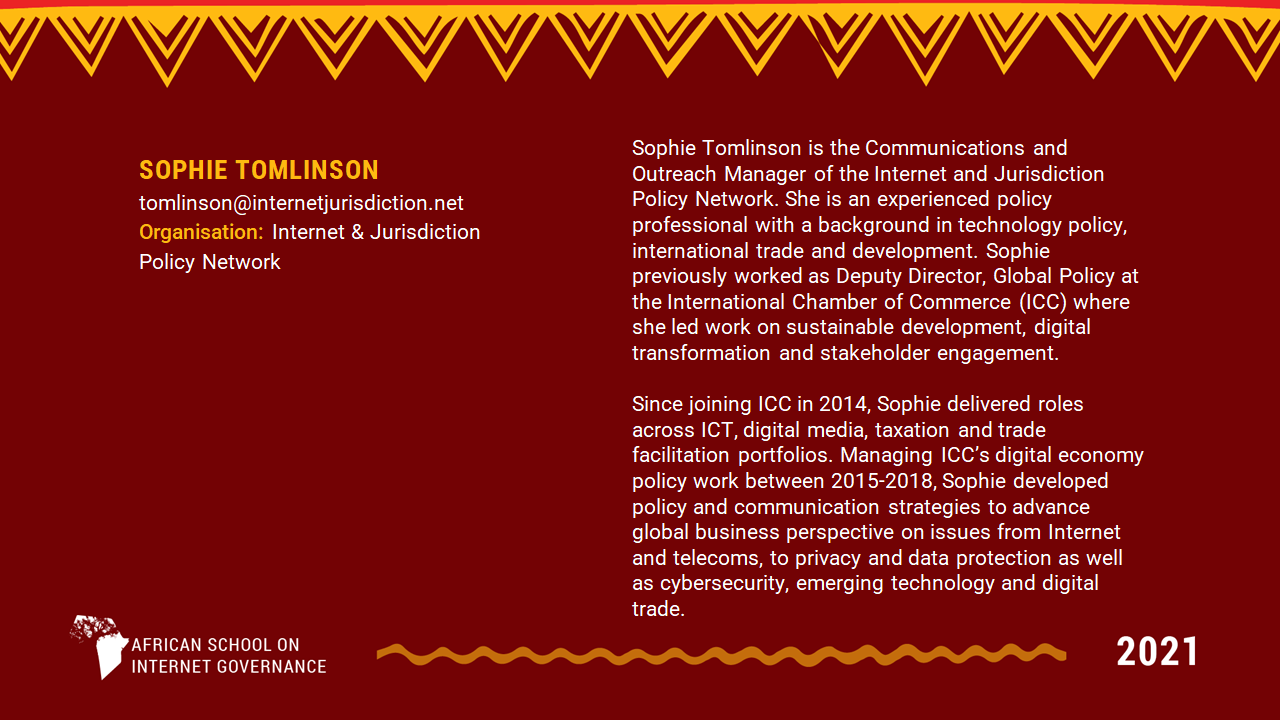
- TATIANA TROPINA
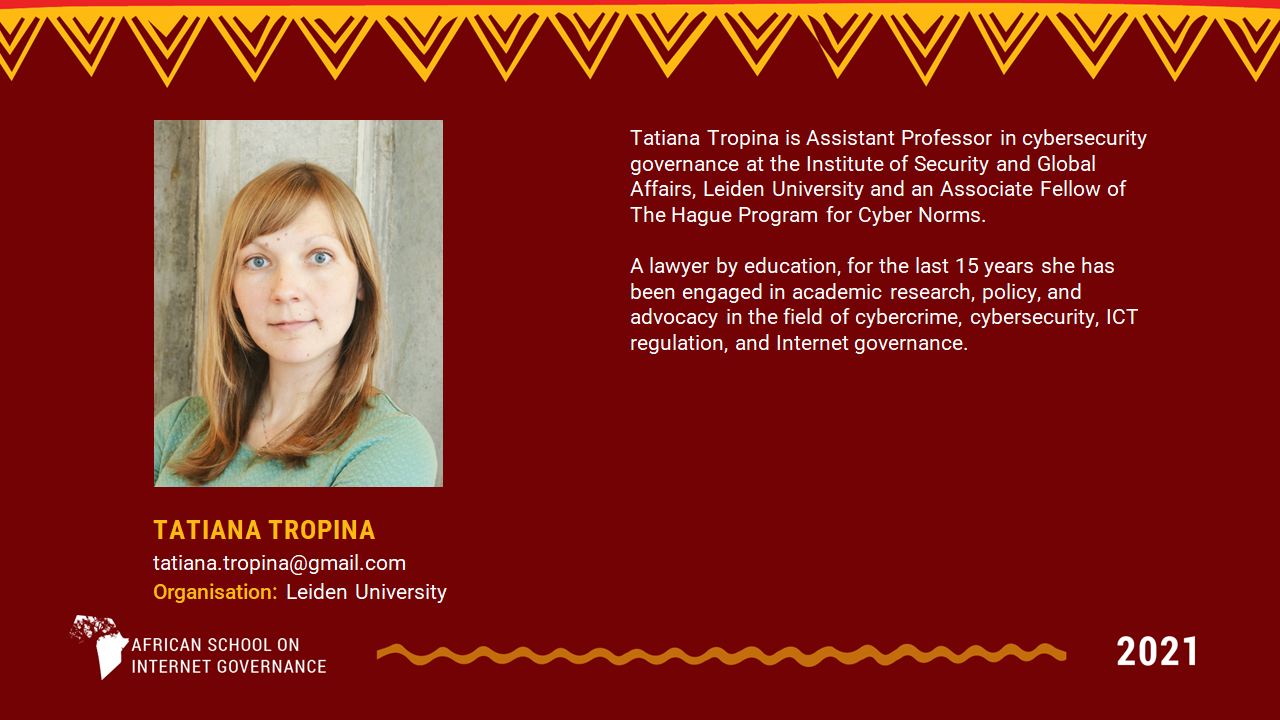
- TIMEA SUTO
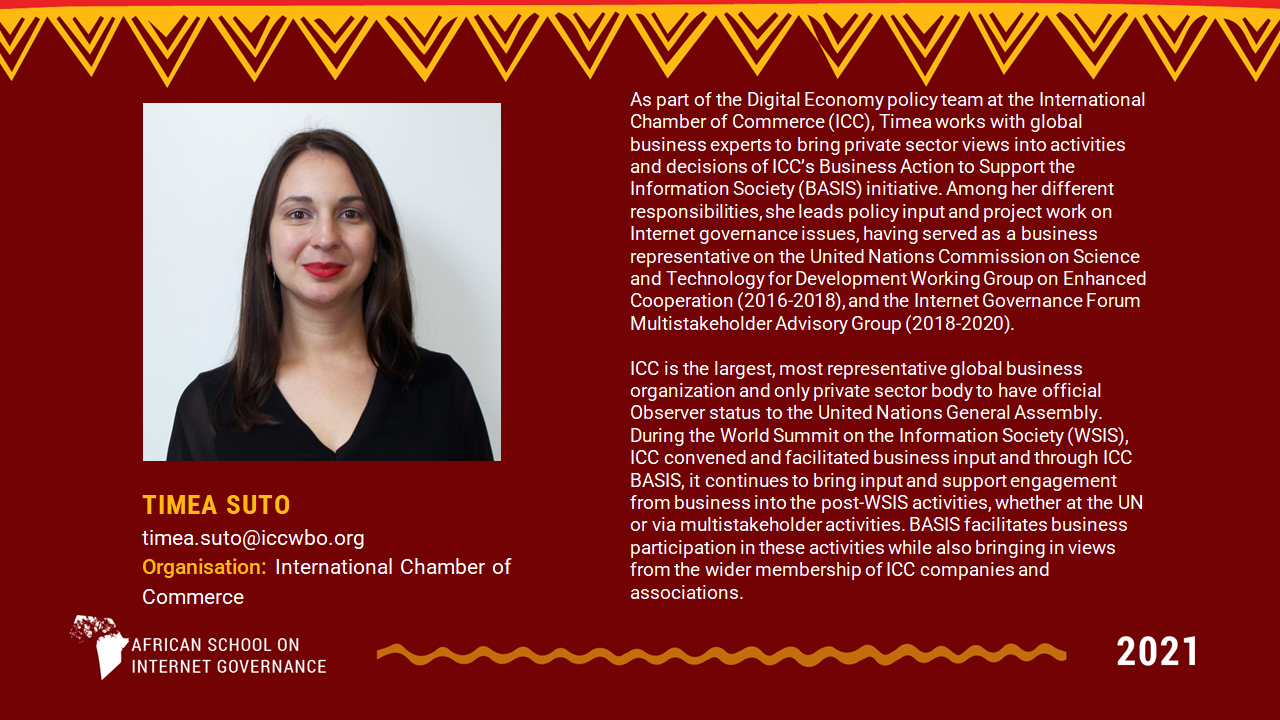
- VALERIA BETANCOURT
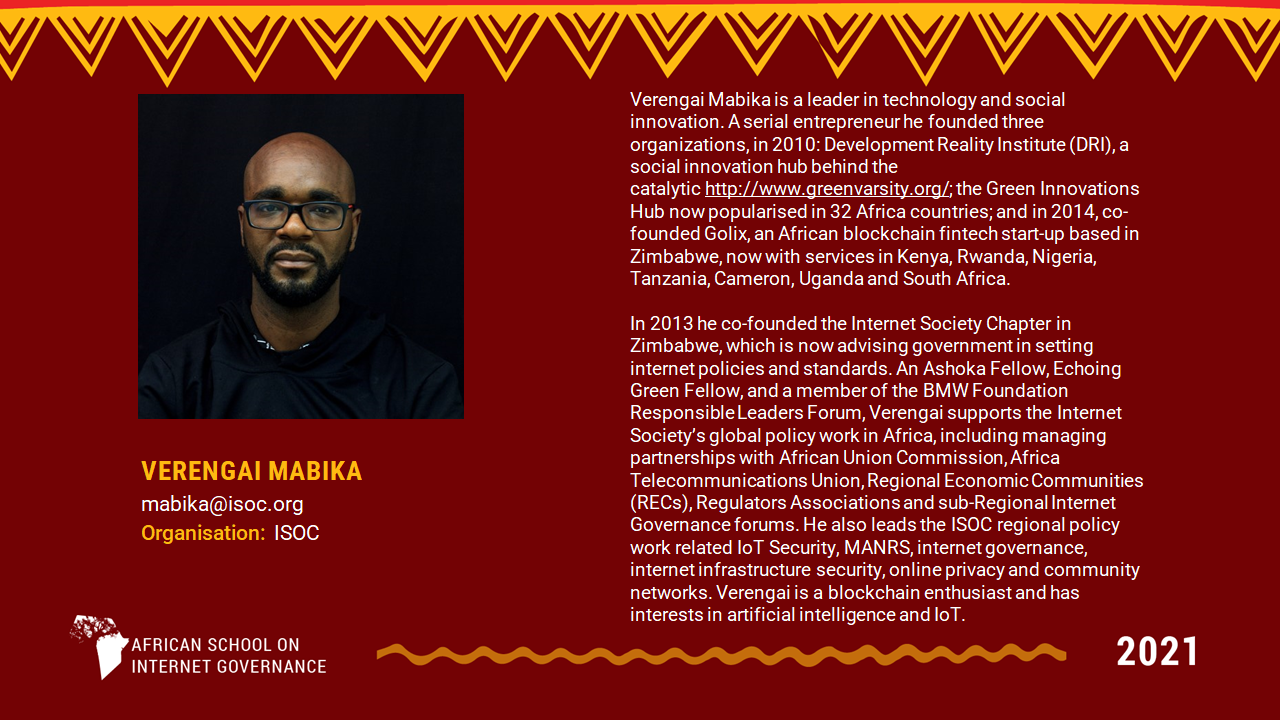
- VERENGAI MABIKA
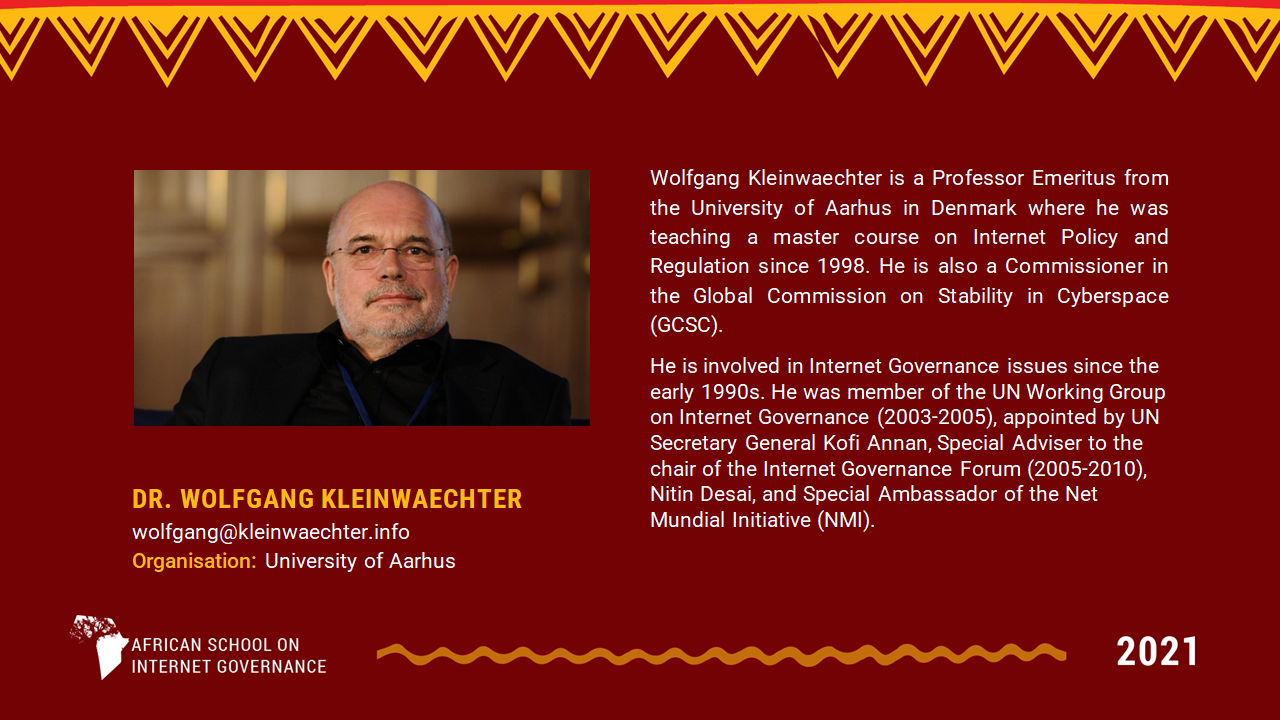
- DR. WOLFGANG KLEINWAECHTER
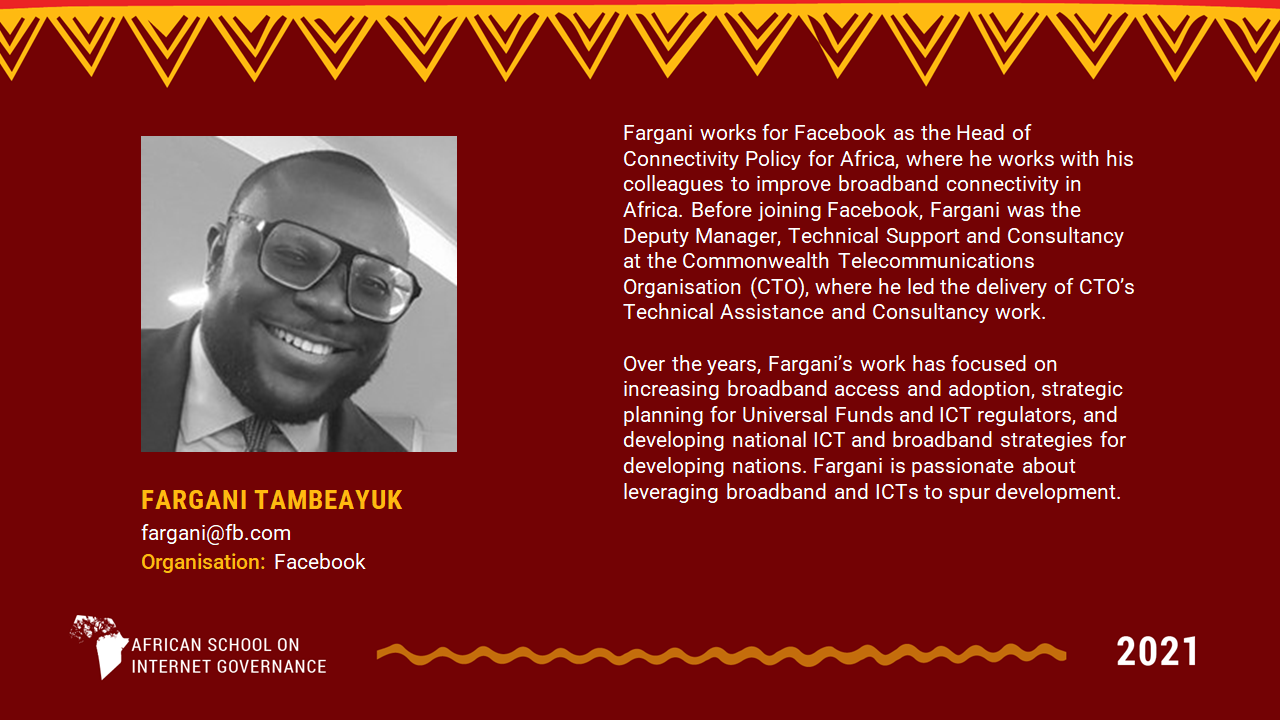
- FARGANI TAMBEAYUK
- 1️⃣ Principles of Participation
- ↗️ AfriSIG 2021 Website and Sponsors
- 🎶 Music Playlists for the School (Please let us know if you have recommendations!)
⏳ UTC Time Converter
Please check UTC Time Converter to know the time of the sessions in your local time zone!
📖 Read Me
 Welcome!🎉Welcome!🎉
Thank you for participating and contributing with your knowledge to the first online African School on Internet Governance (AfriSIG) 2021.
This year’s edition will take the form of a two-week online programme with sessions from 4 to 15 October 2021.
This Readme[1] document is the “what-I-need-to-know” guide to orient and encourage participation. You will find here information and useful links to navigate the event.
When?
- From 4th to 15th October 2021
- From Monday to Friday from 07:00 to 11:30 UTC
- Check out the school Agenda and Overview
This year edition of AfriSIG has 38 participants drawn from 17 countries and over 40 regional and international based faculty members and resource persons. We have tried our best to find a good working option for your real-time engagement.
Who is attending?
- 2021 Fellows and Alumni
- Faculty members, resource persons and guest speakers
- AfriSIG Founders and Supporting Organizations
- AfriSIG Coordination Team
- Documentation Team
AfriSIG coordinating team roles and contacts
AfriSIG event Coordination team is composed by Koliwe, Shivi, hvale you can reach them via email or using the mailing lists for issue relevant for all participants: Koliwe: koliwe@apc.org; Shivi: shivani@apc.org; hvale: hvale@apcwomen.org
AfriSIG Curriculum Team is composed by Anriette, Gaya and Molly. You can reach them via email or using the mailing lists for issue relevant to the course content: anriette@apc.org, Gaya: gayatri@apc.org and Molly: mollyhammond88@gmail.com
AfriSIG Practicum Coordinator, Avri will coordinate the activities around the practicum, you can reach out to Avri: avri@apc.org for any question and doubts you have on the practicum.
APC Tech support will be provided by Maja, you can reach out to Maja: majak@apc.org for any technical question related to the mailing lists, Zoom and the wiki.
Remember that to access the schedule and programme on AfriSIG Bookstack Wiki (Wiki) you have to login in with your registration email.
APC Tech will not provide support for Google Drive and Google Documents.
Event incident team is composed by Koliwe (koliwe@apc.org), Shivi (shivani@apc.org) and Avri (avri@apc.org). Participants can reach them anytime by email or phone. Please contact any member of the Event Incidents Team with any questions or concerns you may have throughout the duration of the event. Complaints will be treated confidentially.
How will it work?
AfriSIG2021 is the 9th edition of the school, and the first held fully online.
AfriSIG’s goal is to develop a pipeline of leading Africans from diverse sectors, backgrounds and ages with the skills to participate in local and international internet governance structures and shape the future of the internet landscape for Africa's development.
Lectures and Practicum Plenary are concentrated in the morning. The afternoons are open for participants day jobs and for self-organised practicum sessions.
AfriSIG is a registered participants only event. The email address you have provided in the registration is the one that identifies you as a registered participant. You should have received or will receive and email that will allow you to access the Wiki.
If for any reason you did not received it or find yourself unable to use/access your registered email please reach out asap the APC Tech Support Team (majak@apc.org) via the mailing list or write directly .
Documentation
All throughout the convening we will take different type of records:
- Audio and/or video recordings will be for internal and documentation use only, express consent will be asked before starting the recording of the session. All recordings are stored securely on APC servers.
- There will be two documentors: Chileshe Gloria Mange and Wairimũ Murĩithi in the main sessions who will take text notes for internal reports and to incorporate learning into our work and practices.
Data cost reimbursements
Moving from face-to-face events to online remote ones brings novelties, including finding sustainable, effective ways to support participation.
At the end of the school, you will receive US$150.00 to help you cover your connectivity expenses for the ten (10) days that the school will run. Please note that during the course of the school, you will receive a separate email requesting your banking details, which you will are required to send by the last day of the School on 15 October 2021. It will also detail the procedure for confirming receipt of the funds.
The Schedule
This is how we have organized AfriSIG 2021 online:
- AfriSIG starts on Monday 04 October and end on Friday 15 October for a total of 10 working days
- AfriSIG do not have any activities planned on Saturday or Sunday.
- The programme starts every working day at 07:00 UTC (check the schedule for the correspondent local time) and ends at 11:30 UTC. A maximum of 4,5 hours of real-time daily engagement.
- Each day Zoom rooms open 30 minutes before the start of the session for technical check-in with Faculty Member and Moderators.
- Every day starts with the traditional AfriSIG Q and A check-in session at 07:00 UTC (30 minutes) to review the previous day’s inputs and discussion.
- Every day two main Lectures and/or Practicum Plenary will take place, while Sunset Chats will run three (3) times per each programme week.
- One hour break is planned between the first and second morning session
- During AfriSIG two weeks programme you will participate to 23 sessions:
- One (1) Orientation Sessions (session 1) on day 1
- An Optional Tech Orientation Session On day 1 from 12:30 to 13:30 UTC
- Ten 10 Lectures, two per each of the 5 curriculum topics
- Five (5) Practicum sessions
- Six (6) Suneet Chats (60 minutes) will take place from 15:30 to 16:30 UTC, three times a week, check the full schedule and programme for more details.
- We will close the school with a virtual AfriSIG Party.
- Sessions start on time and finish as scheduled. Plan your participation and time online. Have your tea, coffee, water. Take breaks, stretch!
The Platforms
AfriSIG is a registered participants only event. The email address you have provided in the registration is the one that identifies you as a registered participant. If for any reason you find yourself unable to use/access your registered email please inform asap the APC Tech Support Team.
- Zoom Room details
To access the zoom rooms Fellows, Faculty Members and Moderators will need to go trough the registration link (see bellow). You will need to have Zoom account to access the meeting room.
If your Zoom account uses a different email than the one you used to registered to AfriSIG 2021 event please inform APC Tech Support asap (majak@apc.org).
To access the Main room where all lecture sessions, practicum plenaries and Sunset chats will take place use this link:
- Main Hall - ID 897 8268 8792 - Registration Link
There will be Five (5) additional rooms for self-managed Practicum activities, which you will be assigned on Day 1, according to the stakeholder you will be listed. You will find their details in the Wiki.
- Working Google folder
A dedicated folder on Google Drive has been set up for daily Q & A check-in, sharing of exercises and self-organized activities around the Practicum. You will find their details in the Wiki. And we will be sharing all links at the orientation.
- AfriSIG 2021 Bookstack Wiki
For the duration of the school, the AfriSIG 2021 BookStack Wiki, will be the central resource center. On the wiki you will find all information about the school including, AfriSIG 2021 profiles of all the fellows, curriculum and session information including reading materials and presentations, which will be added throughout the two weeks of the event.
You can access the wiki here: https://wiki.afrisig.org/login using the email address that you used at registration. You will receive an email to advise your account has been activated. If you need any help do not hesitate to contact APC Tech Support (majak@apc.org).
Respect and protect the privacy and safety of all participants, do not share your login, password or any of the links with anyone that is not a registered participant of AfriSIG 2021.
- The mailing list
The AfriSIG 2021 mailing list afrisig.2021@lists.apc.org is mainly for information during the school, daily updates and support to all participants. Subscribers of AfriSIG 2021 mailing lists are fellows, members of the Coordination Team, the Practicum Coordinator, and APC Tech support.
The programme in a nutshell
Please check the full programme here [insert url]
AfriSIG 2021 is comprised of a Curriculum with Lectures and Sunset Chats, a Practicum and Homework.
The topics of the Curriculum are:
- Digitalisation, the digital divide and data localisation.
- The internet governance ecosystem, the multistakeholder approach and internet governance forums. The role of government and intergovernmental forums.
- Internet architecture, infrastructure, standards Management of internet names and numbers.
- Data governance: data protection, security, data flows sovereignty and localisation.
- Internet governance and social issues: gender, human rights, political participation and access to information
- Cybersecurity, trust, and safety.
- Content regulation: self-regulation, oversight board, national regulation, misinformation, and disinformation. Cross-border content regulation and jurisdiction.
Goody in the digital
- AfriSIG Presentation Template
- Zoom backgrounds
Meeting in the digital space
In order to build a friendly space for this online edition of AfriSIG 2021 session have a dedicated team, Look for their “name tag” in the participants zoom list to see who they are and what they do in each session:
- Moderators: Will lead the open Q & A, introduce the day theme
- Lecturers, Speakers and invited Guests. Will share their knowledge and guide you trough the curriculum topics, hold the space, keep an eye on the time and the chat to bring your comments and suggestion into the main conversation.
- Tech support will support lecturers and participants during the sessions to understand and access AfriSIG 2021 platforms (mailing lists, , from captioning to translation and more.
- Documentation team: Two note takers will document Lectured and Practicum Plenary.
- Participants, which with their insights, thoughts, reflections, provocations will give meaning to staying together and make it special.
Tips for attending sessions
- Each participant can use the “name-tag” in Zoom to share her/his/their name, preferred pronoun, organization, place (it is your choice, choose freely!).
- We invite you to have your video on to be able to see each other, but is fine if you prefer not to; we understand.
- Remember to mute when you are not talking.
- Sit comfortably, bring your tea, coffee, water, pencil.
- Close all your other applications and tabs on your browser to boost connectivity and enjoy doing one thing ;)
- If you want to talk use the “raise hand” function or let know the moderator / lectures typing “HAND” into the chat, We will monitor and bring that voice into discussion.
- If for some reason you are not able to use sound and want to send your input, share your thoughts typing into the chat.
- For breakouts rooms: to enter the breakout room you “must agree to join”. The Tech facilitator will send messages at half-time and one or three minutes before the end. You will be called back to plenary when the time comes automatically.
If you are interested and want to know more, watch the Zoom "How-to Video Tutorial".
Principles and practices of participation
AfriSIG 2021 is committed to providing a safe and welcoming environment for any of its convening whether they happen online or physically, face-to-face of in hybrid settings.
Participating to AfriSIG 2021 imply acceptance of the Principle and Practice of Participation, the Code of Conduct and Sexual Harrassment Policy.
It is vital that discussions include and acknowledge a diversity of opinions and experiences, and that the community ensures harassment of any kind, is not tolerated.
We will take action in response to harassment related to gender, gender identity and expression, sexual orientation, disability, physical appearance, body size, race, or religion. APC does not tolerate harassment of participants in any form.
These are the framing principles we value and apply in this convening:
- Create a safe space for all participants.
- Be respectful.
- Be collaborative and participatory.
- Recognise and value diversity.
- Respect the privacy of participants.
- Be aware of language diversity.
- Handle disagreement constructively.
- Embed politics and practices of self and collective care.
Consent, privacy and confidentiality
While we highly recommend writing and sharing highlights of the School with your networks, on social media, etc., we want to make sure we are all aware of privacy concerns. This includes:
- Ask for consent for photography, audio-visual recordings or quotes
- By default, stick to Chatham House Rule[2]: “When a meeting, or part thereof, is held under the Chatham House Rule, participants are free to use the information received, but neither the identity nor the affiliation of the speaker(s), nor that of any other participant, may be revealed.”
- Recording will be announced to participants so that they are aware and can make informed decision on turn on / off their video camera
- Recording will be happening in the plenary and lectures and for documentation purposes.
- Recordings are stored securely on APC servers.
- Recording might be switched off as well as on upon request. We do not plan to use direct quotes for the APC social media accounts. If you want to quote someone or to share images, always ask for express consent.
- If you want to take screenshots, ask for express consent or announce it so that people can turn off their video if they do not want to go on record. Remember to edit names from the image.
- Ask yourself, do you really need the screenshot? Are there other simple way to build memories of good moments?Practices and politics of technology.
[1] READ ME is an explanatory document that accompanies computer files or software. Mariana Fossati, GenderIT editor, created the ReadMe format for the 2nd Feminist Internet Research (FIRN) Convening in 2020, since than APC has adopted it as the equivalent of the Logistic Advisory for online event. We want to thank and acknowledge her for this brilliant hack of software installation practice.
[2] https://www.chathamhouse.org/about-us/chatham-house-rule
🔦 School Agenda at a glance
AfriSIG Agenda Download (PDF)
🎁 School Agenda and Overview (Interactive)
Day - 1 | Session - 1: Opening and Orientation
4 October, 2021; 7:30 - 9:00 AM UTC
Introductions of participants and their expectations - building on prior online process - and orientation to School platforms, wikis, participation modalities, and code of conduct. In the course of this session participants will be asked to present their pre-AfriSIG assignment which is to identify institutions and legislation in their country that deals with internet-related policy, governance or regulation.
Faculty
- Koliwe Majama/ Anriette Esterhuysen, Maja Krajljic, Shivi
- Adil Sulieman (AUC)
- Alison Gillwald
Day - 1 | Session - 2: Introduction to the practicum
4 October 2021; 10:00 - 11:30 AM UTC
Introduction to the topic, explanation of the task, and assigning roles/groups.
Faculty
- Avri Doria
Day - 2 | Session - 3: The internet governance ecosystem
5 October, 2021; 7:30 - 9:00 AM UTC
Overview and history of the current IG ecosystem globally, and in Africa. This session will cover the WSIS, key events and institutions globally and in Africa.
Faculty
- David Souter
Session Presentation
Session 3: What is internet governance?
Audio Recording
Day - 2 | Session - 4: The multistakeholder approach, multilateralism and digital cooperation
5 October, 2021; 9:30 - 11:00 AM UTC
Overview of the political and historical origins of the multistakeholder approach, and how it has been positioned with regard to the multilateral approach. This session will look at the “enhanced cooperation” debate, the new UN SG’s Roadmap on digital cooperation, and the current trend, prevalent also in Africa, towards so-called “digital sovereignty”.
Faculty
- Wolfgang Kleinwaechter
Session Presentation
Session 4: The internet governance ecosystem
Audio Recording
Day - 2 | Sunset Chat - 1: Debate on the current 'state' and 'status' of the multistakeholder internet governance "ideal"
5 October, 2021; 15:30 - 16:30 PM UTC
Debate on the current 'state' and 'status' of the multi-stakeholder internet governance "ideal".
Moderator
- Anriette Esterhuysen
Faculty
- Wolfgang Kleinwaechter
- Moctar Yedaly
- Jeanette Hoffmann
- Leonid Todorov
- Dorothy Okello
- Fiona Alexander
- Verengai Mabika
- Nashilongo Gervasius
- Milton Mueller
- Anriette Esterhuysen
Day - 3 | Session - 5: The digital inequality paradox
6 October, 2021; 7:30 - 9:00 AM UTC
Digitalisation*, internet access and development in Africa. Overview of the ‘digital divide’ and how it relates to social and economic inequality, and what this implies for efforts to bridge this so-called divide. It will explore the digital inequality paradox and data justice as responses to current governance of digitalisation and datafication. *Digitalisation refers the complex and adaptive digital processes and systems that underpin contemporary economy and society.
Faculty
- Alison Gillwald
Session Presentation
Session 5: The digital inequality paradox
Audio Recording
Day - 3 | Session - 6: Meaningful and universal access to the internet
6 October, 2021; 10:00 - 11:30 AM UTC
Regulation, business models, financing to enable local access networks, including community networks. This session will also look at public access and how it can be mobilised to create a more inclusive access ecosystem. This lecture will include an overview of the distribution of access to the internet in Africa and explore the concept of ‘meaningful access’.
Faculty
- Carlos Rey Moreno
Reference Material
Session Presentation
Meaningful and universal access to the internet
Audio Recording
Day - 3 | Session - 7: Practicum Check-in
6 October, 2021; 15:30 - 16:30 PM UTC
Faculty
- Avri Doria
Day - 4 | Session - 8: Managing names and numbers
7 October, 2021; 7:30 - 9:00 AM UTC
Management of internet names and numbers globally, regionally and nationally (including ccTLDs)
Faculty
- Bob Ochieng
- Barrack Otieno
Session Presentation
To be uploaded
Audio Recording
Day - 4 | Session - 9: How does the internet work and who keeps it working?
7 October, 2021; 10:00 - 11:30 AM UTC
Management of internet names and numbers globally, regionally and nationally (including ccTLDs)
Faculty
- Musab Isah
Session Presentation
Session 9 : How does the internet work and who keeps it working
Session Exercise
(Download doc) Session 9 How does the internet work and who keeps it working_ Session exercise
Google Drive Link: Session 9 How does the internet work and who keeps it working_ Session exercise
Audio recording
Day - 4 | Sunset Chat - 2: "Technical" internet governance of the internet
7 October, 2021; 15:30 - 16:30 PM UTC
Moderator
-
Avri Doria
Faculty
- Dawit Bekele
- Eddy Kayihura
- Pablo Rodriguez
- Yaovi Atohoun
- Molehe Wesi
Day - 5 | Session - 10: Access to information and data governance
8 October, 2021; 7:30 - 9:00 AM UTC
Data, data protection, protection of privacy and access to information. This session will also look at online surveillance.
Faculty
- Kuda Hove
Session Presentation
Session 10 - Access to information and data governance
Audio Recording
Day - 5 | Session - 11: Cyber security: Trust and safety
8 October, 2021; 10:00 - 11:30 AM UTC
Cyber security in relation to the different layers of the internet, international best practices for security, common threats to security and response.
Faculty
- Enrico Calandro
Session Presentation
Audio Recording
Day - 5 | Sunset Chat - 3: To 'Treaty or not to treaty’: Regional and international collaboration for a secure, safe, stable internet in Africa
8 October, 2021; 15:30 - 16:30 PM UTC
Interactive panel discussion on current processes towards establishing common norms and strategies for tackling cybersecurity collaboratively.
Moderator
- Sheetal Kumar
Faculty
- Enrico Calandro
- Tatiana Tropina
- Moctar Yedaly
- Abdul Hakeem Ajijola
- Sheetal Kumar
- Ephraim Kenyanito
Day - 6 | Session - 12: Human rights-based approach to Internet Governance
11 October, 2021; 7:30 - 9:00 AM UTC
Human rights-based approach; institutions and mechanisms, internationally, regionally and nationally. Economic, social and cultural rights as well as civil and political rights. Key resolutions and instruments.
Faculty
- Gayatri Khandhadai
Reference Material
International human rights law landscape
Session Presentation
Human rights and the internet: Application and approaches
Audio Recording
Day - 6 | Session - 13: Gender and internet governance
11 October, 2021; 10:00 - 11:30 AM UTC
Gendered experience of the internet, policy and regulatory measures relating to gender in Africa. Areas of intervention in internet governance from a gender perspective.
Faculty
- Sheena Magenya
Session Presentation
Gender and internet governance
Audio Recording
Day - 6 | Sunset Chat - 4: Shutdowns to opening doors: Focus on internet rights in Africa
11 October, 2021; 15:30 - 16:30 PM UTC
Interactive panel discussion on current processes towards establishing common norms and strategies for tackling cybersecurity collaboratively.
Moderator
- Ephraim Kenyanito
Faculty
- Gbenga Sesan
- Ephraim Kenyanito
- Lillian Nalwoga
- Tichafa Mujuru
- Albert Antwi-Boasiako
- Edet Ojo
Reference Material
Dialling in the Law: A comparative assessment of jurisprudence on internet shutdowns
Day - 7 | Session - 14: Content and the internet: Free expression, hate, disinformation and national security
12 October, 2021; 7:30 - 9:00 AM UTC
Standards in relation to freedom of expression, kinds of content on the internet that are commonly criminalised, identifying hate speech, kinds of disinformation and unpacking the national security defence for censorship.
Faculty
- Gayatri Khandhadai
Reference Material
International human rights law landscape
Session Presentation
Content and the internet: Free expression, hate, disinformation and national security
Audio Recording
Day - 7 | Session - 15: Practicum plenary session
12 October, 2021; 10:00 - 11:30 AM UTC
Faculty
- Avri Doria
Day - 7 | Sunset Chat - 5: Dialogue on digital security
12 October, 2021; 15:30 - 16:30 PM UTC
Moderator
- Koliwe Majama
Faculty
- Natasha Mzonza
Day - 8 | Session - 16: Perspectives on cybercrime: Responses and regulation
13 October, 2021; 7:30 - 9:00 AM UTC
How does legislation respond to “every day” cyber crime and harmful use, including online violence against women? This session will look at the experiences of cyber law enforcement agents and forensic specialists. It will also look at how the new cybercrime legislation in South Africa deals with non-consensual sharing of intimate images online.
Faculty
- Pria Chetty
- Michael Ilishebo
- Allan Mulenga
- Anri van der Spuy
- Dominic Cull
Session Presentation
Perspectives on cybercrime: Responses and regulation
Audio recording
Day - 8 | Session - 17: Working through the I&JPN Policy Network Toolkits on cross-border access to electronic evidence and content moderation
13 October, 2021; 10:00 - 11:30 AM UTC
The I&JPN Toolkits are the result of broad consultations with key policy actors since the 1st Global Conference of the Internet & Jurisdiction Policy Network in 2016, and the tireless work of hundreds of governments, companies, international organizations, civil society, technical operators, and academics who have collaborated to develop interoperable solutions to three concrete cross-border legal challenges including cross-border access to electronic evidence, content moderation. The session will provide an opportunity for participants to learn about the concrete policy challenges the toolkits address as well as analyze the resources and their implementation.
Faculty
- Ajith Francais
- Tracy Sinkamba Faustin
- Frane Maroevic
Session Presentation
To be uploaded
Audio Recording
Day - 8 | Session - 18: Practicum final negotiation
13 October, 2021; 15:30 - 16:30 PM UTC
Faculty
- Avri Doria
Day - 9 | Session - 19: Digital economy: Trade, labour and innovation
14 October, 2021; 7:30 - 9:00 AM UTC
Opportunities and challenges with the digital economy, labour regulations and their applicability to gig economy workers, innovation for change and governance.
Faculty
- Shamira Ahmed
Session Presentation
To be uploaded
Audio Recording
Day - 9 | Session - 20: Taxation: From OTT taxes on social media apps to fair taxation of big tech
14 October, 2021; 10:00 - 11:30 AM UTC
Taxation regime and inequalities in their applicability to Big tech companies, global trends and challenges, regulations on OTTs and alternatives to big tech.
Faculty
- Raymond Onouha
Session Presentation
To be uploaded
Audio recording
Day - 9 | Sunset Chat - 6: Private sector perspectives and challenges
14 October, 2021; 15:30 - 16:30 PM UTC
Moderator
- Anriette Esterhuysen
Faculty
- Emilar Vushe
- Karim Atoumani Mohamed
- Lawrence Roberts
- Desiree Miloshevic
Day - 10 | Session - 21: AfriSIG 2021 practicum - presentation of outcomes and conclusions
15 October, 2021; 7:30 - 9:00 AM UTC
Presentation on the practicum outputs, key agreements reached, reflections on the practicum process and important learnings on negotiations.
Faculty
- Avri Doria
Day - 10 | Session - 22: The African IGF, the global IGF - what to expect and how to participate followed by the presentation of AfrISIG 2021 certificates and evaluation and closure
15 October, 2021; 10:00 - 11:30 AM UTC
The African IGF, the global IGF - what to expect and how to participate followed by the presentation of AfrISIG 2021 certificates and evaluation and closure.
Faculty
- Adil Sulieman
- Chengetai Masango
- Koliwe Majama
- Anriette Esterhuysen
Session Presentation
SESSION 22 - The African IGF, the global IGF
Audio recording
Day - 10 | Virtual Closing Party!!
15 October, 2021; 15:30 - 16:30 PM UTC
🗺️ Zoom Rooms - All classes will take place here!
🔑 Before heading over to the rooms, please ensure you've registered.
All Zoom Rooms
Main room for all Sessions
African School of Internet Governance 2021 - ID 897 8268 8792
🔑Registration Link: https://apc-org.zoom.us/meeting/register/tZ0qf-uupjMtE9bVoMpUBoa43JK8bjC9Uuw-
Practicum Self Managed Groups
Business and Investment - ID 839 4483 1975🔑Registration Link - https://apc-org.zoom.us/meeting/register/tZckc-2grTojHdFIdFsN5n4YR6CHL0X3lQ6v
Civil Society - ID 818 3893 7767
🔑Registration Link: https://apc-org.zoom.us/meeting/register/tZUldOGhrTwtHNOYabgxJQWO-_rJ7WO_OBfT
Government & IGO - ID 814 1571 6561
🔑Registration Link: https://apc-org.zoom.us/meeting/register/tZUpduyvrz0vHNVzAsea7a6U9PORZbQ2_HNA
Technical Community - ID 846 6695 1028
🔑Registration Link - https://apc-org.zoom.us/meeting/register/tZArce-hqzoqGNwLbQpH1XSIWHYXvOhaRoZU
Academics, Bloggers and Press- ID 896 8513 7959
🔑Registration Link - https://apc-org.zoom.us/meeting/register/tZ0rf-yprTwjH90EGtnNqNVOglmdIiwpeRVz
Tips for participation in Zoom sessions
- Update your Zoom client to the latest version. The zoom app takes 5 minutes to install, so please set it up before the sessions.
- Please join the sessions before they start (we have 60 minutes for that), so we can assist you if you experience any issue.
- Please use your real name or nickname, so we can know who you are and let you in. You can change your name after you have joined.
- Please use headphones with microphone rather bluetooth headphones where possible.
- Please mute your microphone when entering a session and unmute only when you want to speak.
- If you need a break during the sessions, take it.
How to use zoom
Join the workshop session by opening the link in your browser, a client or an app. You will be redirected to the correct zoom room with the waiting room. When the host will adds you to the meeting you will be able to see the main screen.

Configure Audio
If your audio is not working, please check your settings.
For Audio click on the up arrow next to Unmute/Mute button and check if your Microphone and Speaker have been correctly configured.

To test Speaker and Microphone click on Audio Settings in the same menu and click on the link Test Speaker and Microphone.

In the window that opens you can Test the Speaker and Microphone and select the volume.

Configure Video
If your video is not working when you click Start Video, please check your settings.
Click on the up arrow next to Start Video and see if Camera is selected.

If you would like to examine settings in more detail, click on the last option Video Settings... and the following window will open.

Here you can define how your video should be presented and we recommend you select the option Hide Non-video Participants so that you will be able to see only the videos of participants who have their cameras enabled.
Chat
Zoom enables you to participate in public chat and also send private messages to specific participants. To send a private message select the participant in the dropdown field which is by default set to Everyone (for public chat).

Share screen...


If you select the wrong window you can always stop sharing and then start sharing the intended one.
📑 Essential Links
1. AfriSIG 2021 Course Folder
2. AfriSIG online event logistic advisor
3. AfriSIG 2021 main practicum folder
4. Practicum description and overview
5. Practicum details for working groups
6. Question and Answer Sheet
7. Provide playlist recommendations
⚙️ Pre-AfriSIG 2021 “Homework” Exercise: Mapping ICT laws and authorities in Africa
Please click here to access the Workbook
Objective:
The objective of this exercise is to collectively map the different regulations or laws that govern ICTs in Africa and the authorities that create these regulations.
This workbook will help us visualise the ICT ecosystem in the countries in Africa for this workshop and beyond!
Instructions:
- Find your country on the list!
- Add your name to the list of participants filling out information for that country.
- Follow this up by first listing down the authorities that make ICT laws and regulations in your country.
- Move to the table and list down the different laws/regulations and indicate broad areas they cover. If possible, add the link to the law or regulation.
- If someone from your country has already mentioned the names of authorities and regulations, try to add more information or add entries that are missing.
- Please do not delete information added by another participant. You can leave a comment on the text if you have any questions.
- You can take the help of the CYRILLA Database or the ICT Policy Africa if needed.
- Please complete the worksheet no later than 13 UTC on 4 October 2021
- If you need any help, please feel free to reach out to the organisers any time.
🔖 Essential Practicum Documents
1. AfriSIG 2021 main practicum folder
2. Practicum description and overview
3. Practicum details for working groups
✔️ Fellows' Profiles
Detailed profiles of fellows in AfriSIG 2021 class.
ABRAHAM SELBY
AHMAD ADEYINKA YUSUF

ALBERTINE SHIPENA
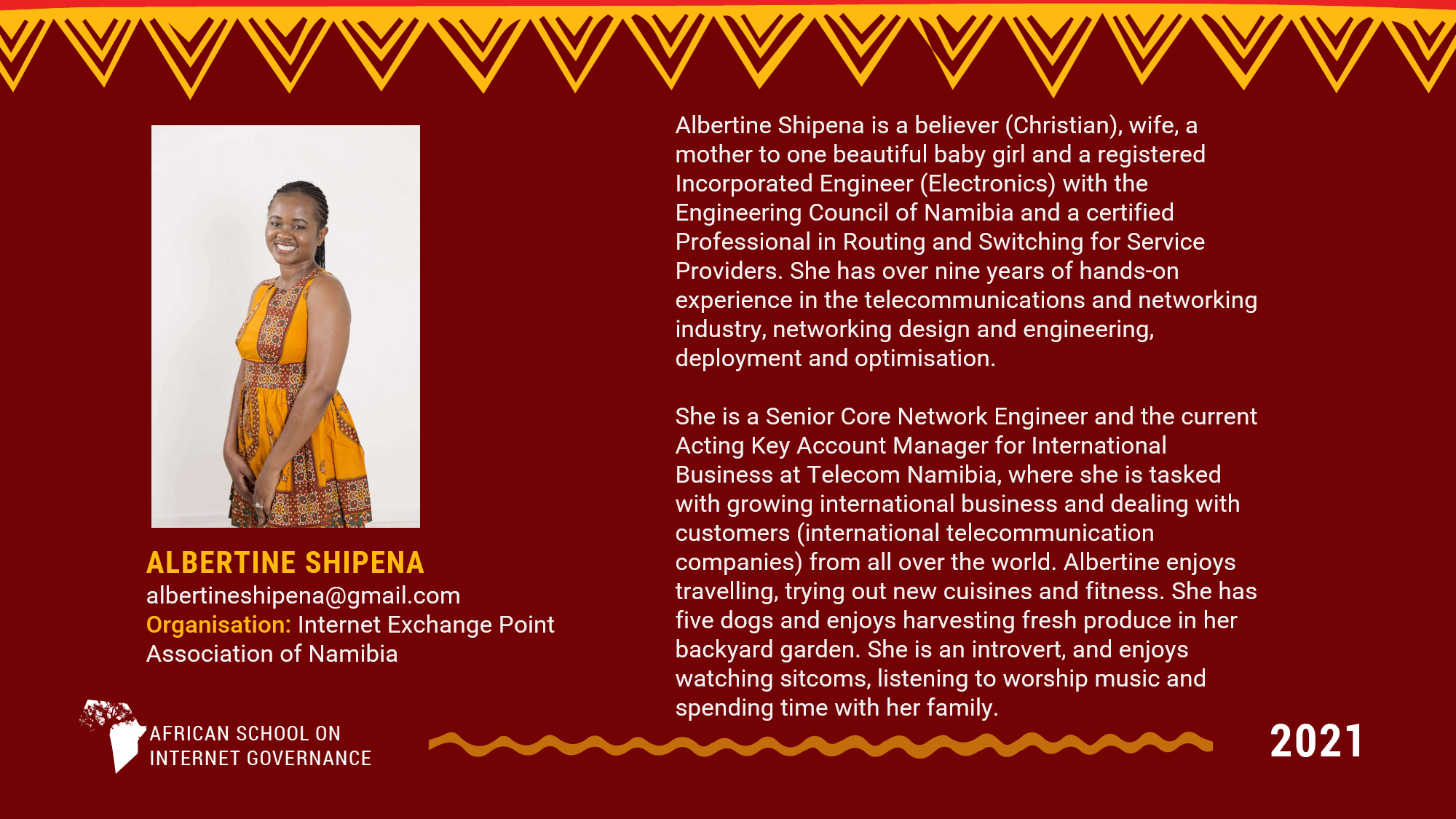
ALLAN CHEBOI
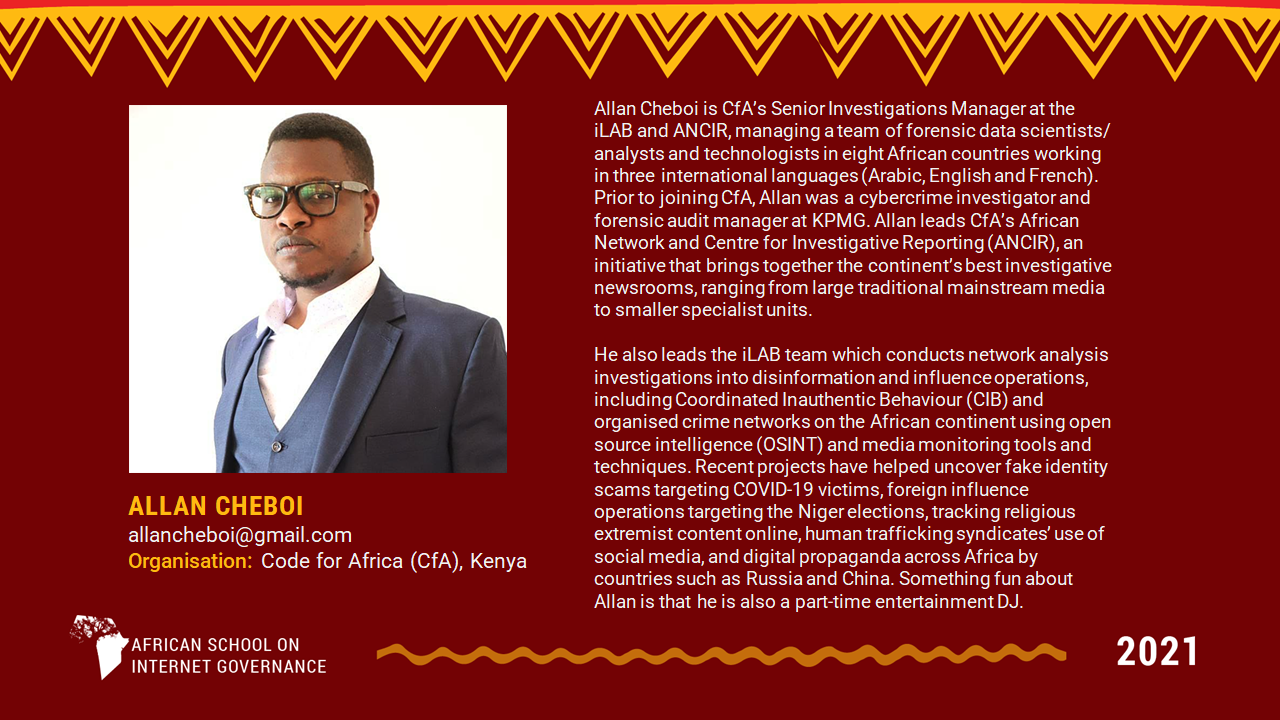
ALPHONCE ODHIAMBO
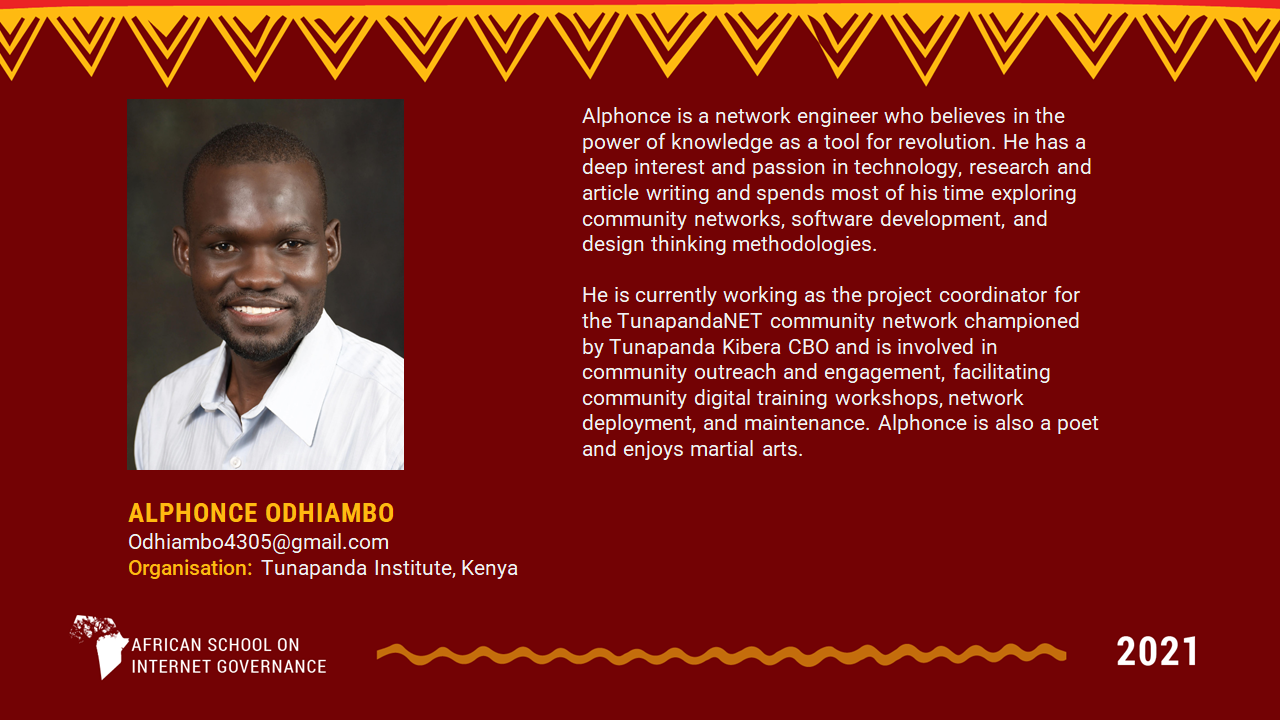
ANNE W. NJATHI
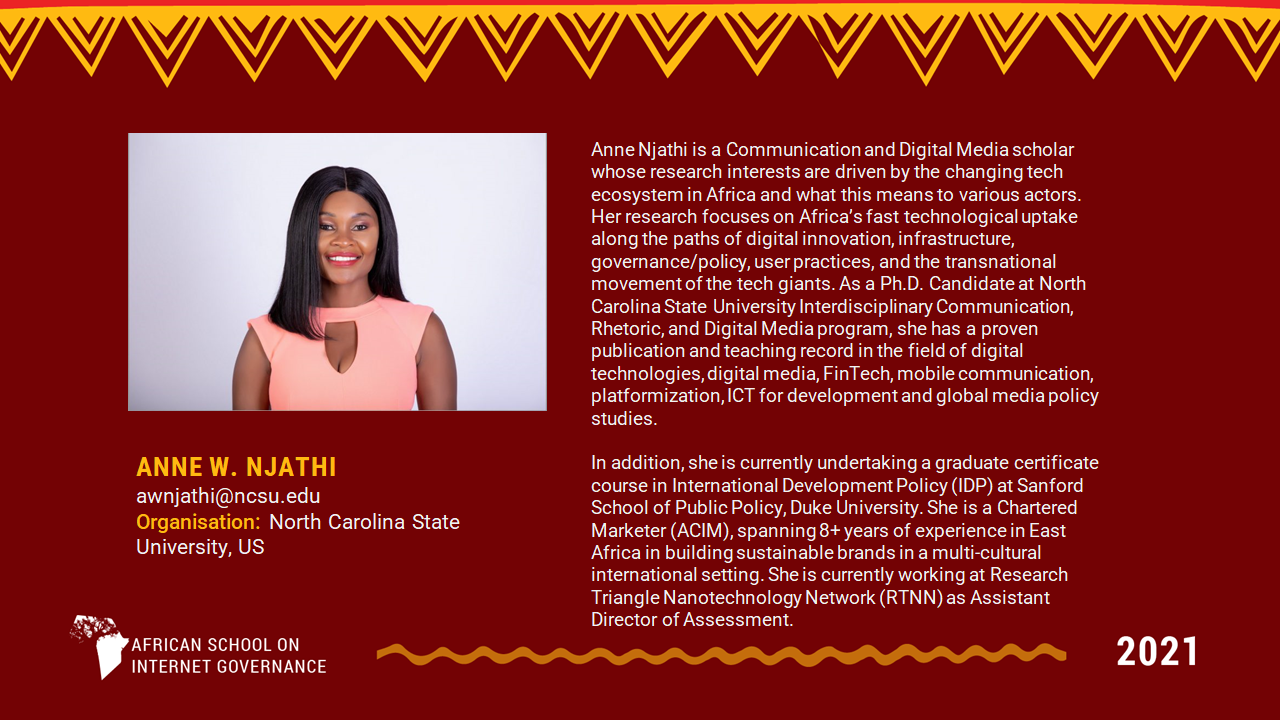
BADRIYYA YUSUF
BENDJEDID RACHAD SANOUSSI
BRIAN OBILO
CATHERINE MUYA
CHRISTIAN NZHIE NGONO
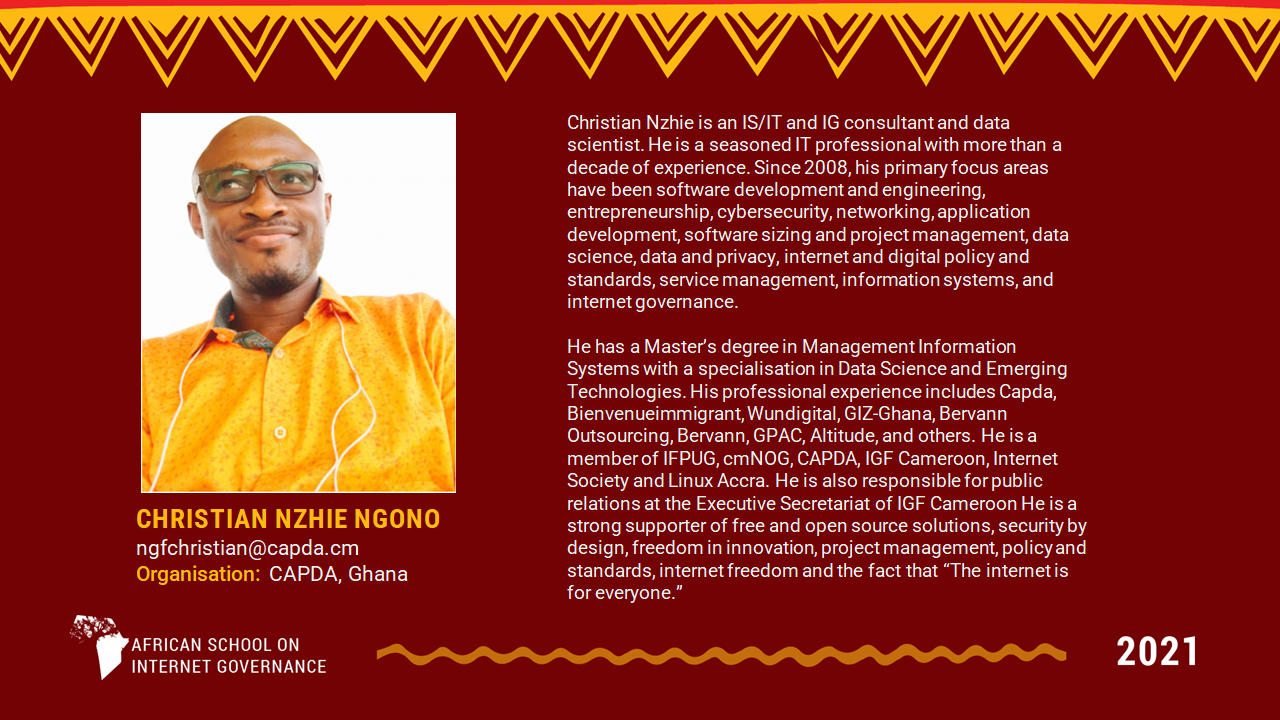
DIANA NAMANDA
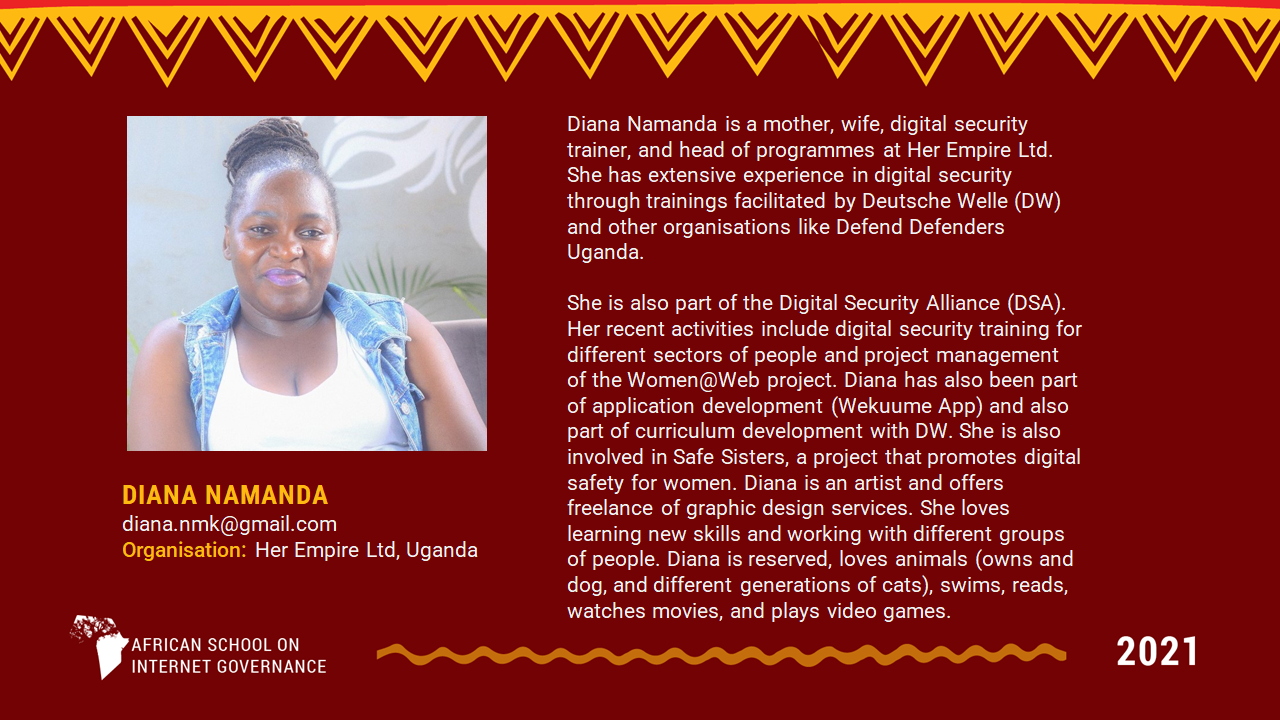
FATOU SARR
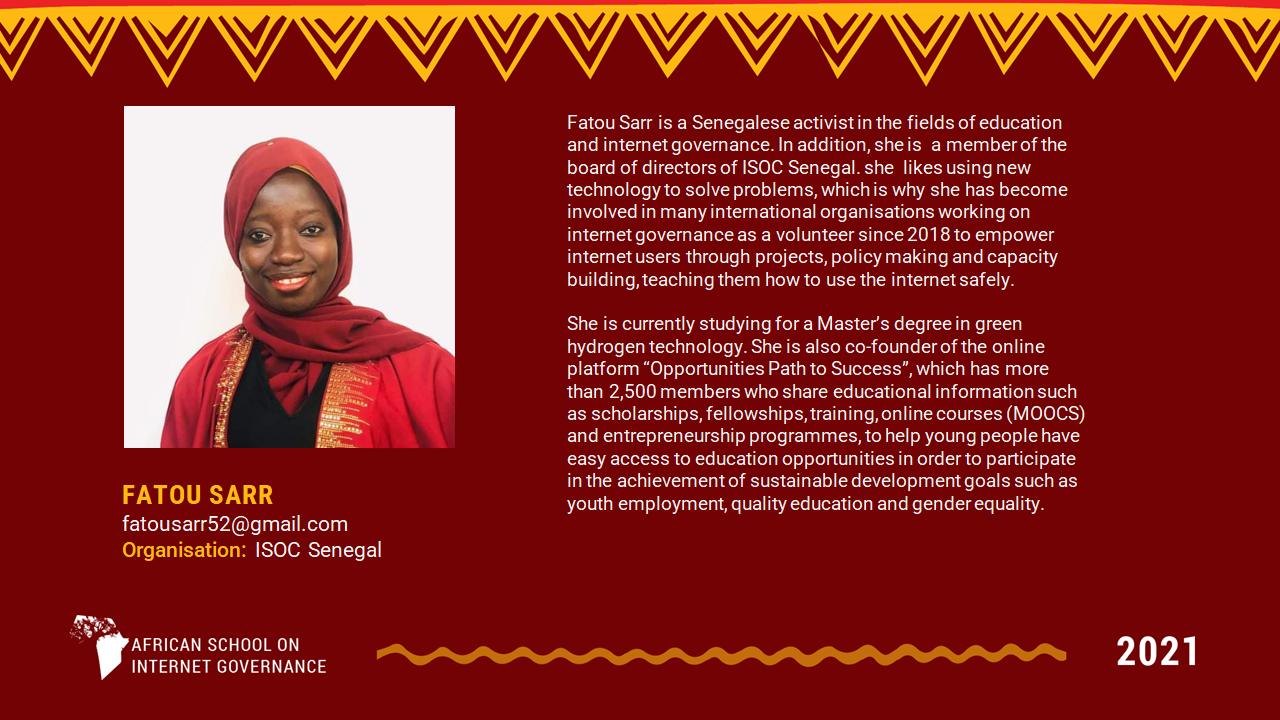
FAVOUR BOROKINI
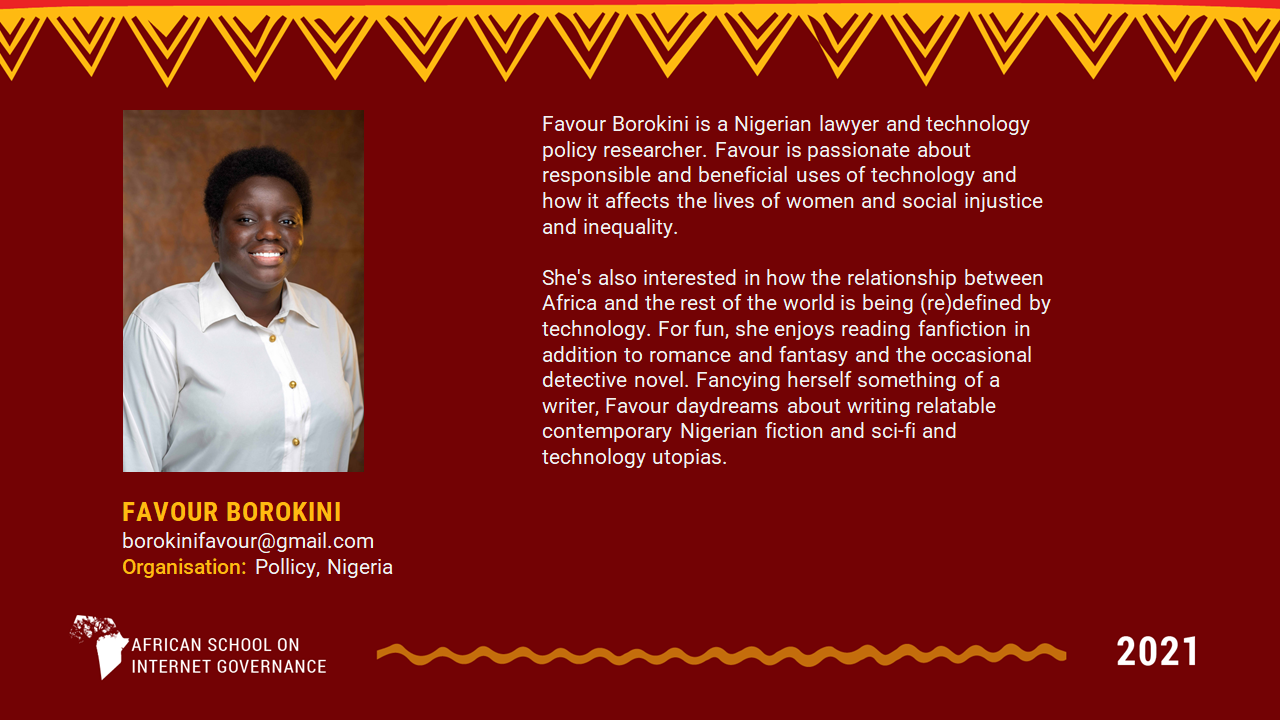
HASTING TJIPUEJA
HERMAN RAMOS
JOSAPHAT TJIHO
JULIJA KALPOKIENE
LEVY SYANSEKE
MAHENDRANATH BUSGOPAUL
MARIAMA DEEN-SWARRAY
MAXINE MOFFETT
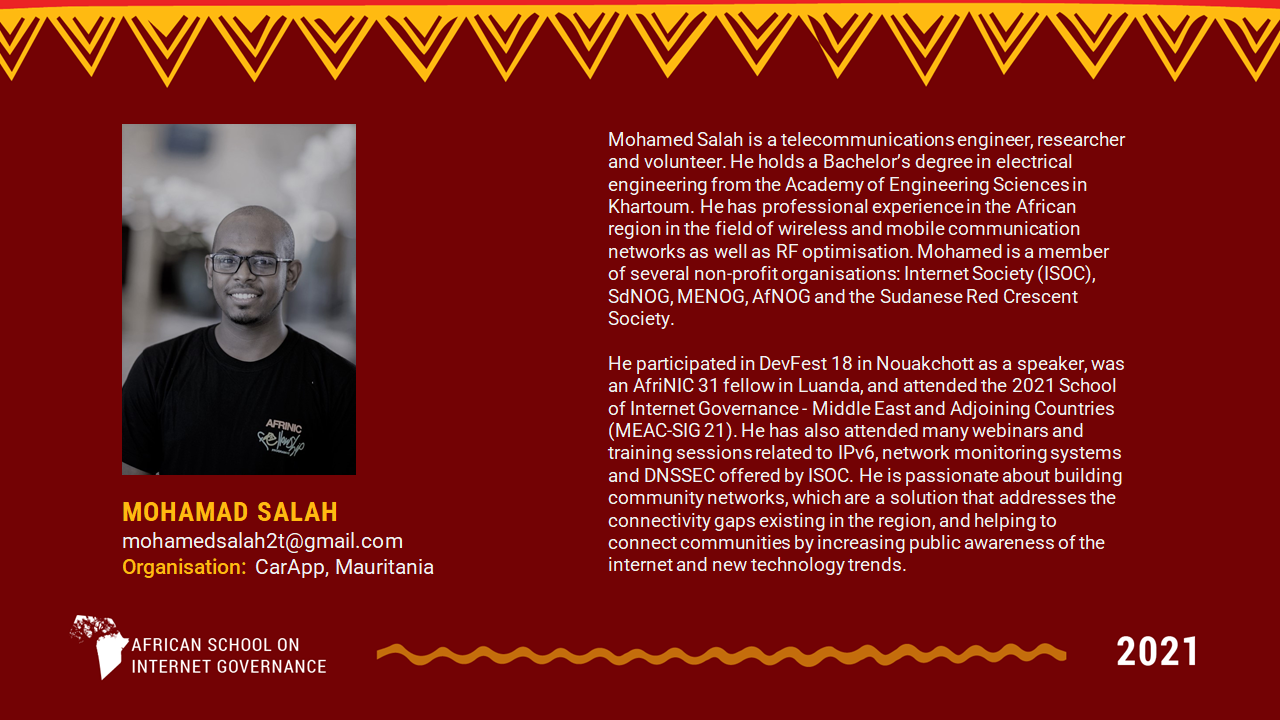
MOHAMAD SALAH
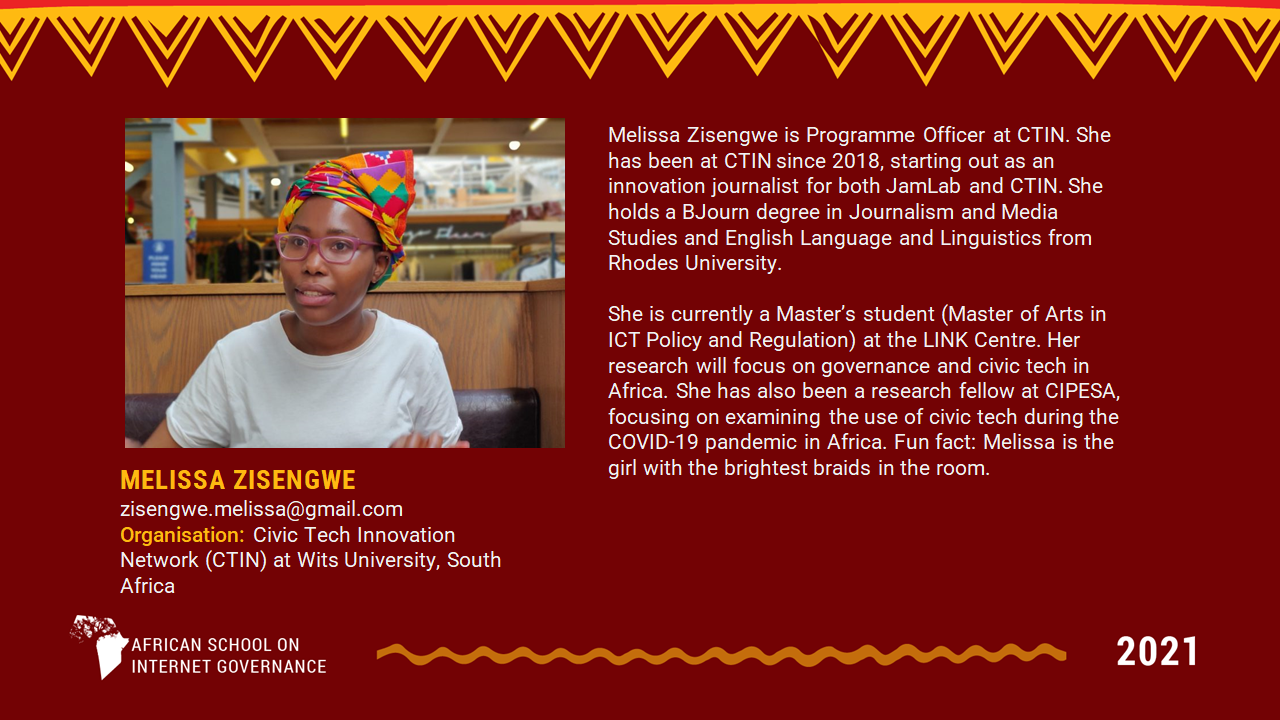
MELISSA ZISENGWE
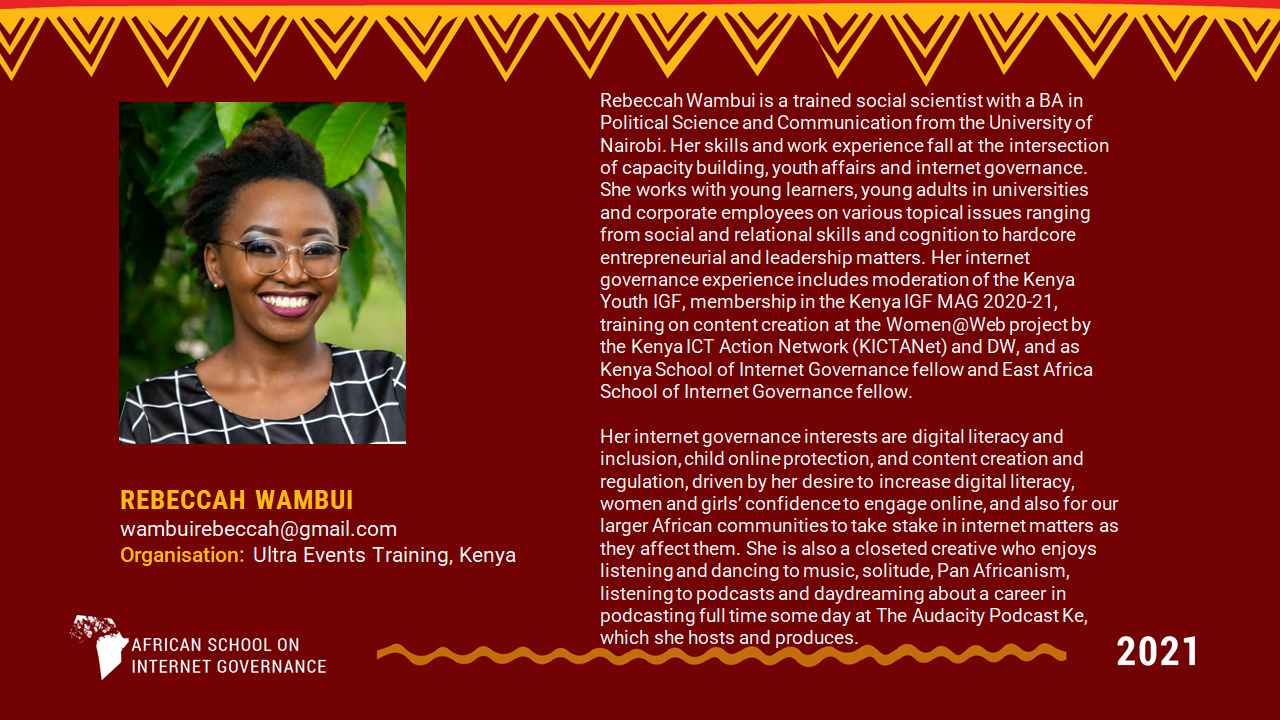
REBECCAH WAMBUI
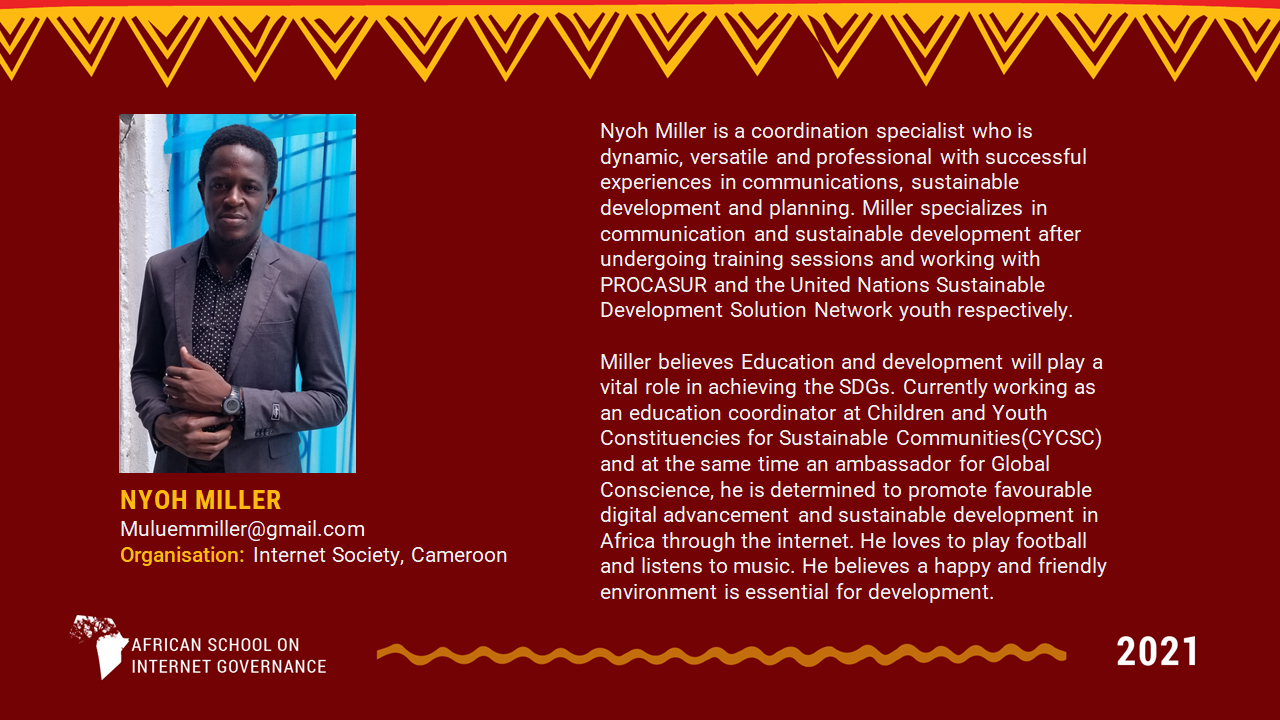
NYOH MILLER
OBIOMA OKONKWO
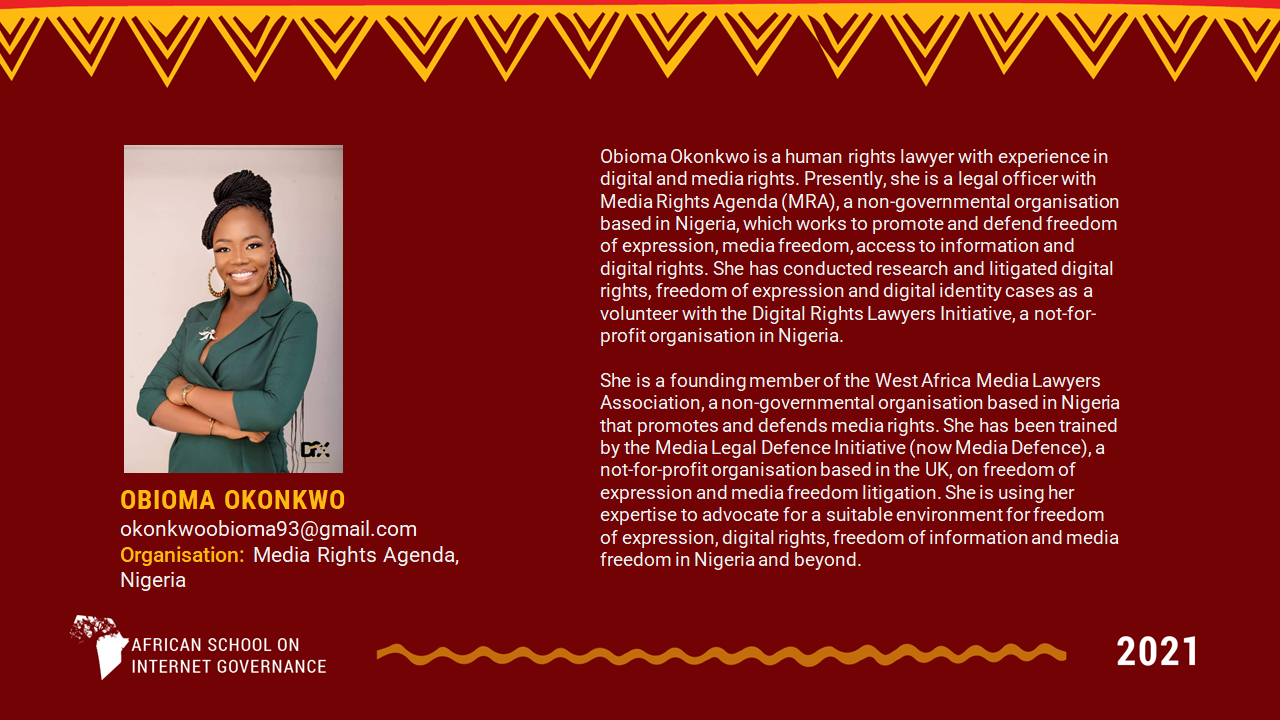
PLANTINA TSHOLOFELO MOKONE
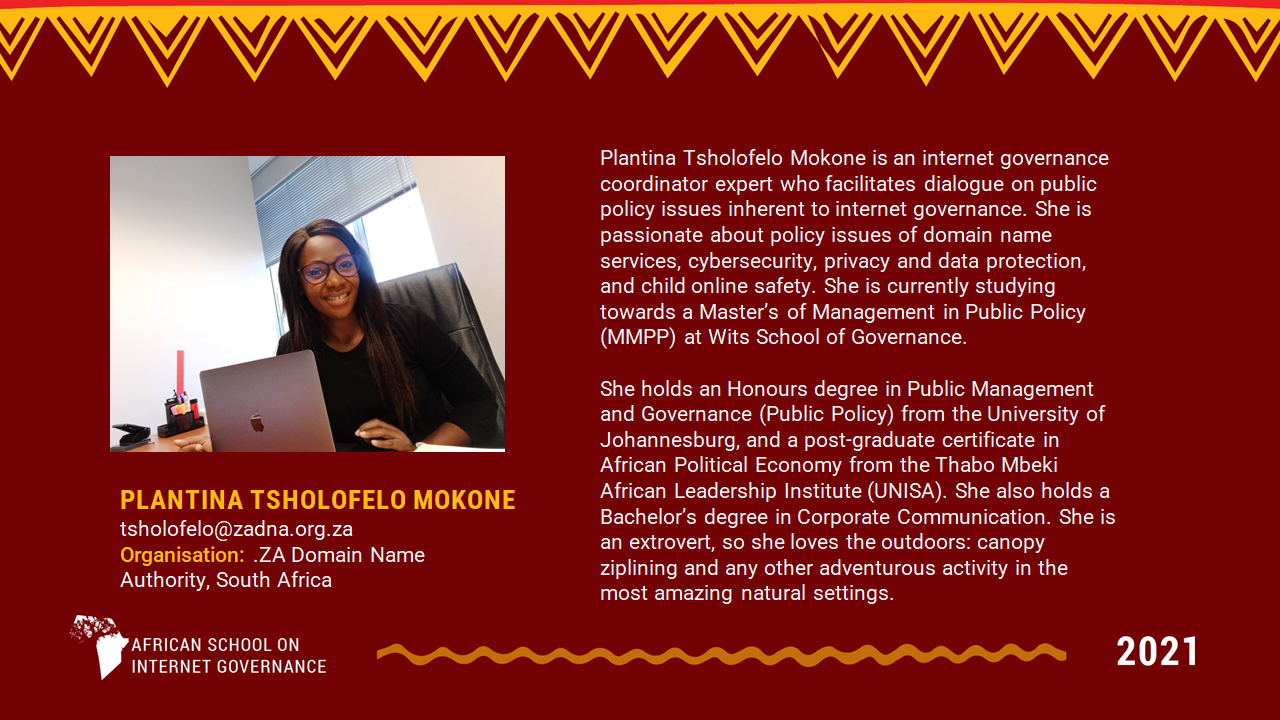
PROVIDENCE BARAKA
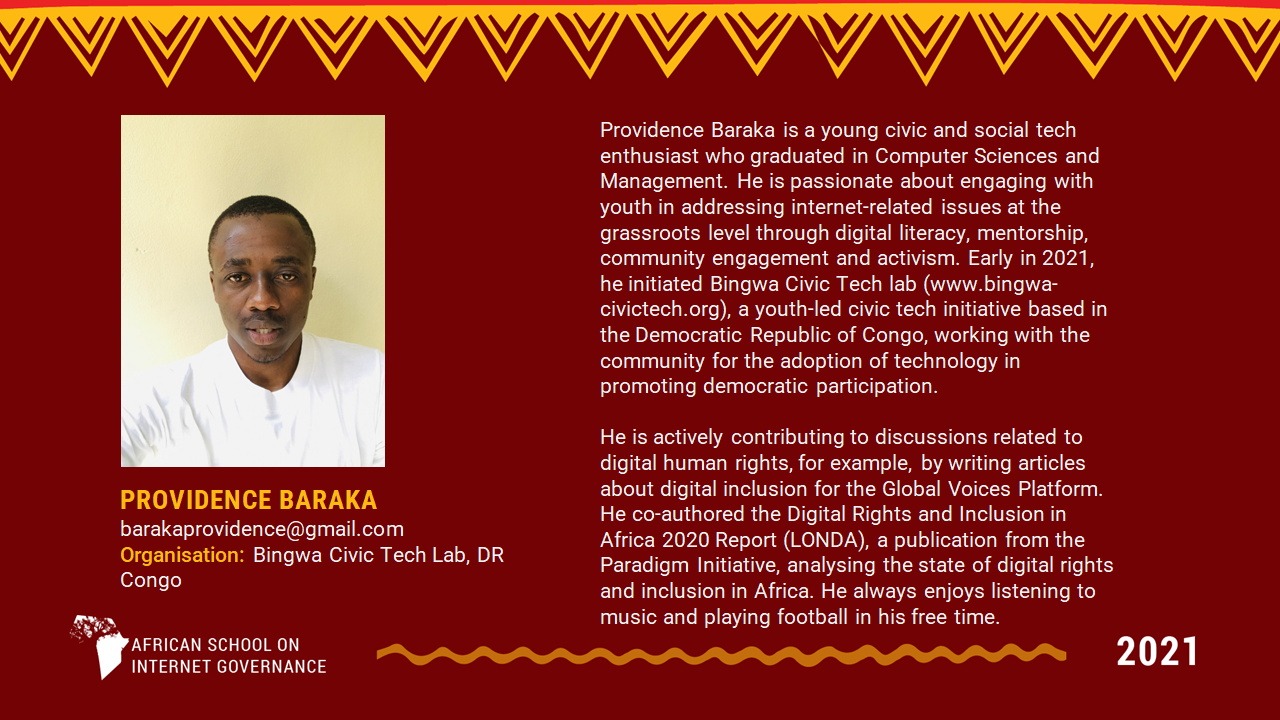
RUTH ATIM
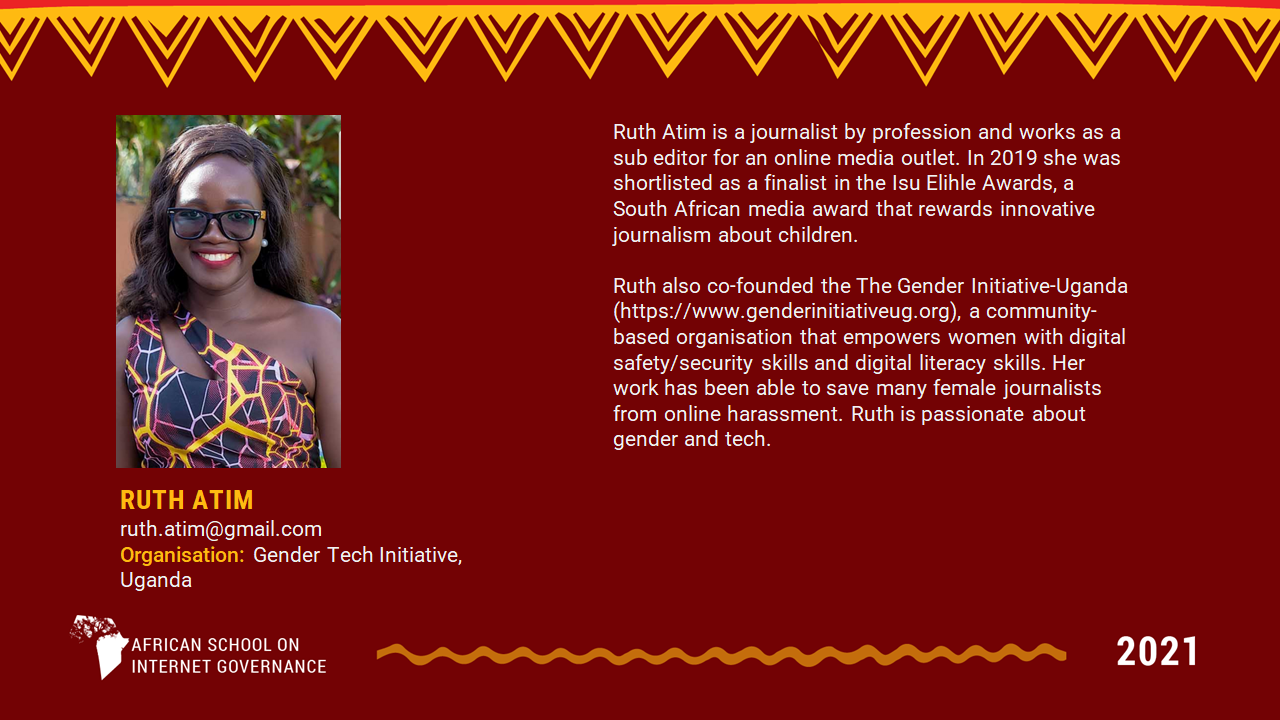
SANDRA ACENG
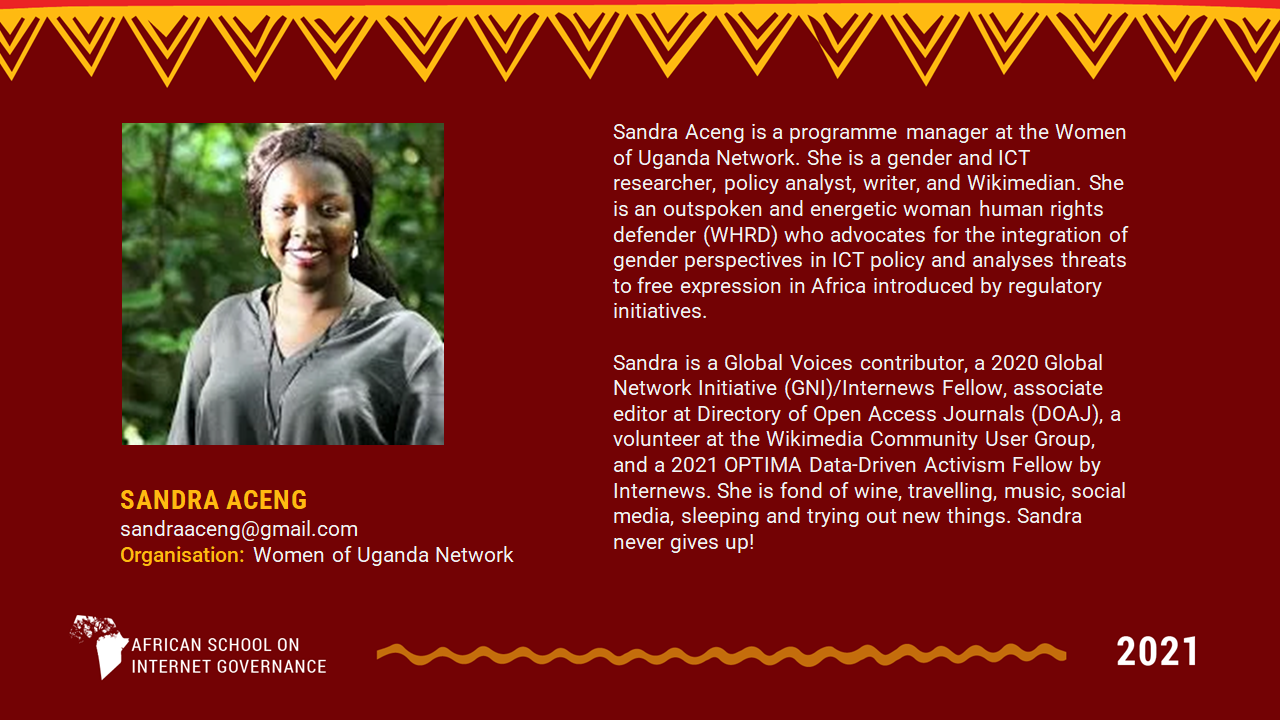
SANDRA KWIKIRIZA
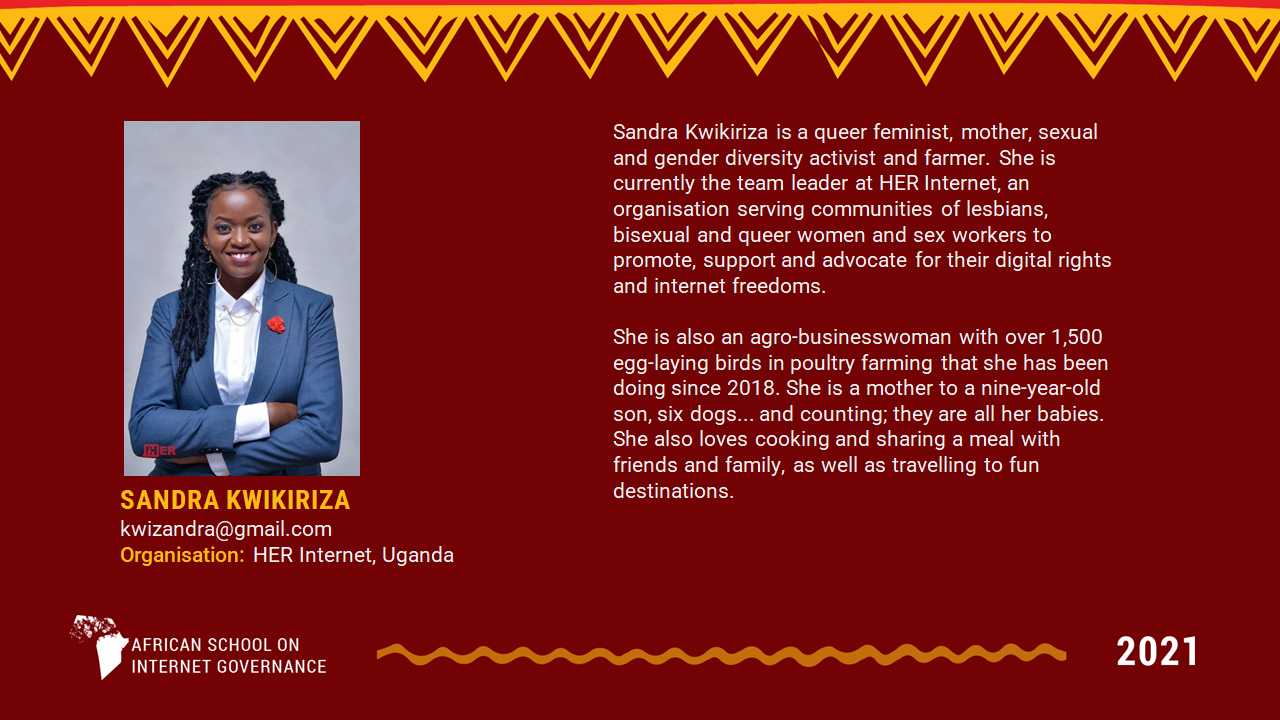
TABANI MOYO
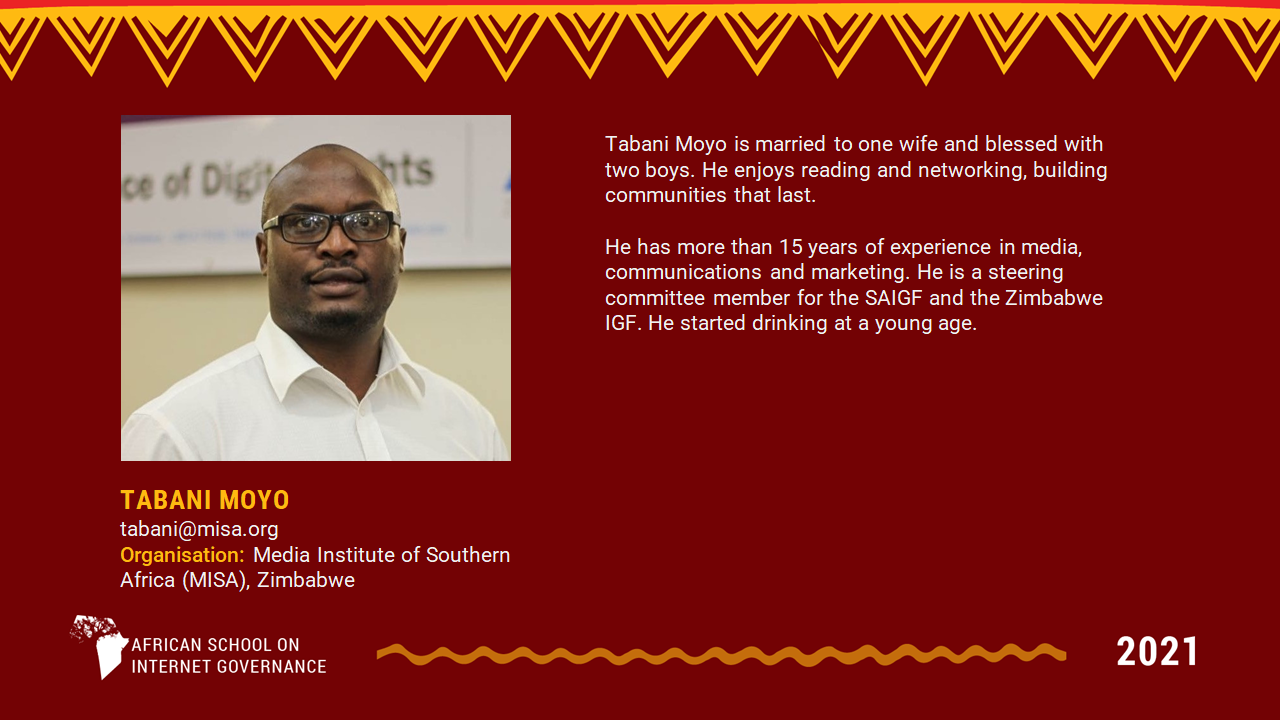
TSEMA EDE
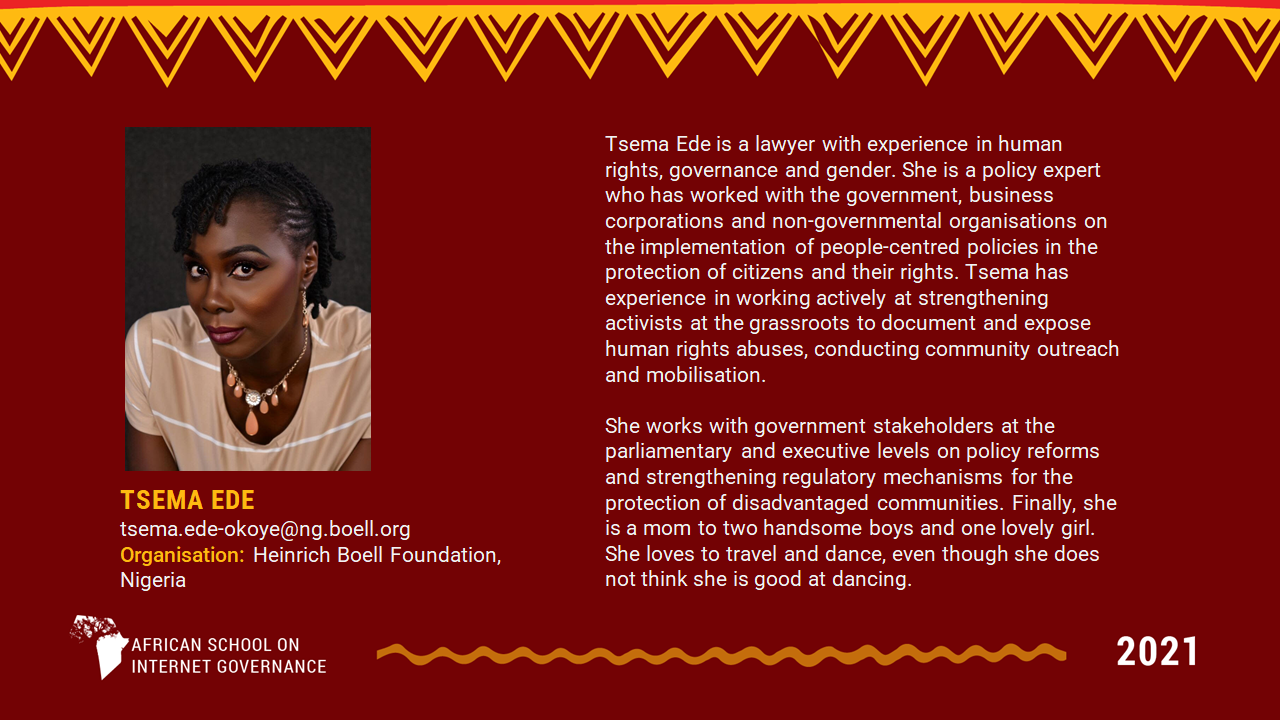
TSHEPISO HADEBE
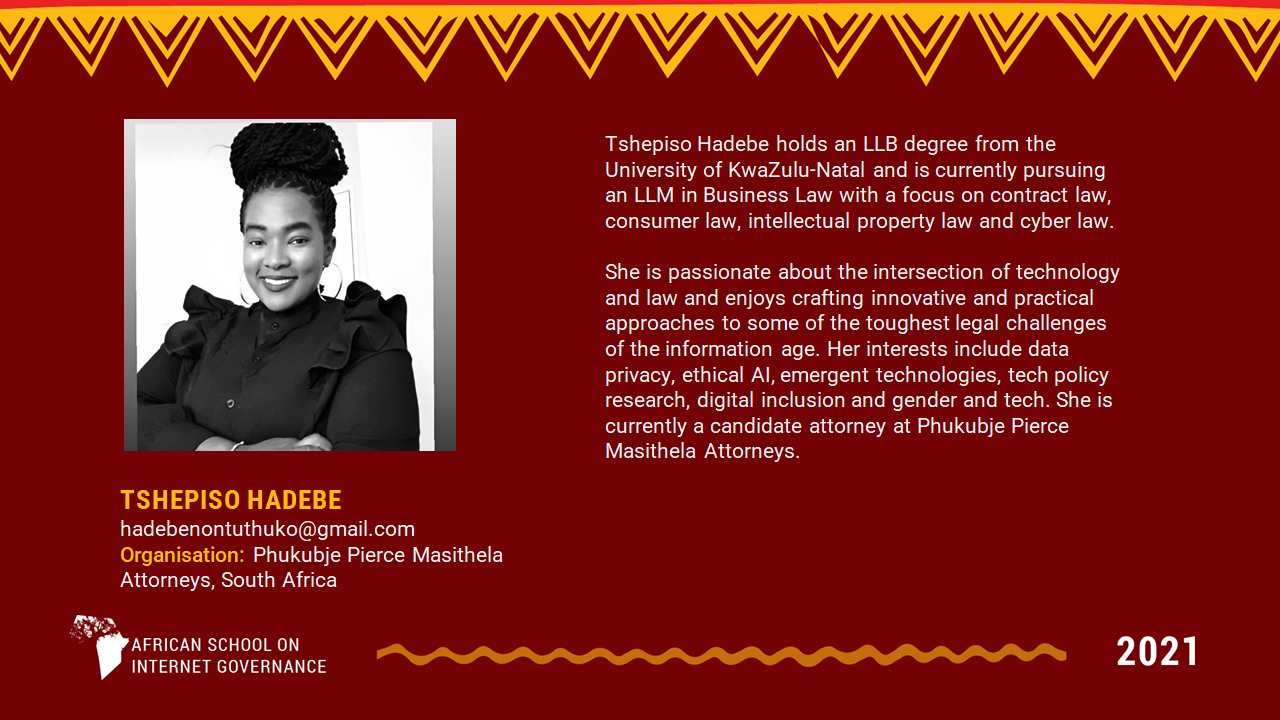
WILFRED WARIOBA
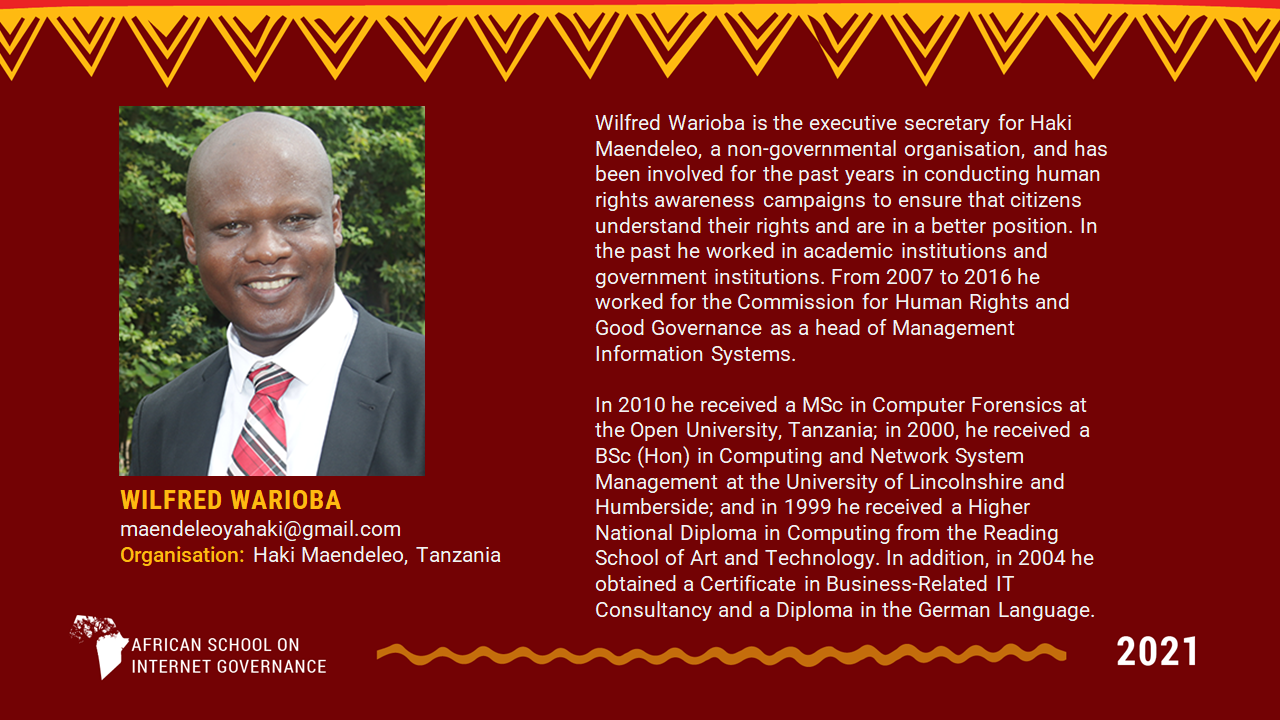
ZEPHE RADUMA ODHIAMBO
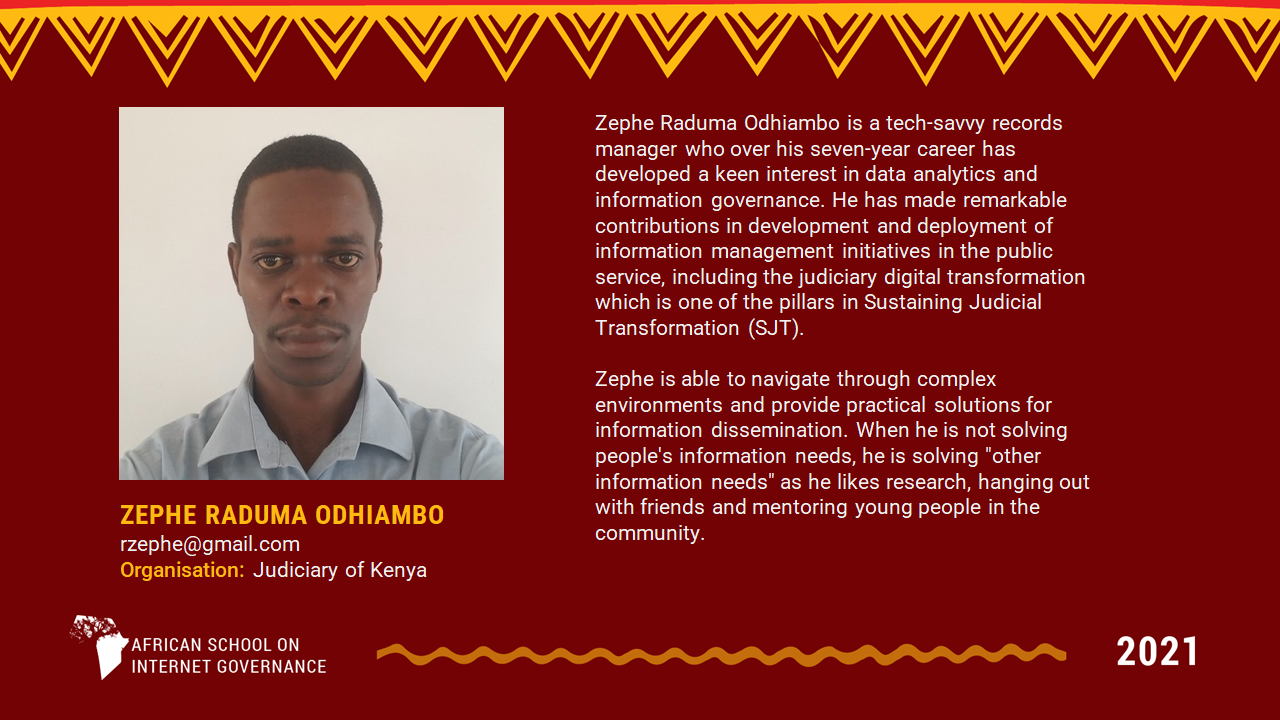
ZANYIWE ASARE
✔️ Faculty Profiles
Detailed profiles of faculty for AfriSIG 2021 class.
ABDUL-HAKEEM AJIJOLA
ADIL SULIEMAN
AJITH FRANCIS
ALISON GILLWALD
ALLAN MULENGA
ANRIETTE ESTERHUYSEN
BARRACK OTIENO
BOB OCHIENG
CARLOS REY-MORENO
CHENGETAI MASANGO
DAWIT BEKELE
DESIREE MILOSHEVIC EVANS
DOMINIC CULL
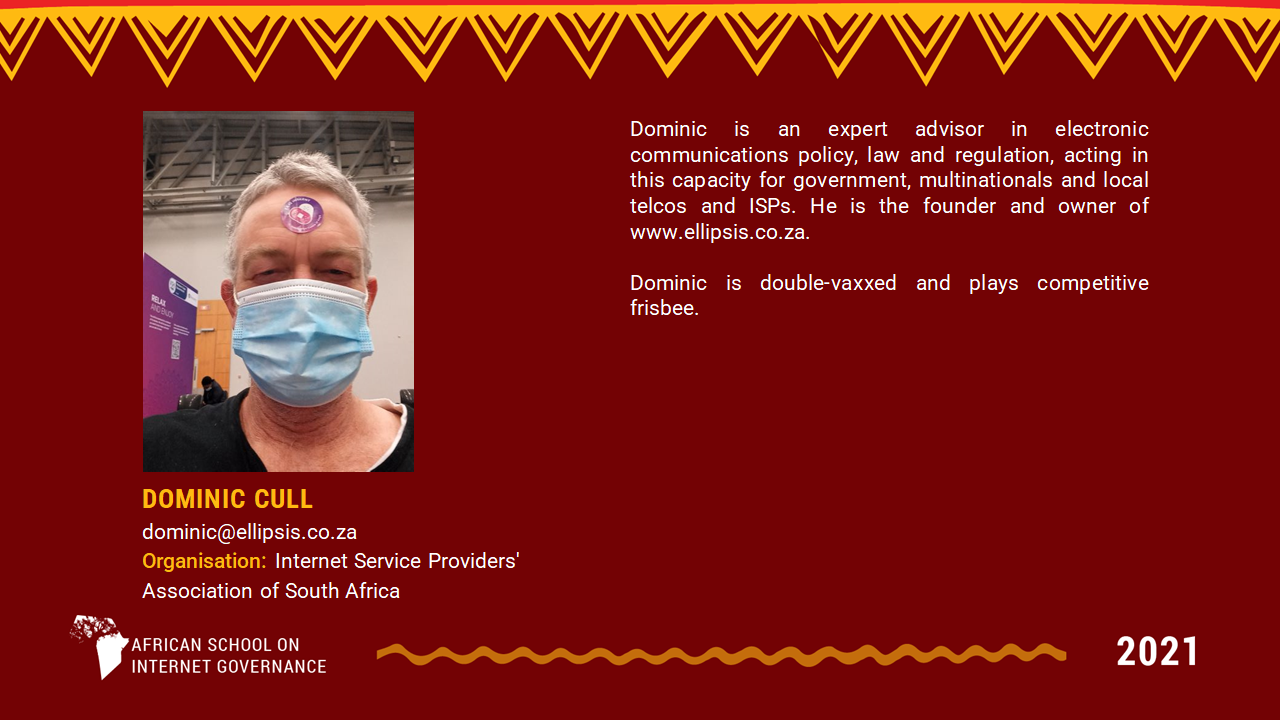
ENRICO CALANDRO
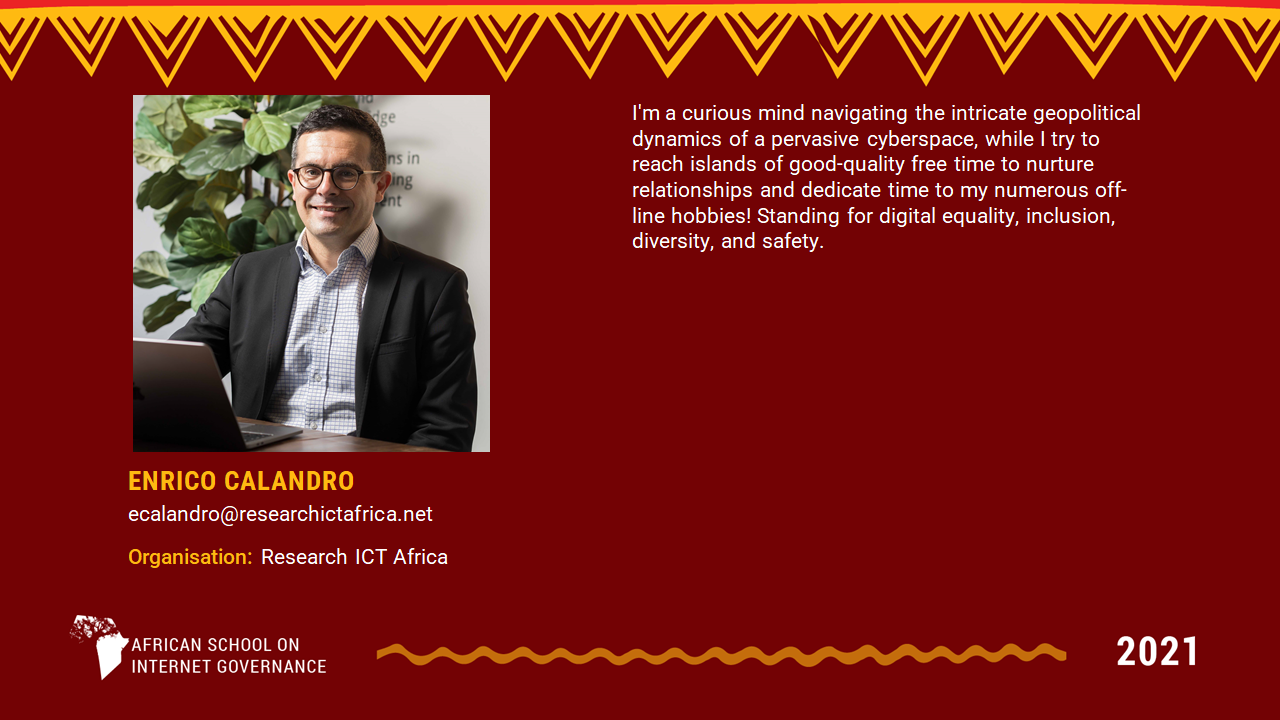
EPHRAIM PERCY KENYANITO
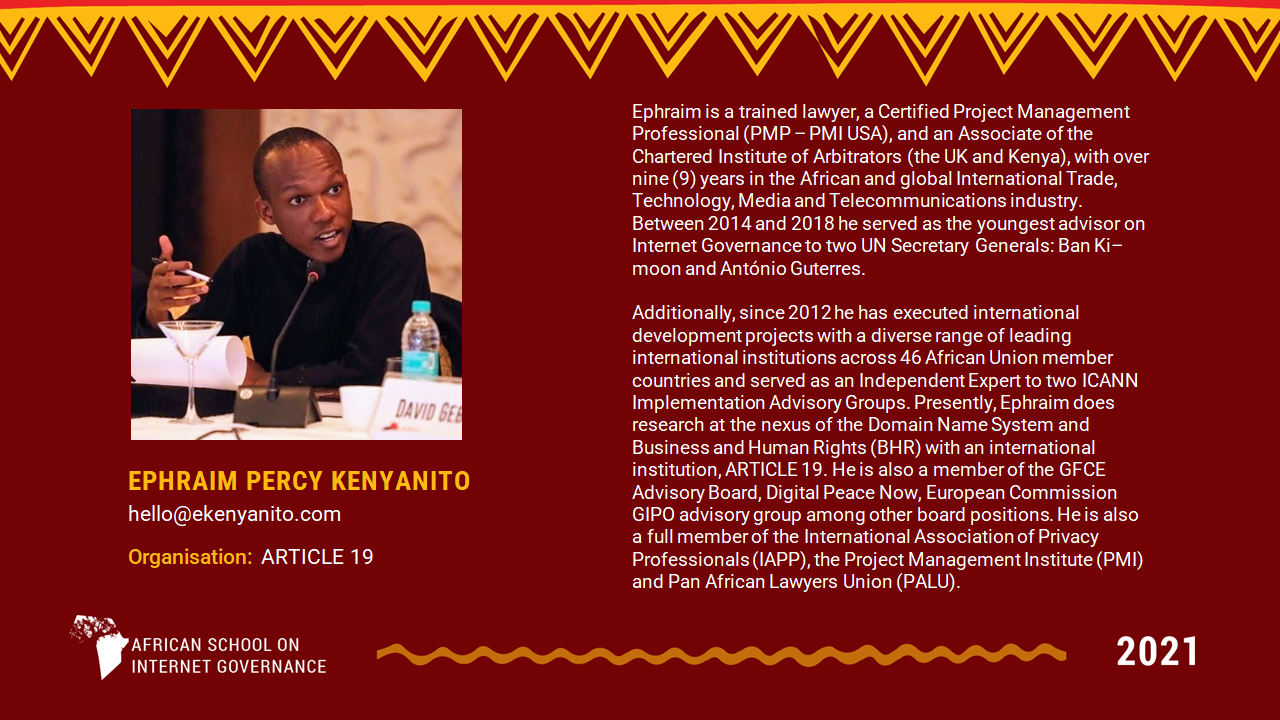
FELICIA ANTHONIO
FIONA ALEXANDER
GAYATRI KHANDHADAI
'GBENGA SESAN
KARIM ATTOUMANI MOHAMED
KUDA HOVE
LAWRENCE OLAWALE-ROBERTS
LEONID TOOROV
LILLIAN NALWOGA
MALLORY KNODEL
MARGARET NYAMBURA NDUNG'U
MICHAEL ILISHEBO
DR. MILTON L MUELLER
MOCTAR YEDALY
MUSAB ISAH
NASHILONGO GERVASIUS
PRIA CHETTY
RAYMOND ONUOHA
SHAMIRA AHMED
SHEENA MAGENYA
SHEETAL KUMAR
SOPHIE TOMLINSON
TATIANA TROPINA
TIMEA SUTO
VALERIA BETANCOURT
VERENGAI MABIKA
DR. WOLFGANG KLEINWAECHTER
FARGANI TAMBEAYUK
1️⃣ Principles of Participation
The Association for Progressive Communications is committed to providing a safe and welcoming environment for discussing issues related to its community. The APC Community comprises members of the network, all APC staff and team and its larger network of partners, friends and allies.
The code of conduct and ground rules apply to this meeting, all APC hosted events, conference-related social events, such as parties or gatherings at restaurants or bars and spaces, and includes our mailing lists, wikis, platforms, websites and any other spaces that APC hosts, both online and off. Participants are responsible for knowing and abiding by these guidelines. In this event, the code applies to anyone who is part of the event, which includes organisers, resource persons, participants and performers.
All APC meetings, virtual and physical meetings, are intended to be SAFE spaces and we ask participants to be guided by the following:
|Be respectful
|Listen actively
|Be respectful of others’ views even when you disagree
|Be collaborative
|Recognise diversity
|Respect privacy of participants
|Ask for consent for photography, audio-visual recordings or quotes
|Be aware of language diversity
|Handle disagreement constructively
|Act fairly, honestly, and in good faith with other participants
It is vital that discussions include and acknowledge a diversity of opinions and experiences, and that the community does not tolerate harassment of any kind.
We expect the members of the APC community to treat one another with respect and to acknowledge that everyone can make a valuable contribution. We may not always agree, but the space and conversation must always have openness to positions that may not be aligned or in agreement. Frustration cannot turn into a personal attack. It's important to remember that a community where people feel uncomfortable or threatened is not a productive one, and that the meeting conduct and ground rules are anchored in the APC values we have all committed to uphold. It is our collective responsibility to ensure that we create a safe, creative, productive and welcoming space that can hold us in all of our diversity.
We will take action in response to harassment related to gender, gender identity and expression, sexual orientation, disability, physical appearance, body size, race, nationality, caste, ethnicity or religion. APC does not tolerate harassment of participants in any form.
Definitions
Harassment
includes, but is not limited to:
- Offensive comments related to gender, gender identity and expression, sexual orientation, disability, mental illness, neuro(a)typicality, physical appearance, body size, race, caste, ethnicity or religion.
- Unwelcome comments regarding a person’s lifestyle choices and practices, including those related to food, health, parenting, drugs, and employment.
- Physical contact and simulated physical contact without consent or after a request to stop.
- Deliberate intimidation.
- Sustained disruption of discussion.
- Continued one-on-one communication after requests to cease.
- Sexual harassment
Sexual harassment
is a broad term. For the purposes of this event it is defined as:
Any unwelcome sexual advance in the form of words, images, gestures or physical contact in physical, digital or communication spaces which may reasonably be expected, or be perceived, to cause distress, intimidation, fear, humiliation, or harm to another. The term also covers any request for a sexual favour, or a threat of a sexual nature. Sexual harassment may occur in any space, including the workplace. This includes activities of face-to-face meetings, virtual meetings and digital communication of all kinds. It can be a one-time incident or a series of incidents. Sexual harassment may be unintended, deliberate, or coercive. Sexual harassment may occur both within formal working hours and spaces, and outside these. Men, women, transitioning and transgender individuals may be victims or offenders.
Sexual harassment may result in discrimination, and it may create a hostile working environment. Other forms of behaviour which cause discrimination, fear, and/or a hostile working environment may be implicated in sexual harassment, such as harassment based on race, gender, sexuality, national origin, physical appearance, age, ancestry, disability, economic disparity, nationality, or religious or spiritual beliefs. APC recognises that APC's staff members, partners and event participants are from diverse contexts, and that sexual harassment experiences are embedded within the cultural, social, historical and personal contexts.
Sexual harassment should not be confused with unintentional careless communication in a diverse working environment, or with our efforts to create a working culture which is open to conversations on sexuality and human rights.
We understand that the impact of sexual harassment on APC's working culture can be highly destructive, and we understand the harmful impact of sexual harassment on any person’s work, mind and body.
Examples of sexual harassment include (but are not limited to):
- Gratuitous or off-topic sexual images or behaviour in spaces where they are not appropriate.
- Unwelcome sharing of sexualised content in visual, audio or text form
- Deliberate stalking, following or intimidation, online and/or offline
- Harassing photography, video or audio recording
- Inappropriate and/or unwanted physical contact
- Unwelcome sexual attention, in any form of communication
- Requests for sexual favours, verbal or physical contact of a sexual nature in exchange for an opportunity
- Threats, either explicit or implicit, to withdraw an opportunity or resources unless sexual contact and/or communication is permitted
- Advocating for, or encouraging, any of the above behaviour.
If you believe you have been harassed, or notice that someone else is being harassed, or have any other concerns, you are encouraged to raise your concerns in confidence to the Event Incidents Team.
APC commits that each case will be considered, and concrete actions will be taken as appropriate.
Please refer to APC’s sexual harassment policy for how APC responds to sexual harassment.
Code of Conduct and Anti-Harassment Policy Response Process
If you are being harassed by a member of the community or a participant or organiser at the conference, or have any other concerns, please contact a member of the Event Incidents Team.
When a complaint is made or an incident occurs that breaches this code, the Event Incidents Team will confidentially review and respond to any participant who has experienced harassment or inappropriate behavior.
If the person who is harassing you is on the Event Incidents Team, they will recuse themselves from handling your incident. If the person who is harassing you is a member of the organising team, they will not receive differential treatment than any other participant in the handling of the complaint.
We will try to respond as promptly to complaints as we can. These steps will be taken once you make a complaint:
- One or more members of the Event Incidents team will discuss the issue with you.
- They may take notes, with your consent, of what you say.
- One or more members of the Events Incidents team will separately speak with the person(s) against whom the complaint is lodged.
- The process will involve attaining resolution while ensuring safety, dignity and respect for everyone involved.
If a participant engages in harassing behavior, the Response Team may take any action they deem appropriate, up to and including expulsion from all APC spaces during the event, and identification of the participant as a harasser to other APC members or the general public. The Event Incidents team will prioritise marginalised people’s safety over privileged people’s comfort.
Any member of the Event Incidents Team can be contacted with any questions or concerns participants may have throughout the duration of an APC event. Anonymous complaints can be reported to the team on Telegram or submitted via email.
↗️ AfriSIG 2021 Website and Sponsors
You can also find out more about the African School on Internet Governance here.
AfriSIG 2021 Sponsors

🎶 Music Playlists for the School (Please let us know if you have recommendations!)
Spotify Playlists:
YouTube Playlist:
1. Multiple genres from across the world
Please provide suggestions and Recommendations here